They Never Learn.

There is an old rule in politics that states that it is not the original sin that gets politicians in trouble. It is the cover-up or lying about it that does them in. The examples that prove the rule are too numerous to mention and span the globe. This week we have another classic case in point: Shane Jones and his explanation as to why, as Associate Minister of Immigration (the Minister of Immigration at the time, David Cunliffe, had earlier refused to revoke Liu/Yan’s residence visa and for some reason unknown to me was not involved in the granting of citizenship), he ignored expert legal advice and granted a Chinese fraudster expedited citizenship.

According to Jones he did so on humanitarian grounds because he was told by an unnamed Internal Affairs official that the applicant–he of at least three different names and an Interpol warrant out for his arrest–would be executed and his organs harvested if he were sent back to China. Forgive me if I cough. That is up there with Annette King’s claims that no one in the Labour government knew about Operation 8 until the weekend before it began.

Others have already torn Mr. Jone’s supposed rationale to shreds. Beyond the fact that not even the Chinese execute people for common fraud, even if they are members of Falun Gong (a claim supposedly made by but never proven by Mr. Liu/Yan), a legitimate fear of a politically-motivated death sentence would result in an asylum request, not a citizenship application based  upon a business visa. Nor would Mr. Liu/Yan speak of traveling back to China with a delegation of Kiwis in order to explore business opportunities in the PRC (as it is claimed he did in his conversations with immigration officials now testifying at his trial on false declaration charges). But according to Shane Jones, not only was he facing certain death but also certain organ harvesting (which raises the question as to how the unnamed Internal Affairs official could know this in advance given that the Chinese do not harvest organs from all executed prisoners because the health of the condemned varies). Put bluntly, Mr. Jones is simply not credible, and unless that unnamed official comes forward to take responsibility for the bogus claims (which Mr. Jones could have ignored), his justification simply does not wash. Add in the fact that Mr. Liu/Yan had donated considerable sums of money to Labour coffers in the lead-in to his citizenship application, and the smell of something fishy permeates the affair.

What is amazing is that when confronted with the evidence presented in court, David Shearer continued to back Mr. Jones and even allowed him to go public with is ridiculous justification. That violates a second rule of politics, which is that when smoke begins to surround a politician on ethical issues his or her party needs to move swiftly to prevent a full-fledged fire from erupting by distancing the tainted one from the party as a whole. By not doing so immediately and only leaving open the possibility of standing Jones down if an investigation proves him guilty of wrong-doing in the Liu/Yan affair, Mr. Shearer has failed the basic test of leadership that involves saving the party from further uncomfortable scrutiny on the issue of campaign financing and political donations.

Once again, let us remember the iron law of oligarchy that governs all political parties: the first duty of the party is to preserve itself. Individual political fortunes come second. Legalities aside, it is the appearance of unethical behavior on the part of Mr. Jones that is at play here.

What is even more amazing is that this comes on the heels of the John Banks-Kin Dotcom scandal and John Key’s equally egregious mistake in not removing Banks from his ministerial post while the Police investigated whether Banks violated political finance laws in his dealing with Mr. Dotcom. Regardless of whether the press played this sequence of events on purpose, the scenario unfolded as follows: National was on the ropes in the weeks leading up to a dismal budget announcement, beleaguered by policy and personal conflicts and dogged by an increasingly assertive mainstream press. Rather than strike a contrast in approach that would give it the moral high ground that would allow it to score major political points against its weakened rival, Labour’s response to revelations of the dubious ethics of one of its senior members in a past government–dubious ethics that are being aired in court for crikey’s sake–is to bluster and blow more smoke on the matter. Do they never learn?

Just as Mr. Key should have removed Mr. Banks from his ministerial position as soon as his denials and lies about his relationship with Mr. Dotcom were exposed, so Mr. Shearer should have moved quickly to demote Mr. Jones until such a time as an independent investigation exonerated him. Given the passing of a few news cycles and the issue would have faded into the political “bygones be bygones” category. By not doing so Mr. Shearer has allowed the Jones-Liu/Yan relationship to become a distraction away from National’s peccadillos and policy failures. He has, in fact, thrown National a life line in the days before the budget announcement and the decision to demote Banks (who could stay in government but not be a minister pending the resolution of the Police investigation), and I would imagine that the National caucus are high-fiving and back-slapping each other in delight.

Of course there are political calculations in all of this. By-elections are costly, list candidate replacements are unproven or unreliable, internal Party factional disputes run the risk of being aggravated or exposed.  National is clearly waiting for the Budget to be announced before moving on Banks. Labour does not want to lose a senior figure who “ticks the boxes” of important internal constituencies. And yes, there is a difference between illegal and unethical activity.

But in putting these calculations ahead of ethical considerations given the appearance of impropriety, both parties have once again shown their contempt for the NZ public. And on this score, Labour’s contempt is much worse. After all, Mr. Banks was just a greasy-palmed private citizen seeking to be mayor when he approached Mr. Dotcom for support. Mr. Jones, on the other hand, was a Minister of State who apparently used his office to bestow special considerations on an individual in exchange for, uh, party “favors.”  Both actions were slimy, but it is the official nature of Mr. Jones’s intercession that makes his behavior worse. Which is why he should have been stood down straight away, because rightly or wrongly, it is the attempt to downplay or cover up past impropriety, rather than the potentially unethical or illegal behavior itself, that will cling to the Labour Party long after Mr. Liu/Yan’s case is adjudicated.

Against “courageous corruption” as Crown policy

It should come as no surprise that I disagree with Chris Trotter’s latest piece about the Urewera raids. Don’t get me wrong — I think his assessment of the operational capability New Zealand police and intelligence services are correct. Their actions were strategically and tactically flawed, and they seemed to hold unrealistic expectations of the task they were undertaking. But some of the judgements Chris wraps around this argument are troubling to say the very least.

Not all of them. Some are fine: we need a competent security and intelligence apparatus, and the lack is something that should be rectified. Some are nonsense: a sophisticated left-wing propaganda network (where have they been these past two electoral terms?) and sleeper cells of “sympathetic journalists” (presumably not those who are shills for the corporate élite?). Some are merely distasteful. Others, however, are downright frightening, and the worst of these is the notion that the Crown should not be bound by its own laws when prosecuting dissident citizens.

Also lacking were the reliable media “assets” so highly prized by the British security services. Individuals to whom key elements of the Crown’s case … Where, for example, was the Crown’s equivalent of Wikileaks? Clearly no one was prepared to play the role of Private Bradley Manning by dumping all the evidence denied to the Prosecution on a suitably insulated and legally untouchable website.

Let’s not forget that some of this actually happened. Elements of the Crown case actually were leaked to the public, and some suppressed material was published in daily newspapers and was the subject of (unsuccessful) contempt proceedings.* Other elements, having been retrospectively ruled in by a court despite having been collected unlawfully, were used throughout the trial to create a prejudicial atmosphere around the trial.

Given those events, the argument here is essentially that the Crown didn’t leak enough evidence; didn’t act ruthlessly enough and was too heavily burdened with scruples to secure a “right” outcome. The call for an officer of the Crown to wilfully breach the very laws they have sworn to uphold, in the name of their own individual assessment of a complex situation, is extremely concerning. Having failed to conduct their evidence-gathering operations lawfully, and having failed to persuade a judge that, in spite of that, there was still a sufficient reason to admit all the evidence, the argument here is that the Crown should have taken an extrajudicial Mulligan.

When I started writing it this piece was considerably more personalised to Chris, and how his post seems to provide final proof of his degeneration from idealistic radical to authoritarian establishment curmudgeon. The reference in the title is to his now-infamous declaration that Labour’s breach of electoral law during the 2005 election campaign was justified inasmuch as it prevented a terrible counterfactual — a National government led by Don Brash — from coming to pass. I disagree with that argument on the grounds that the integrity of the democratic system as a whole is of greater importance than any particular electoral outcome, and I disagree with his argument regarding the Urewera 4 for the same reasons: the integrity of the justice system is of greater importance than the outcome of any given case.** But I don’t want to dwell on the personal; rather than trading extensive cannonades with Chris (again), I think there’s more value in covering my reasons for holding these views in principle, leaving aside the specific merits (on which we’re never going to agree), or whether I support the principals in either case.***

The first and most obvious argument against this sort of extra-legal recourse is: be careful what you wish for. If you want the Crown to leak, to cultivate sources in the media whom they can trust to run their propaganda for them, and to resort to whatever other means they might need to secure what you think is a “right” outcome, you’d better hope you always agree with them. If you don’t, eventually you’ll find yourself on the wrong end of it. The danger of this for the ideological left in Aotearoa should need little elaboration: almost all the authoritarian cards and most of the ruthlessness in playing them are in the hands of the various factions of the ideological right, and they are constrained more by norms of conduct and the need to appear to be less ruthless than they are than by black-letter law or constitutional barriers. These norms are quite robust, but they essentially all operate on the honour system: they persist because people observe them. If you break the law in the name of the rule of law, you erode the rule of law. If you destroy the village to save the village, you still destroy the village.

This leads into the second point: changing norms of Crown conduct, or what we might call “authoritarian sclerosis”. Norms that constrain what a government, the Crown or its agents may acceptably do are becoming more lax, and have been since shortly after 9/11, when the Terrorism Suppression Act that gave rise to the current farce was hastily passed. In the past two parliamentary terms this has continued to accelerate, partly as a consequence of hysteria around — and blurring of — activism and terrorism more generally. The government, by leave of an increasingly punitive and paranoid populace, can now impose disproportionate punishment on certain offenders via the “three strikes” regime, and indefinite “civil” detention of certain offenders. The infiltration of the security and intelligence apparatus into harmless activist groups such as those that agitate for animal rights has been well-documented in recent years. It has gotten to this point despite the fact that (Urewera case aside) the two most significant threats to our national security in the past decade have been an Algerian theologist who now makes kebabs in a food hall on Karangahape Road, and three Catholic pacifists with agricultural implements. The government can now amend or suspend almost any law or enact almost any measure it likes, with immediate effect and without meaningful judicial oversight, in the service of rebuilding Christchurch. There are laws on the books that shift the burden of proof of innocence for some types of copyright infringement from the accuser to the alleged offender. On US urging, the New Zealand police recently undertook expensive, unprecedented and legally risky operations against a foreign national who had apparently committed no serious crimes against New Zealand law, and it now seems increasingly unlikely that the case will amount to anything. The government may now spend beneficiaries’ money for them. They are are moving to require DPB mothers (and their daughters!) to use long-term birth control, and to force them to work when their youngest is just one year old. The latest proposal is to force beneficiaries to vaccinate their children, in violation of the fundamental right to refuse medical treatment. These latter policies of authoritarian sclerosis disproportionately affect Māori, who are already disproportionately impacted by the state’s historical use of its power via colonialism. I could go on, but you get the point: the door to the police state is not yet open, but it is creaking ajar. Those who benefit from opening it do not need agents of the left nudging that door wider for them, but they will gratefully accept it if some are willing to do so.

This is all bad enough in itself, but as well as eroding the norms of what is acceptable, authoritarian sclerosis makes it more difficult to erect robust black-letter or constitutional safeguards against undue exercise of power by the state over its citizens, making it more likely that the norms which are being undermined are all we will be able to rely on in future. Again: be careful what you wish for.

Perhaps more important than all of that, though, is the incentive that the Mulligan creates within the organs of the Crown responsible for implementing the policies outlined above. If you make excuses for underperforming or incompetent agencies, if you cut senior officials slack when they or their subordinates fail to discharge their duties adequately, when they bring into question the good standing of their departments; if you seek to tailor laws and regulations to them rather than requiring them to work within the existing bounds of proper conduct, then you produce agencies which are dependent on special pleading and special treatment. When you select against competence, independence, resourcefulness and strategic thinking by allowing “right-thinking” loyalty and patronage to thrive, you breed pampered inbred poodles reliant on favour from political masters, rather than vigilant, independent watchdogs of civil society.

Multiple layers of dysfunction contributed to the Crown’s failure to convict on substantive charges in the Urewera 4 case. They started with the drafting of the Terrorism Suppression Act, which Solicitor-General David Collins declared “unnecessarily complex, incoherent, and as a result almost impossible to apply”. Court interpretations giving the police permission to undertake surveillance operations that were later ruled illegal also contributed. Police culture and operational capability, and a lack of both strategic and tactical awareness also contributed strongly, and Crown Law’s failure to make best use of the meagre evidence that derived from those preceding actions was merely the last in a long chain of failures.

If you want to make a system stronger, the solution is to genuinely strengthen it, making it better, by having those agencies take their lumps and learn their lessons, by punishing failure and rewarding success; by staffing it with better people, better trained and with greater strategic vision. I want an intelligence/security and police apparatus and a justice system good enough that it doesn’t need to be oppressive to be effective. One that I can trust to keep society safe, and to not persecute me while doing so. That can’t happen if we erect a scaffold of legal or extra-legal privilege beneath the sagging edifice, pretend there’s nothing wrong, and call it a win. It didn’t work for the investment banks, and it can’t work here.

L

* Chief High Court Judge Randerson and Justice Gendall found that the publication had not “caused a real risk” of prejudice, so fair enough. But they also stated that “The breaches of suppression orders and the unlawful conduct of a major news organisation and a senior newspaper editor should have resulted in their prosecution” by the Police, and that the court was “at a loss to understand why these breaches were not prosecuted.” While they raised the point that the penalties for such breaches are risibly small, it’s also hard to avoid the conclusion that the Police were simply reluctant to punish actions that might have helped their case.

** In principle, there is a time for extrajudicial action, for exercise of the reserve powers or of the almost-limitless authority of the sovereign parliament, or for rebellion by the people. Desperate times may call for such measures. These are not such times.

*** For the record: Of course, I did not support the 2005 National party. I am satisfied with the Urewera 4 verdicts since they accord with what I know about the case, though I also would not have been averse to a retrial and an opportunity for them to clear their names more forcefully.

Urewera Terror: epic fail

Whatever your opinion regarding the Urewera Terror raids, you have to admit that the Police and Crown Law have failed.

The so-called “Urewera 4” were convicted on about half of the least-serious charges brought, and the jury was hung on the more serious charges of participation in an organised criminal group. The defendants may be retried on these latter charges, and they may yet be found guilty. But the paucity of the Police and Crown Law operation is pretty clear regardless.

Let’s put this in context. The Crown sought initially to lay dozens more charges against many more people than the four who eventually stood trial; leave to bring charges under the Terrorism Suppression Act was not granted, and most of the other charges were dropped after the Supreme Court ruled that the evidence upon which they were founded had been illegally obtained. A year of fancy intensive surveillance; an extreme and unprecedented police assault on an unsuspecting community, including violent treatment of old people and children; four and a half years of lawyering comprising the most expensive trial in New Zealand history, held almost as far from the homes of the defendants as is possible; leaks and publicity tactics designed to bring about a de-facto trial-by-media — and the best they convict on is Arms Act offences such as about half the adult male population of rural New Zealand would be guilty of at some time or other? This, we are supposed to believe, is Aotearoa’s finest at work.

Not only did they fail at the nominal objective of securing convictions, they totally failed at the personal, punitive motive of punishing Tāme Iti and shaming him before his people. Iti has been literally the face of Māori activism, at least since Hone Harawira took the institutional path, and it is impossible to see this trial as anything other than utu for his temerity in escaping conviction for previous acts of defiant political theatre, most notably shooting a flag at a Waitangi Tribunal hearing in 2005. By going in loud and heavy, attempting to show them uppity Māoris who was boss, the Crown set themselves an ambitious target: they had to actually show who was boss. By failing to convict him on the serious charges at a canter, they failed. Tāme Iti is now a celebrity. His mythology is greater than his deeds, except inasmuch as resisting such a legal and ideological onslaught with dignity is a significant deed in itself. He has, in the view of a significant minority of the population, been victimised by the system, and that victimisation provides proof of Crown oppression he had previously struggled to demonstrate. For the rest of the population, Iti represents a brown, tattooed bogeyman, an object of fear, and of loathing that ranges from mild to virulent depending on who you talk to. Iti isn’t standing for office, he doesn’t need to be loved by 50%+1; he just needs to engender fervent support among an active minority, and vague feelings of unease in the rest. Notoriety differs from fame only in its polarity. The Police and the Crown have granted Tāme Iti this sort of fame. He should probably thank them for it.

As if the particular and the personal weren’t failures enough, the Crown also failed at the strategic project of redefining “activism” as “extremism”. Despite all the preceding factors weighing in the Crown’s favour, that a heavily-vetted jury was split indicates that they have failed to blur this crucial distinction, and failed to reframe left-wing and Māori activism* as a threat to civilisation, rather than a legitimate expression of dissent in an open society. This suggests that, in spite of years of Police infiltration and surveillance, of decades of stigmatisation and propagandisation of groups from Ngā Tamatoa to Ploughshares to SAFE, in spite of the better part of two centuries of official attempts to elide the gulf between dissent and insurrection, the public doesn’t really buy it. The jury — and, I would suggest, the people of Aotearoa — quite like and value that distinction and although it is been somewhat eroded, there it remains.

For that finding alone, and regardless of the result of any retrial, yesterday was a good day.

L

* Māori and leftist because, let us not forget, the Right Wing Resistance are free to continue with their training camps and their pseudo-secessionist projects, unmolested.

Theater of the Absurd.

Is there something in the water that trial lawyers drink?

First the prosecution claims that the Urewera Four and their merry band of role-playing wanna-be commandos were in the bush training for urban guerrilla warfare and posed an imminent threat to New Zealand’s peace and tranquility. The defense answers that all the gun play was just a wanaga exercise designed to train people for private security jobs so that they could move off the dole (even though all of the original defendants were well-known Left activists of various stripes, and several had jobs). Then Tame Iti’s lawyer sums up his defense by claiming that Iti is comparable to Nelson Mandela in the historical scheme of things. WTF?

Are these lawyers high? Is there something about the High Court that brings out the hyperbole in barristers? Do they think that juries are idiots? Or do they think that by offering up a mountain of bluster that the jury will not differentiate between smoke and fire? One thing is clear–the lawyers in this case clearly have Ph.D.s in argumentation: they Pile it High and Deep.

The sad fact is that after more than a million tax-payer dollars have been spent on punitively prosecuting some deluded and/or foolish people for acts that are otherwise commonplace in rural New Zealand, acts that happen on a weekly basis, we have been saddled with a four year court process ending in a trial in which both sides make patently absurd claims to bolster their respective cases.

Whatever the outcome of the trial, if this is the state of the art when it comes to criminal prosecutions and defense, then New Zealand is being very poorly served. And having to pay for that poor service is as galling as having the case go to court in the first place.


Exaggeration as a prosecution strategy.

Judging from the media coverage of the Urewera 4 trial, including video and audio evidence given by the Crown to the press, the prosecutorial strategy is quite clear. It consists of three interwoven strands that together offer a narrative about politically-motivated armed criminal conspiracy. The first is to say that the activities depicted in the evidence were serious military-style (paramilitary) training. The second is to characterize the exercises as, in the words of the Crown Prosecutor, “training for…guerrilla warfare,” something that implies a target and an objective. The third is to claim that this training constituted a clear and present danger to the New Zealand public, or at least to the political elite who the defendants in the alleged conspiracy commonly oppose. Although the usual sub judice protocols are said to be in place, selective  leaking of the video and audio tapes (whose legality is in dispute) helps the Crown backdrop its case, in a form of trial by media in which there is no right to rebuttal. The release of the audio and video evidence was done for prejudicial reasons, not because the Crown had to.

The problem for the Crown is that the video and audio evidence covertly collected by the Police suggest something less than dangerous proficiency on the part of Tame Iti and his activist comrades. There is no doubt that the camps had a paramilitary flavor to them. So do hunting camps, paintball competitions, male-bonding sessions and survivalist exercises. More tellingly, the video shows rank amateurism and indifferent commitment by the people involved.  As an example, Omar Hamed, an original defendant who is not on trial, is seen in close up video coverage looking like an excited 12 year old with his first rabbit hunting.22 (which was the actual weapon he was holding) as he stares directly but obliviously at a surveillance camera a meter away (which suggests a lack of situational awareness given that the Police claim that Mr. Iti repeatedly warned his activist colleagues to beware of “eyes and ears” on their activities). His pea shooter may or may not have been loaded. Mr Iti’s concerns, as it turns out, were justified.

In the video some people march purposefully and some shuffle listlessly and mill about while others converse and apparently shoot at unspecified targets. Some give instructions. Some wear balaclavas. A car bonnet is used to prop up a shot. There is rudimentary martial arts training seen in the video, but it is farcical given the skills of the people involved (in a creepy sidebar with relevance to this aspect, it is suggested in some quarters that Mr. Hamed is more dangerous to activist Left women than he is to the status quo). Audio of cluster fire (cluster fire is the overlapping of multiple shots from several weapons in order to saturate a target area) does not identify who was doing it or what they were shooting at, and the presence of spent cartridges under a pock-marked tree tells little in light of the amount of hunting that occurs in the Ureweras.

Frankly, I would be more concerned if the videos showed the activists on a boar hunt, slitting the throats of piglets while yelling “death to imperialism!” The activities shown are far from that and much more about make believe. From what I have seen, the NZ public have little to worry about from this crowd.

As I have said before, it is not a good look for anti-war, Maori and environmental activists to be playing at commando. But it is not a crime to do so–many other people do–so the prosecution’s case is built on a grand exaggeration. It attempts to show a level of competence, organization and training focus to the paramilitary exercises that simply was not there. If anything, the video evidence is an embarrassment to those in them, whether or not they had a political motive for being at the camps. That is curious because neo-Nazi groups do the same type of “training” with a better (yet pathetic) level of competence and a definite, publicly stated political goal of preparing for racial conflict, yet somehow have avoided being the subject of a Ruatoki-style Police response and four year Crown prosecution.

The Crown exaggerates its case not only to secure convictions but also to smear and deter. Mentioning the phrase “guerrilla warfare” indirectly introduces the word terrorism into the juries’ minds. By overlapping the two concepts the prosecution smears a certain type of Left activism with the dreaded “T” word. Even those not on trial–we should remember that all charges were dropped against  13 defendants–are tainted by their association with that word even though no formal charges of terrorism have been laid against any of them. The purpose of raising the specter of guerrillas in our midst is clearly to smear the defendants, but also to deter others on the Left who might wish to add paramilitary skills to their activist inventory.

The Crown imputes coherent motive to the defendants when it speaks of guerrilla warfare. It claims that it has evidence of such. But even if a common motive was established (perhaps hatred of “Da Man”), the inference is that this motive was focused on preparing to use armed violence against specific targets in pursuit of a unified goal. That is a stretch, not only because of the varied causes that the original group of defendants espoused, but also because of the clearly different levels of enthusiasm and combat skills they exhibit, none of which come remotely close to credible guerrilla organization and tactics.

Thus, from what the press coverage has been so far, the Crown prosecution of the Urewera 4 is much ado about nothing. The process is the punishment, because after four plus years of uncertainty, expense and de facto restrictions on their movements (some of the original defendants have been refused entry to foreign countries, which means that their names are on an international security list very likely provided by the NZ authorities), those on trial today, their Urewera colleagues and others on the activist Left (since the neo-Nazi Right appears to be immune) will think twice about making like Warriors even if this trial results in acquittals (the most likely case for conviction will be firearms law violations). Regardless of the outcome of the trial, in that regard the Crown prosecutors and the Labour and National governments that have overseen them will have won. Engaging in procedural delays, legal manipulation of charges and prosecutorial exaggeration is a successful Crown strategy regardless of the formal outcome.

That is the most troubling aspect of the entire affair. By stretching the definition of what constitutes a serious threat of domestic guerrilla warfare in order to prosecute a well-known group of Left-leaning fantasists (who may or may not have had wanna-be militant ambitions), in what appears to be a specifically targeted vendetta, the Crown has played loose with the basic rules of democratic jurisprudence. In doing so fairness and justice in the legal system has been sacrificed at the alter of political opportunity, which is a far worse outcome than the individual fates of the accused.

There may be new and alarming revelations to come that would substantiate the Crown’s case against the Urewera 4. But from where I sit, using what is currently in the public domain, this appears to be a prosecution based on malice, not facts.


Justice Gnomes

The New Zealand Police [and Crown Law] appear to be adopting the Underpants Gnome strategy to deal with minor breaches of public order and transgressions against the general authority of the state:

1. Brutally arrest and lay spurious charges for general idiocy or mostly harmless defiance.
2. Weather firestorm of public and civil society outrage.
3. Drop or substantially downgrade charges after months (or years) of tedious ‘review’.
4. Insist that, despite expert opinions to the contrary, their original decision to lay charges — and the excessive means by which the arrests were effected — are perfectly justified.
5. ????
6. Profit!

This pattern holds in three high-profile cases that spring easily to mind: most clearly the “Urewera Terra” raids and subsequent fiasco, about which Pablo has written previously; more recently the case of Arie Smith, documented best by Russell Brown; and the pattern has today been completed by the decision to drop charges against Tiki Taane.

There are certainly other examples, which readers can discuss in comments. An exception to the pattern has been the Crown’s treatment of the Waihopai Three, who are being vexatiously pursued for damages they can’t pay, having been found not guilty by a jury of their peers. Pablo has written about this, also. In stark contrast to the high standard of conduct expected of random individuals stands the lax attitude towards police discipline, with egregious conduct documented or alleged in two out of three of those cases, and in others.

This coming weekend (weather & workload permitting) I’ll be visiting a block of land in Taranaki that the police had also pegged as housing “terrorist training camps” back in 2007. They failed to reach even the lax evidentiary requirements to gain the proper warrants to conduct raids there, but according to contemporaneous news reports they weren’t far off, and had dedicated considerable time, effort and money towards that end. Based on what I know about these particular circumstances, they would have roused a few kaumātua at Parihaka and its surrounds; some possum trappers, and depending on the day, perhaps a hunter or two (most likely Pākehā), since the most dangerous people in there are the folks who go in of a weekend with quad bikes and boxes of ammo and bottles of spirits to blaze mobs of goats, and leave them on the flats to rot as pig bait. Policing of this sort is a fool’s errand, and after nearly four years we have no reason to believe that those cases that had accrued slightly more evidence than the one of which I’m aware will have meaningfully more merit.

Watching and listening coverage of the 1981 Springbok tour riots this past week or so I’ve been struck by how his preoccupation with symbolic insults to law and order, rather than more substantive breaches, is reminiscent of police and government conduct under Muldoon, during that era — a short, sharp, shock doctrine of fiercely punishing trivial breaches in order to send a signal to those who would commit more serious actions. I don’t have time at present to go into a deep discussion of the implications of this activism among the police, and indeed Pablo has already covered much of that ground better than I could. But the apparent detachment between police command and both the ordinary citizens of the state and the country’s expert civil society agencies would be hilarious if it wasn’t so concerning.

Perhaps the worst aspect of this trend is that it serves to undermine the credibility of and public confidence in the police, which civil society needs to function. Especially at society’s margins — including Māori, the disabled, and activists — with whom police should be especially assiduous about building relationships.

Update: And would you look at that — right on cue, the remaining trumped-up firearms charges against the Urewera 18 have been dropped, on the grounds that continuing proceedings would not be in the public interest. Indeed. So, authoritarian apologists for the police state and anti-Māori revenge fantasists, how you like THEM apples?

L

Rioting Poms.

A short while ago we were treated to the spectacle of a Royal Westminster wedding, a royal tour of Canada and the US, then another lesser royal wedding. The UK and colonial media went crazy with 24/7 coverage of the fairy tale personae involved, and the image conveyed was of stability and continuity in British foundational politics.  All was well in the Realm.

In the months since the first royal celebration things have grown dimmer. There is the hacking scandal in which politicians and the police appear to be complicit in the illegal tapping of private information by media corporations (primarily but not exclusively Murdoch-owned assets). Added to this sign of elite criminal coziness, now there is a police shooting followed by wildcat riots that represent criminal opportunism rather than outrage about the death itself. The UK media are swamped with reporters, police spokespersons and politicians all chanting in unison about the “mindless thuggery” and criminality of the youth who are widening the scope of violence beyond Tottenham and London itself.

The official emphasis on criminality cannot hide a number of things that depict a reality that s a far cry from royal bliss. The youth involved, while criminally opportunistic in their looting and vandalism, are a mix of ethnicities, but all seeming of working class or unemployed status (On TV I actually saw some young Hassidic Jews amongst the rioters in Tottenham). Some may have participated in earlier demonstrations and rioting about restrictions on access to higher education and the cost of basic services. They appear to be coordinated–in yet another tweeter and smart phone fashion–enough to stay a step ahead of the thinly stretched British Police. The fire service is not attending to full alarm fires because of fears for their security and the Police cannot predict when the next smash, burn and grab will happen. The mob is ahead of the Man, and the mob is angry.

So far the British government has declined to send in the army even though suggestions have been made that they have very robust anti-riot capabilities in Northern Ireland. The language used to justify that non-action is precious: the government states that it does not deploy such hard assets on British soil. So the riot police in London chase rioters using shields, helmets, horses and batons while the British Army uses armoured personnel carriers, water cannon trucks and live ammunition to keep the peace in Belfast and beyond. Some Imperial habits are hard to break, even though the Empire is long gone and its post-colonial consequences have come home to roost in the capital itself.

The hard fact is that the criminality of the rioters is a political act whether or not those involved or the government and corporate media would like to admit it. At a time when the PM, Police Commissioner, Mayor of London, and assorted other leading officials were on vacation in places like Ibiza, Tuscany and Milos, the youth now on riotous display swelter in the housing estates where unemployment, racial separatism, ethnic conflict and everyday economic insecurity are rife. Like their counterparts in any number of less developed countries, they can see up close the material lifestyles and commodity consumption of the royals, celebrities, sportsmen and corporate elites, but do not have (and likely will never have) the means of access to them. Worse yet, they live in a world where the institutional framework is stacked against them, leading to the violent turn inwards when the opportunity presents itself. The Police response is to ask parents to lock up their children.

Be it Marx, Luxemburg, Lenin, Guevara, Marighella, Ayman al-Zawahari, or Muqtada al-Sadr, revolutionaries understand the potential of the criminal mass engaged in collective violence. Lumpenproletarians are the street vanguard who, however unconsciously, help to bring social contradictions to a head and expose the weakness of the elite response and the inherent fragility (sclerosis?) of the status quo as a whole. Where instigated or abetted by politically conscious cadres (and there is some evidence of this at play here), their actions are designed to accelerate the organic crisis of the State, in which economic, social and political cleavages overlap and congeal into compound fractures not resolvable by force, reform-mongering or after-the-fact piecemeal pacification. Given the ongoing repercussions of the 2008 recession and the increasingly global debt crisis, and no matter how they are disguised by ethnic and religious division, the structural foundations for a larger class war in the UK may be fixing in place.

This does not mean that the British government will not be able to quell the disturbances this time around. But what these riots may be is a dress rehearsal for more to come, perhaps in conjunction with the Olympics next year, where militant planners accelerate the pace, focus and intensity of mass collective violence at a time when the British elite are exposed to global scrutiny and their security resources are already working at full capacity. That raises the issue of whether the official approach to rioters will shift to the more lethal Northern Irish “solution” set, and whether those charged with adopting a more lethal approach will have the ideological conviction to respond in such a way to the actions of fellow citizens rather than foreigners (I note that it will be possible for the official narrative  to scapegoat “outsiders” drawn from minority ethnic communities that hold non-Western beliefs, but even that may fail to overcome foot soldier or beat police reluctance to turn their weapons on their own).

In any event, we should see the riots for what they really are: an expression of mass subordinate discontent and disaffection, the product of profound alienation, expressed through collective criminal violence operating in seemingly opportunistic and decentralised fashion in the face of official incompetence or lack of will. That, by most reasoning, is a good sign of a pre-revolutionary situation, one that has the potential to become more of an existential threat to the status quo should tactical guidance and coherent ideological justification be given to it. After all, if what we are experiencing is a crisis of capitalism in the liberal democratic world, then it was only a matter of time before superstructural conditions and precipitating events would combine into a violent rejection of the system as given in countries in which the societal contradictions were most apparent. Be it in Greece, in France, in Spain or now in the UK, should these contradictions continue to fester and combine, it will not be Tea Party-type clones that will lead the insurrectionary charge, nor will they be as polite.


PS: Before Red Dave and other ideologically militant readers opine that I am belatedly joining their ranks, let me state that I do not see this as the beginning of a global revolution or necessarily of one in the UK. It is a pre-revolutionary moment, which means that the UK government still has the ability to engage in divide-and-conquer, selective application of force and reform-mongering tactics (along the lines I mentioned with regard to the Arab uprisings in an earlier  post dedicated to them). There is a fair bit of ground to cover before the Arab Spring gives way to a Red European summer.

Dollar dollar bill y’all

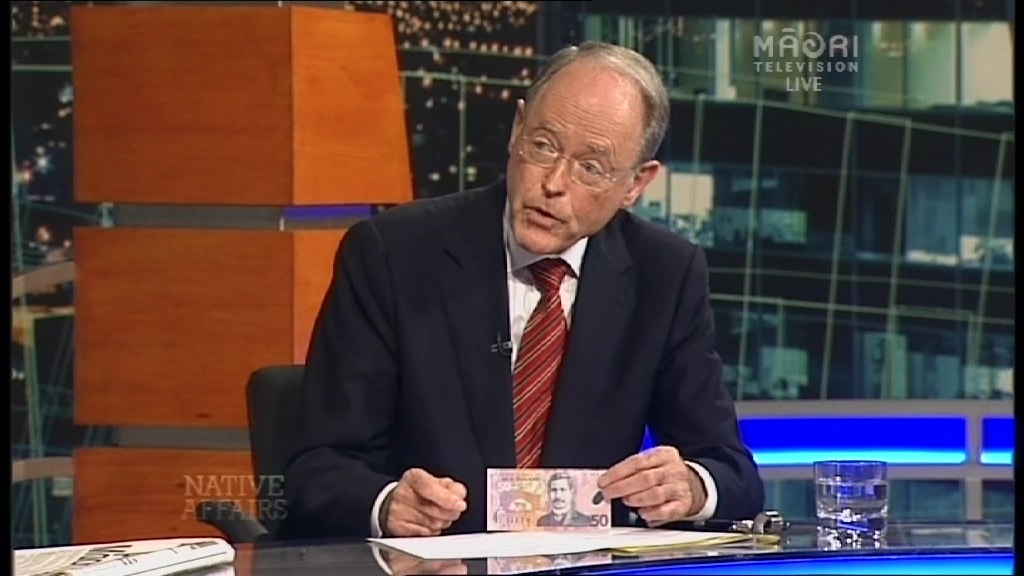
Tonight’s Native Affairs debate between Pita Sharples and Don Brash is now up on their website, and it is must-watch television for a few reasons. The first and most immediately evident is Julian Wilcox’s quality as an interviewer and moderator — this was not a structured debate, with time allotted and mechanical switches between speakers, nor preset, pre-scripted questions. It was a free-flowing affair, with Wilcox acting as both interviewer and moderator; and throughout the two speakers were respectful, genuine, and both had ample opportunity to get their points across. It was superbly done. (Hone Harawira, in a later discussion, twice jokingly invited Wilcox to stand for Te Mana, but for mine he’s too valuable in the media.)

Another reason it was remarkable was because of Don Brash’s bizarre, out-of-touch equation of sentimental or cultural attachment to natural features — maunga, awa, moana and so on — with “animism”. It’s a perverse position to take, given the deep connection New Zealanders — both Māori and Pākehā — have to their landscape, about which I’ve written before. Imagine, if you will, a series of billboards featuring Aoraki Mt Cook, the Waitemata Harbour or Rangitoto, the Waikato or the Whanganui, Wakatipu, Taupo, or my own ‘home’ mountain of Taranaki — with the legend “Brash thinks this is just a lot of water”, or “Brash thinks this is just a rock”. If ACT were politically relevant, it might be worth doing.

Cash Rules Everything Around Me
C.R.E.A.M, get the money
Dollar dollar bill y’all
— Wu-Tang Clan

Like the gangstas of Staten Island legend, this sense that only what’s literal and material matters, that when push comes to shove, money trumps everything is integral to the faux-rational actor model to which ACT subscribes, and this leads into the major thing which made this interview important:

(Image snapped by Michael John Oliver, via twitter, thanks!)

And a brief transcript:

Brash: “Pita, I put …”
Sharples: “No, you didn’t.”
Brash: …”Apirana ta…Ngata on …”
Sharples: “The country put that on. Let’s be clear about that.”
Brash: “I made the decision. I made the decision, as governor. And I put him on that because I think he’s one of the greatest ever New Zealanders.”

Don Brash, the archetypal white rich guy, brought along a fifty dollar note — a note that many poor Māori voters rarely even see — to a debate that was substantively about the reasons why Māori are politically, socially, and economically deprived.

To appeal to Sir Apirana Ngata in a newspaper advertisement — as Brash did this weekend — is merely crass. To bring that actual visage in as a prop in an argument to dismantle the Aotearoa that Ngata and others had worked to build — that, as Sharples said, Ngata was criticised for being a “radical” by rich white guys like Don Brash — and seeking to imprint his divisive and offensive policies with Ngata’s mana is offensive to the man’s memory. To seek to take personal credit for Ngata’s mana being properly recognised — “I made the decision” — is obscene. To play a statesman’s memory like a chip on a weak hand at the last-chance saloon is no sort of respect. It is the ultimate “I’m not racist” gambit — “look, some of my best banknotes have Maaris on”. I wonder if he would treat the memory of Sir Edmund Hillary or Kate Sheppard in this way. Distancing himself from John Ansell’s misogyny by saying “hey, I put a broad on the $10” would be a thing to see. He had a decent crack at “I’m not racist, my wife’s from Singapore” back in the day.

Don Brash, during his brief run in politics, accumulated a series of bad images — “poor optics” as the lingo goes. Walking the plank, struggling to climb into the racing car, scooping mud out of his mouth at Waitangi, and so on. This image — of Brash big-noting to Māoridom, if you’ll excuse the phrase; showing them who’s got the Benjamins, or the Apis — should be one of the enduring memories of the campaign. Brash probably thinks it’s a smart symbolic play, but it calls to mind a bunch of things he doesn’t want to call to peoples’ minds — his own wealth, the extent to which he’s economically out of touch with those he claims to want to represent, and perhaps most of all an almost unspeakably flawed sense of political and historical reverence, which places him out of touch at a deeper level; a level of shared sentiment and aspiration, of common culture and values.

In television, the rule is: don’t tell, show. No matter how often he tells Aotearoa that he shares our views and aspirations, we won’t believe it unless he shows us. Since storming the lofty heights of the ACT party Brash is busily telling us that what we stand for what he stands for, despite 98.3% of the evidence contradicting that assertion. And now he’s showing us exactly the same.

L

Recuerdos de la Muerte (Memories of Death).

Today (March 24) is the 35th anniversary of the coup that ushered in the “dirty war” in Argentina that cost 30,000+ lives, more than 10,000 “desparecidos”  (“disappeared,” or those who were last seen in custody but whose bodies have never been discovered), with tens of thousands tortured and exiled. Never has the dark side of the Argentine psyche been on worse display than during the so-called “Proceso de Reorganisacion Nacional” (“Process of National Reorganisation”), and hopefully the bitter lessons learned will prevent a repetition of that wretched episode in Argentine history. The hard truth is that although the September 11, 1973 golpe that ousted Salvador Allende in Chile is more well-known (as was the dictator Pinochet), and the Argentine coup followed others in Uruguay (1973), Bolivia (1974), Peru (1968), Brazil (1964) and several previous ones in Argentina itself (1962, 1966, with an internal military coup in 1970), the dictatorship installed in 1976 was the most sadistic, murderous and cruel of them all. In its brutality and efficiency it was the exemplar of South American authoritarianism.

For people like me–raised in Argentina and directly exposed to the dictatorships of the 1960s and 1970s–the horrors of those days do not go away easily. For a generation of Argentines, to say nothing of their counterparts in Chile and elsewhere such as in Central America, the traumas of those years will linger forever, and it is only now, with the birth of a generation completely unaffected by the dictaduras, that the process of psychological healing can begin in earnest. While people who came of age in the 1960s and 1970s continue living, it will be impossible to erase from the collective memory the pervasive climate of fear that characterised life during those times.

The immediate result of the climate of fear was known as “atomizing infantilisation:” the body politic is forcibly stripped of its horizontal solidarity networks by the imposition of state terror, which paralyses resistance and reduces the individual social subject to the level of a child’s nightmare. Just as children fear the monsters under their beds and are powerless to stop their depredations, so too a society subjected to a systematic campaign of state terror is reduced to a sense of utter helplessness and vulnerability. After all, in the case of the dictatorships, the monsters were real and death or torture could occur at any time, for seemingly any reason. Terror appeared arbitrary but was in fact systematic, with the objective being to break the will of anyone who might oppose the dictatorial project.

The result was a condition of survivalist alienation: people just tried to go about their personal business, retreat into their immediate private lives and avoid trouble by relinquishing public commitments. The Argentines had a phrase for this: “de la casa al trabajo y del trabajo a la casa:” From the house to work and from work to home. Under such conditions there is no collective social subject. There is just submission.

It was under these conditions that the beginnings of the neoliberal macroeconomic experiments began in the Southern Cone. It was not just a matter of outlawing unions and political parties. It was about “cleaning the slate” of all those who could thwart the laboratory experiment that was the imposition of monetarist policies in South America. It was about using the climate of fear to reforge collective identities  so that the working classes would never challenge the primacy of capital again. It was about elites taking advantage of the window of opportunity provided by dictatorship to restructure the economy in a more favourable image, setting in place structural changes that would fundamentally alter class relations and the relationship of the state and society to capital in a way that the latter would always have the dominant say in social life. It was about, in the language of the time, “forcibly extirpating without anesthesia the malignancies of communism, atheism, feminism and homosexuality from the body politic” (the phrase is attributed to Argentine General Benjamin Menendez, who was one of the dictatorship’s most bloodthirsty leaders). In sum, the project was about using systematic application of state terror to sow the seeds of fear, alienation and despair in which market-driven projects could be imposed. Above that, the use of state terror was focused on social cleansing–in Chile it was about eliminating class challenges to capatilist rule. In Argentina it was about preserving an elite way of life. In either case, the dictators stopped at nothing to make their point.

These are the projects from which Roger Douglas, Richard Prebble, Ruth Richardson, John Key and the Business Roundtable take inspiration. These are the models upon which the NZ economic reforms are based. And if we think of the way in which NZ macroeconomic reform and other aspects of social policy have been “reformed,” we can see that the authoritarian example has been emulated in more than the economic realm. In other words, the NZ market “model” is a softer version of the Southern Cone dictatorial projects, absent the repression but with the same thrust.

We should also remember the climate of fear when we observe the Middle East. Populations that have been victimised, brutalised and traumatised by long-standing dictatorships are unlikely to have forgiveness and conciliation on their minds as the dictators begin to tremble. But the dictators and their allies know this, which stiffens their resolve to not suffer the retributions that they richly deserve. That does not easily make for a democratic “spring.”

All of which is to say, when it comes to contemplating the virtues of dictatorial regimes because they provide economic models or security partnerships, the answer in the first instance should be the rallying cry of the heroic Mothers of the Plaza de Mayo: “Nunca Mas!!”

NB: The title of this post comes from Argentine author Miguel Bonasso, who wrote a book by that name.

The three cities of Christchurch

As local context and in contrast to my recent posts on the media response to the Christchurch earthquake, you must read this arresting report from Christchurch resident Peter Hyde. It is long, but the following facts are crucial:

There are THREE cities in Christchurch right now, not one.
RESCUE CITY is inside the four main avenues, and it is cordoned off. That means almost all our knowledge of it comes from media, and man is it a honey-pot for them!
It’s given us understandably-incessant tales and images of injury, tragedy, loss, broken iconic buildings, heroism, sacrifice, leadership and gratifying international response. It’s extremely television-friendly.
My quake experience started there, but actually almost nobody lives in Rescue City. The resources and attention which are seemingly being poured into it right now are NOT addressing the most urgent post-quake needs of the population of Christchurch.
SHOWER CITY is any part of Christchurch where you can take a hot shower, because you have electricity and running water and mostly-working sewer lines. By latest estimates, that’s about 65% of the city — much of it out west.
In that part of Christchurch, weary and stressed people are getting on with life — though some may be wondering if they still have a job. And a few of them with energy and time to spare are wondering if they can do more to help the rest of the city.
The media naturally lives in Shower City, and they talk almost exclusively to the business leaders and the Rescue City leadership who also inhabit it.
REFUGEE CITY is the rest of Christchurch — mainly the eastern suburbs, though there are pockets elsewhere. It includes perhaps 50,000 to 100,000 people, though a more-mobile chunk of them may have self-evacuated by now.
Only half of those who remain in Refugee City have power, and almost NONE have running water. Many have been living on their own resources, and their neighbours’, for over a week now.
That means that batteries have run down, gas (if they had any to start with) has run out, other supplies are low or gone. Roads are often very bad – and a lot of those from the poorer suburbs have no transport anyway.
Their houses may or may not be intact. Their streets may be clear, broken, or full of silt. Or sewage. There are no showers. Or ways to wash clothes. Or to wash dishes. Or to heat the “must boil” water that is available — assuming they can make it to the nearest water truck, day after day. No refrigeration. No working toilets, and precious few portaloos. No face masks to defend against the blown silt.
They have no internet either, and usually no phones. And their radio batteries are dead or dying. The papers — if you can get one — are rapidly dated, and usually far too general in their coverage. It really doesn’t help someone without a car in Aranui to know that Fisher and Paykel are providing free laundries in Kaiapoi!
All the above means the locals have few resources, little information, and no “voice” either. It’s remarkably hard to call talkback radio – or your local politician — or emergency services — when your landline is out and your cellphone battery is dead. Or when it maybe has JUST enough charge to stay on hold for 5 minutes – but not 20! – when calling the sole government helpline.
The media flies over, drives past and dips into Refugee City, usually at the main welfare or water points. But they don’t cover it that much. From my observations, the officials – those who are making decisions about the relief effort – seem to do likewise.
[…]
IN THESE POWERLESS SUBURBS, THE OFFICIAL RESPONSE IS FAR FROM ENOUGH. Especially in terms of the fundamentals.

It continues at considerable length, and I urge you to read it all, particularly the bit which tells you what you can do to make a difference.

Edit: There is another similarly grim comment from Puddleglum at The Standard:

I’ve spent the last few days shovelling silt in the east of Christchurch. My nephew who had helped dig a friend out of his house in Bexley on Saturday has been over more of the eastern suburbs. Basically, it gets exponentially worse the further east from the central city you go.
These people are already angry, stressed, dismissive of the reactions of most authorities and doggedly trying to do it themselves – yet, as the poster notes, they had the fewest resources to begin with. It’s heartbreaking. Bitter jokes punctuate emotionally strained comments about ‘you just have to go on’, ‘what else can you do?’, ‘THEY won’t help’. They did really appreciate the volunteer ‘diggers’, though.

Read the whole thing.

I’m on deadline and short on time, but my initial response is as follows.

The response is not blind to class or social station. Of course it’s not; as early as last Wednesday I was seeing tweets from people in what is now Shower City saying “we’re doing it hard, but those poor areas down the line haven’t got anything”. This is a feature of disaster responses everywhere. Of course, those suburbs hardest-hit are those suburbs hardest-hit. But what’s really problematic is intersectionality: live in a hard-hit suburb and you’re poor? Tough for you.

I suspect the problem is not so much exploitation as it is ignorance, both wilful and otherwise; by both officials and others. Referring back to the discussions of exploitation on my previous posts, it might be that the residents of Refugee City would welcome a horde of snooping cameras, as long as they could be assured that the footage they captured would stimulate a greater and better-targeted response.

The media has a responsibility to tell this story, as much as it does to relay the uplifting narratives of solidarity and community resilience from Rescue and Shower Cities. A week on from the event, it should not fall to an insomniac resident of Refugee City who is fortunate enough to have the electricity, technical means, personal wherewithal and social networks to tell this story as if it is some sort of revelation. That is the job of the professionals. We should already know all of this.

In their meagre defence, I have heard some media outlets asking questions such as these. A reporter (from TV3) asked Bob Parker yesterday, after the fanfare resulting from the discovery of the time capsule, whether it was good enough that Aranui still didn’t have toilets. (His reply was not good enough — that the response had been very good overall — and the journalist did not push him.) They toured Aranui yesterday, talking with the residents and broadcasting their concerns — lack of facilities, lack of attention, breakdown of the rule of law. Breakdown of the rule of law. People fleeing their homes because, at twilight, groups of people roam around casing houses for burglary.

The media must report this, and in some cases it has: but ultimately it is for the government to undertake a response which mitigates against this inequitably-distributed misery. And a government who is reportedly considering policy changes which will weigh heavily upon lower-income New Zealanders would be well-advised to look after those citizens’ response.

As they say: the whole world’s watching.

L

(Thanks to Emma Hart for bringing this to my attention.)