
Add Condi to the list

According to this story, Former US Secretary of State Condoleezza Rice has admitted involvement in a (technical) conspiracy to torture US terror detainees:

In little-noticed comments Thursday, the former White House counsel for President Richard Nixon John Dean said Thursday that former Secretary of State Condoleezza Rice may have unwittingly admitted to a criminal conspiracy when questioned about torture by a group of student videographers at Stanford.
Rice told students at Stanford that she didn’t authorize torture, she merely forwarded the authorization for it. …
“She tried to say she didn’t authorize anything, then proceeded to say she did pass orders along to the CIA to engage in torture if it was legal by the standard of the Department of Justice,” Dean said. “This really puts her right in the middle of a common plan, as it’s known in international law, or a conspiracy, as it’s known in American law, and this indeed is a crime. If it indeed happened the way we think it did happen.”

Now, there’s a lot of ifs in there, and anyone with a more thorough knowledge of the issues in play is welcome to pour cold water on it. But to my eye, if this lawyer is right then it stands to reason that the Hat Trick of those at the top of the US torture agenda has now expanded to a Gang of Four.

Incidentally Pascal’s bookie, who ought to blog more often, makes a strong case in defence of Obama’s restraint on the torture issues in a series of comments at The Standard. The key point is the following:

[if Obama was too heavily involved] the story would become Obama v Bush, Dem v GOP. Rather than The Law v Criminals.

He’s right: if it’s to be done, it must be done right, and the taint of partisan politics mustn’t be admitted as a distraction. His role is to provide political and legal conditions within which such a prosecution can thrive of its own accord, not to drive the prosecution himself. He’s doing that; those who want Bush, Cheney, Gonzales and (perhaps) Rice to stand trial had best hold their tongues and show a little faith.

L

Social, economic and political fallout of the Pirate Bay convictions

pirate-jail-thumb-230x130-2644-fBackground
The Pirate Bay is a BitTorrent tracker – one of the world’s largest, most popular and best-known. Four of its co-founders were yesterday convicted of “assisting in making copyright content available”, sentenced to 12 months’ jail each and required to pay 30 million Kronor (about NZ$6.3m) between them. The offence was not the same as actually distributing the copyright material – the torrent files hosted on TPB are not themselves subject to copyright, but they enable a user to easily access material which is. For a quick backgrounder, see The Guardian’s FAQ, and for exhaustive coverage, see Threat Level’s archive.

I’m very interested indeed in the roles which intellectual property mechanisms play in the world. This verdict has complex and possibly profound political, social, technological and economic implications. I won’t argue its legal merits, but, despite their claims, I don’t think this case or verdict is in the content owners’ best long-term interests, because it perpetuates a business model which has been proven unfit for its purpose.

pirate-bay-guilty-mass-protests-followSocial and political implications
The social and political implications of this verdict seem likely to result in a sort of Streisand effect where by winning a battle, copyright owners may galvanise opposition to their business model and enforcement practices. This verdict was never going to be the end; as defendant Peter Sunde said it was to decide nothing other than which side would file an appeal. [Video in two parts here and here. The first five minutes or so is in Swedish; the rest is in English.] So as much bad-will as there is against the content owners, there’s plenty more time for it to build.

Online media consumption (sanctioned and otherwise) is largely the domain of the two generations born since the baby boom – quite distinct from those in control of the legal, business and political systems which produce that media and constrain its usage, who are middle-aged and older. There exists a significant disconnect between these generations, and the Pirate Bay verdict seems like it could crystallise that disconnect into an outright generational divide along political and philosophical lines. Those in their thirties and forties have been heavily involved in shaping the internet into the phenomenon it is, nurturing fledgling technologies (including filesharing) to meet their own needs and building cultures and identities around different types of participation. It’s theirs; they created it. The generation now in their teens and twenties have known nothing else, and they are the driving force behind its constant recreation, and are if anything even more strongly engaged. The content industry is currently trying the ‘stick’ approach – trying to dictate terms to two generations who’re used to having things their way and are more than capable of making it so. As those generations displace their pre-internet elders, and as the developing world begins to participate more strongly in traditionally-Western information communities, content owners will find themselves less able to dictate terms, not more so. Those in charge of intellectual property realise this and have been busy over the past few decades establishing and extending copyright, patent and trademark systems, conditional trade treaties, anti-circumvention legislation, privacy infringements under the guise of cyber-terrorism prevention, and other such measures under the auspices of TRIPS, the DMCA, the PATRIOT Act, IPRED and plenty of lawsuits, including this one – all in order to retain their existing, inferior business models rather than be forced to compete on the open market of ideas in order to develop better ones.
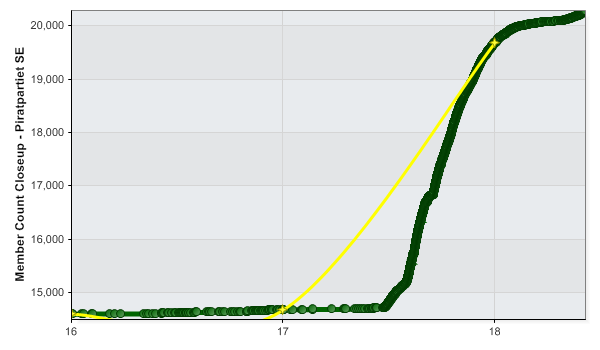
pirate-party-membership There are political implications for all of this, as well – the Pirate Party of Sweden, formed to reform copyright law, abolish the patent system and strengthen privacy rights, claims to have gained 3,000 new members in the seven hours following the verdict, giving it a larger membership than four out of seven current parties in the Swedish parliament (and if their online membership graph can be believed, it looks like they were up above 5,000 new members within 12 hours). Candidate Christian Engström said:

“The ruling is our ticket to the European Parliament,” concluded Engström, who expects a populist backlash against the ruling to help his party’s chances of gaining a seat in the EU’s primary legislative body. [source]

Now, single-issue parties have a particularly hard row to hoe (even TPB’s Peter Sunde doesn’t vote for the Pirate Party), and in terms of realpolitik few countries can afford to deviate from the intellectual property line established by TRIPS. Nevertheless there are big philosophical issues at stake here. Politicians ignore those two generations at their peril.

Technological and economic implicationspirate_bay

Technological and economic implications are linked because technology dictates the means by which content may be distributed, and without distribution there is no revenue. The Streisand effect mentioned above will likely manifest initially in the market for media as a short-term (and possibly short-lived) , but its long-term implications are much broader. Many of the content owners’ arguments against groups like TPB rest on the flawed premise that demand for content is static and copyright infringement is zero-sum (that is: every copy downloaded represents one less copy bought). The fall in revenue, they claim, is because of copyright infringement, so reducing copyright infringement will necessarily cause revenue to pick up again. There are two problems here: first, the genie is already out of the bottle, and two generations are now accustomed to consuming media on their own terms. They will not be forced to consume media in only the ways which content owners want them to, and whoever applies the stick in an attempt to make them do so will suffer as a consequence, because the content industries depend upon their consumers for survival, not the other way around. Second, and this is critical: by engaging in an aggressive game of whack-a-mole to safeguard a broken business model, the content industry has hastened the destruction of that business model by ensuring that only the fittest filesharing systems survive. Cory Doctorow makes both points better than I:

If The Pirate Bay shuts down, it’s certain that something else will spring up in its wake, of course — just as The Pirate Bay appeared in the wake of the closure of other, more “moderate” services.
With each successive takedown, the entertainment industry forces these services into architectures that are harder to police and harder to shut down. And with each takedown, the industry creates martyrs who inspire their users into an ideological opposition to the entertainment industry, turning them into people who actively dislike these companies and wish them ill (as opposed to opportunists who supplemented their legal acquisition of copyrighted materials with infringing downloads).
It’s a race to turn a relatively benign symbiote (the original Napster, which offered to pay for its downloads if it could get a license) into vicious, antibiotic resistant bacteria that’s dedicated to their destruction.

Content owners, by enforcing the discipline required to survive in a hostile environment, are granting clandestine distribution systems an enormous advantage: those systems evolve and improve while their own system stagnates. There are a few exceptions: Radiohead and Trent Reznor are at the forefront.

Of much more grave seriousness, however, is the chilling effect this verdict could have on the internet – search engines, ISPs and end users. Roger Wallis, Emeritus Professor of Media at Sweden’s Royal Institute of Technology (and an expert witness for the defence) warned:

This will cause a flood of court cases. Against all the ISPs. Because if these guys assisted in copyright infringements, then the ISPs also did. This will have huge consequences. The entire development of broadband may be stalled.

His point is that TPB’s technology meant their servers never hosted copyright files – those were hosted on its users’ home computers, and TPB simply provides a search engine to find content and a service which tells one user’s computer where to find files hosted on another user’s computer. If that makes one criminally liable, then those who are doing the actual distribution (te end users) and a whole lot of other people and organisations whose computers provide similar assistance including search engines and ISPs, are also criminally liable – and could even be more culpable than TPB were, since those computers actually host and distribute the copyright files themselves. Due to the highly robust, distributed, fault-tolerant nature of modern content-distribution systems made fit by nearly a decade’s worth of fine-tuning, there is simply no way to beat filesharing without targeting end-users and ISPs on a case-by-case basis. Any reluctance to roll out or use broadband internet services will have catastrophic flow-on economic effects, and given that media consumption is a major driver of broadband, content owners are in a catch-22 situation: either they aggressively prosecute ISPs and end-users or they fail to beat filesharing. In the former case, they get to keep their business model, at the cost of making criminals of their consumer base and ensuring that yet more complex, robust and powerful distribution mechanisms are developed – and possibly at the cost of the internet as we know it. In the latter case, they have to develop systems which are fit enough to survive on their own. The longer they delay, the harder it will be.

An upcoming post will look at the battle for hearts and minds which will fundamentally determine the winner in this contest.

L

Ink by the barrel

There’s an interesting range of responses to the Tony Veitch guilty plea of reckless disregard causing injury to Kristin Dunne-Powell, his conviction and sentence to a fine and community service.

Some are baying for blood. The KBR aren’t quite unanimous that he should go to jail, but they’re close (though there is a foul stench of `men have rights [to kick the shit out of people who don’t behave]’ as well). Haiku Dave is particularly grim:

should have got jail, then
he’d know what it’s like to be
attacked from behind

Idiot/Savant is arguing it’s Bruce Emery all over again (and he’s not wrong). Commenter Alison at The Hand Mirror shows some sense, figuring that if prison isn’t a good thing for a random violent offender, it’s not going to be a good thing for Veitch either. Heather Henare, of Women’s Refuge, is similarly cool-headed. The Herald’s Your Views is divided, as are the talkback hordes. A particularly inspired friend and colleague of mine suggested he be made to front the ACC back injury ad campaign, needing to stand on a rickety chair or somesuch in order to reach something up high. Humiliation comes in many forms.

Judge Doogue told told Veitch he was the architect of his own misfortune, and I think that if he does genuinely intend to take legal action against the media for their treatment of the case this past year, then Tony Veitch will also become the architect of his own humiliation. The facts of the case are fairly simple: there is no possible justification he can give for his attack on Dunne-Powell, no argument he can make which will put him on the side of right, and any moral high ground he tries to occupy will come under sustained fire from more sources than he and his team of lawyers can possibly afford to shut down because public sympathy toward celebrities evaporates pretty rapidly when they are seen to be taking advantage of their celebrity status. At this point anything Tony Veitch says or does will play against him. If he tries to smack down the media establishment, any publisher who chooses to fight gets the chance to put the whole stinking mess on the public record. Tim Pankhurst, if he were still editor of the Dominion Post, would pick it up in a moment out of sheer bloody-mindedness. Veitch might be planning to go back to work for The Radio Network, and that might mean APN goes easy, but that’s a great risk to them – while NewsTalk ZB and Radio Sport might not need to demonstrate their lack of fear or favour, the NZ Herald surely does.

My advice to Tony Veitch: keep your head down and take your lumps like you made Kristin Dunne-Powell take hers [though you deserve yours, and she didn’t]. If you want to show us you’re better than we think you are, there is no short-cut, no easy atonement which you can buy or create from words or gestures. You can’t fix this by becoming a legal bully as you are (or were) a physical bully. If you genuinely want to be known and recognised as a good and righteous person, then the time to undertake good and righteous action is now. For your own sake if for nobody else’s.

L

What David Garrett really thinks

ass_in_jailI’m guessing most of the country has moved on from this issue, but last week I suggested that vto post his email reply from Garrett on the `creature comforts’ issue. He didn’t want to, which is fair enough, but I was interested in my own personalised bit of invective, so I emailed him myself.

I didn’t get invective, I got an explanation of what (and how) he really thinks on this matter, which is most excellent. For all that I disagree with his policies and his ideas, David appears to be entirely lacking in guile, which can only be a good thing inasmuch as it enables the electorate to take him at face value. (Ok, not entirely without guile – he was complaining on Focus On Politics (audio) on Friday that the media take his jocular utterances too seriously.)

The email thread is reproduced verbatim below the fold. I had delayed posting this over the weekend in order to give David time to reply to my last message, but as of this morning he hasn’t done so.

L

Continue reading “What David Garrett really thinks”

Accepting torture

Between even more travelling for work than usual and a cold I’ve been a bit beyond writing, although my list of half written posts has grown :)  Of everything that’s gone on recently it’s the issue of prison rape that’s been closest to a coherent thought. More precisely, why do we accept prison rape?

Since David Garrett’s offensive comments plenty of people have talked about the idea of rape-as-a-part-of-your-punishment and I’ve particularly liked:

  • Idiot/Savant’s “Creature Comforts” which neatly ties the issue back to ACT’s anti human rights agenda.
  • Maia’s Reasonable Opinions which points out that comments like Garrett’s make it clear that some people are rapeable. The comments thread, while heated, is worth a read too!

All of the MSM commentary, and most of the on-line discussion, has taken for granted that prison rape occurs. Where is the analysis of how much prison rape occurs and what is, or could be, done to to eradicate it?

When did prison rape gain acceptance as a normal and inevitable part of our society? What would it take to change that?

Identity politics behind school stabbing?

An article in the Herald gives a clue in favour of what I suspected: that there might be more to the assault by an Avondale College student on teacher David Warren than meets the eye. A few bullet-points below:

  • Warren was a Japanese-language teacher with a brusque and sometimes offensive manner, who allegedly joked about the Republic of Korea. His attacker was new to NZ and likely unfamiliar with our ways had apparently been here for two years and at Avondale College all of 2008.
  • Korean students (and I’ve taught hundreds) are quite strongly inculcated to respect and admire teachers. It’s part of their Confucian socialisation. I simply can’t imagine one attacking a teacher, or even speaking rudely to a teacher they don’t know very well indeed, much less while in a foreign country.
  • Probably the only thing stronger than this is the Korean sense of national pride. If the two things came into conflict, it would have to be a grave insult indeed to result in this sort of response.
  • Koreans have an abiding hatred of the Japanese, founded (among other things) on the crushing occupation they suffered through the first half of the 20th Century and not helped by a) pervasive anti-Japanese propaganda at home and b) continual denial by the Japanese of any imperial wrongdoing (not unlike their attitude to China and elsewhere).
  • If a joke was made in the context of the Japanese language, which Koreans were forced to adopt, learn, and use, even to the point of taking Japanese names (not unlike how Māori was here, though more brutal) about Korea, then I can certainly see it being grave enough.
  • Students are speaking anonymously about the case for fear of expulsion – WTF? Why does the school get to impose this sort of constraint?
  • Avondale College Principal Brent Lewis claims to know nothing of the sort, contradicted by his own staff and pupils. I detect arse-covering.
  • I can’t find any reference to the incident on Korean English-language news sources, but if there emerges a sniff that this may be a matter of national identity, it could turn into a Big Freaking Deal. Especially with Lee Myung-bak here to gladhand and the chance of a Free Trade Agreement being floated. Talk about bad timing. Update: exexpat notes below that Korean-language media have picked it up, with the nationalism line intact.

None of this is to excuse the student’s attack, of course. But it doesn’t look like a random bit o’ violence to me.

Update: The attacker has been named, and a bunch of the details seem to be disputed, see here. I’ve amended the post to remove details which seem to be incorrect.

Disclaimer: Can I be completely explicit for people who are too suspicious to believe or too stupid to read the statement above (which I almost didn’t put in because I thought it was bleeding obvious): I am not trying to blame Warren or defend Chung – I am trying to consider the dynamic in play here. If you attempt to call this into question or engage in any such behaviour yourself, expect to be soundly ridiculed. You might note I’ve tagged this post hate crimes.

L

Three strikes: providing an incentive to kill

Chris has used up two strikes; a pub fight, and getting caught carrying a knife during a burglary. Back out of jail it’s hard to find work, money’s really tight, and old habits kick back in so late one night Chris opens a window in an dark house in an expensive street.

Part way through checking through the house for valuables, there is a noise, and a light turns on. Grabbing a knife Chris sees a woman standing in the doorway to her bedroom. Chris has two options:

  1. Run out the front door – knowing that if the woman picks Chris out of a line-up or the Police solve it with forensics it’ll be a life sentence for aggravated burglary; or
  2. Stab her – if she’s dead there’ll be no line up, so unless the Police can solve it with forensics there won’t even be a trial.

Very sadly ironic, indeed

DPF has just blogged on the murder of Aasiya Hassan. He comments on the irony of an apparently reformist Muslim beheading his wife in a way resembling an honour-killing. The irony he doesn’t seem to see is that he is guilty of doing the very thing he claims is a problem, when he says

The problem is when people apply a stereotype to all individuas in a group, rather than treat people as individuals.

The fact is that murders, like suicides and like rapes, are committed by people from all strata of society, from all cultural and ethnic backgrounds, and by and large for the same sorts of reasons. This includes honour-killings, which occur frequently enough (and are tacitly accepted as being `provoked’, attracting less opprobrium and lesser sentences) in western cultures as well – just using different methods, and not formally defined as such. We call them by the more appealing handle `crimes of passion’. Such acts are committed using methods and technologies which are readily available to the murderer, both in a physical sense of I-can-get-my-hands-on-it and in the cultural sense of that’s-just-how-it’s-done. Middle-class [Anglo-American] people tend to use poisons and firearms; working-class [Anglo-American] people knives or blunt objects or nooses, and so on. That a Muslim man, wronged in his marriage, might resort to beheading is as obvious as saying that he might have shot her if he was a white middle-class American. But DPF implicitly privileges some murder methods over others, and implies that Hassan might have avoided the stereotype by choosing another method, as if the method – not the fact of the killing – was the important thing.

David is appealing to the symbolic nature of a beheading to demonstrate that the stereotypes about Muslims are well-founded, rather than treating this murder as an individual case, as he preaches.

This is a bone thrown to the wolves of the KBR, but unusually, this one does not make David look sensible by comparison.

L

Edit: Added [Anglo-American] above to distinguish the generalisation somewhat.