PC priorities

The media beat-up du jour is the non-story of Te Papa Tongarewa “barring” (or “banning”, “forbidding”, other such absolute terms) pregnant and menstruating women from entry due to the nature of some tāonga on display.

Except they’ve done no such thing. The “ban” isn’t actually a restriction at all — they’ve been clear that it’s a request, not an ironclad edict; and in any case, the exhibit isn’t open to the public, but to staff from other museums. It’s an invite-only behind-the-scenes tour. And the crucial point is that the tāonga in question have been given to Te Papa on condition that this advice is given to prospective viewers. Let me be crystal clear: nobody would be barred from attending on the grounds that they are pregnant or menstruating. If someone wanted to turn up and say “bollocks to all of that, me and my unborn child are going to see those taiaha!”, it’s been made clear that she would be permitted to do so. That might be inflammatory and offensive, like farting in church or wearing a bikini to a funeral, but nobody is forbidding it. And that’s as it should be: Te Papa is our place and nobody should be barred outright. If the condition required exclusion, then that would be fair enough on the part of the owners — who can reasonably impose whatever conditions they please — but quite explicitly not ok for Te Papa, who would be better to decline the opportunity outright to maintain its public mandate.

Of course, this hasn’t stopped everyone with a platform from winding up to rage against the imposition of archaic, alien superstitions upon their civil liberties. But almost without exception, the restriction-which-isn’t-really-a-restriction doesn’t apply to them, since — as far as I’m aware — none of those objecting are in fact museum staff who would be eligible for the tour. And amongst this vicarious umbrage there’s an awful lot of squawking about misogyny and imposition of cultural values, and much more uncritical repetition of the misleading language of “bans” and such. It goes as far as idiotic and lurid suggestions about personal searches using sniffer dogs, for crying out loud.

All this has manifested as a soft and rather opportunistic sort of anti-Māori racism, where Māori are the casualties of our sticking up for the rights of pregant and menstruating women. There’s a common implication that they are the oppressive stone-age patriarchy using whatever means they can to victimise our women; and “forcing” their rude barbarian culture into our civilised and noble times. This is understandable from the usual PC gone mad crowd who’ve suddenly — conveniently — found their inner feminist, but somewhat more disappointing from those who would often be described as the hand-wringing PC liberals, people who ought to know better that it is possible to reconcile conflicting cultural values of this sort in an amicable fashion via the standard tools of live-and-let-live liberalism. And while those same hand-wringing PC liberals do rail against the worst excesses of those illiberal institutions which make up mainstream NZ society — chief amongst them the Catholic church — the response to this case has generated anger out of all proportion. Te Papa had to make the decision: take the tāonga on with the advisory condition, or not at all. Perhaps those objecting to this policy would prefer that nothing of this sort ever go on display. There is a genuine cultural conflict here, but it can quite simply be resolved: those pregnant and menstruating women who believe their right to attend trumps the request to the contrary may do so then and there. Not only are they not prevented from doing so by those hosting the tours, they actually have the right to do so should they choose, and that right should be defended. Those who do not may do so at another time which is convenient to them. The tragedy is that for most of the liberals in this battle of PC priorities, women must be given categorical superiority over Māori. They are arguing for their own culture to be imposed across the board; the very illiberalism they claim to oppose.

There are (at least) two people who are making good sense on this matter: Andrew Geddis, whose liberal argument is very close to my own views, but much better formed; and Lynne Pope who, almost uniquely among the bullhorns sounding around this topic, is a Māori woman who’s actually been on the tour in question. Neither of them have lapsed into the myopic, reflexive Māori-bashing which is the most unbecoming aspect of this situation.

The lesson for New Zealand’s liberals is this: it isn’t necessary to trample on the cultural needs of Māori to accomodate the needs of women. Liberalism itself provides tools to reconcile these differences. They just need to be used.

Update 20101018: As usual, Scott Hamilton makes good sense on this topic.

L

Unattributed paraphrasing as unspoken flattery?

From time to time I read bloggers who complain that there work is stolen by MSM “repeaters” and repackaged under the repeaters’ by-line or in a story under their name. This form of plagarism is hard to prove conclusively because unless the repeater uses phrases word for word, s/he can claim that fortuitous intellectual coincidence rather than malice was involved.

Then I read Kerre Woodham’s column in today’s HoS. The tone is similar to the thrust of my post earlier in the week about the rise and fall of Paul Henry. That’s OK, as a number of people have taken the view that TVNZ management is as much if not more responsible than Mr. Henry for the debacle that his “insensitive remarks” has turned into.

But what are the chances that she and I would both use the phrase “bullet proof” in paragraphs specifically referring to the moment at the Qantas Media Awards when Henry decided he was invulnerable? Since her version appears five days after mine did, is it a wonderful coincidence and example of great minds thinking alike or an example of the type of repeating that other bloggers have complained about? In other words, is this Kerre’s “Noelle moment” or am I reading too much into it and being too possessive of a widely used argument and phraseology?. Readers can compare both essays and decide for themselves.

Either way, I guess I should be flattered–except that she gets paid to write things that I dole up for free.

Frogs, toadies and tadpoles


There’s been a long and turgid discussion about the Greens’ support for the Canterbury Earthquake Response & Recovery Act (CERRA) on Frogblog, with commenters including many of the usuals from around the blogosphere, Russel Norman and Kevin Hague, and someone called BJ Chip (who I assume is a comms flack) running defence for the Green party. (I can’t figure out how to link to individual comments, sorry). Another commenter, Geoff Fischer, makes a persuasive case against the Greens’ newfound pragmatism, both on the Frogblog thread and on his own site. Whilst I don’t entirely agree with Geoff (I’m a pragmatist at heart) I think his critique is a good one, particularly for the Greens (who aren’t). But there are also strong pragmatic grounds to attack the Greens’ decision to support the CERRA; grounds which, if the Greens are serious about their new realpolitik posture, they’d do well to consider.

I’m often disappointed by the Greens’ persistent — even pigheaded — reliance on the ‘principled stand’ in politics. While valuable among a suite of tactics, it’s overused as a one-size-fits-all response which pigeonholes them as idealistic zealots who don’t compromise and can’t be worked with. But although I think its consistent use is a poor strategy in the general case, it gives the Greens a valuable trump card: the ability to say “these are our principles; if you don’t like them, go ahead on your own”. While it all too often results in other parties abandoning the Greens as irrelevant and going ahead on their own, it does build a powerful narrative about the Greens which speaks to characer and reliability and permanence. Principled politics, as Geoff says in other words, has an objectivity about it which is often lost in modern pragmatic discourse where what often passes for ‘true’ is whatever you can argue. When all the other parties in parliament — even the other parties who (however unjustly) appeal to the ‘principled’ brand, such as ACT — are falling over themselves to betray their principles, it’s all the more important that you stick to your own. Put another way: when your political strategy is to be principled, refusing to act on principle is not a pragmatic decision.

Most obviously, taking a uniquely principled stance at the time when the pressure is greatest to cave in hugely strengthens that narrative mentioned above, ensuring the long-term strength of the brand. It’s easy to be principled when nothing is on the line — the measure of a party’s commitment to principle is how it performs when the stakes are highest. That measure has now been taken.

Secondly, principled politics is what the Greens know. It’s their realm of competence. An idealistic stance would have given them the ability to critique whatever misdeeds the government undertakes in the name of this act with a clear and objectively indisputable line (“we voted against it”), whilst the best they can muster at present is the equivocal, inconsistent line which Norman is running in the Frogblog thread (“we objected to it and we don’t like it but we voted for it anyway because we thought it was the right thing to do”). BJChip demonstrates a fundamental lack of understanding how public-sphere political communication works with (her or his, I’m not sure) defence: “if they give us such idiotic cr@p [as “you voted for it”] we can give it back chapter and verse”. I replied with the following:

And not a word after “but you voted for it” will be worth a damn out there in the cold, pragmatic world of realpolitik which the Greens have now decided to enter. In that world “but you voted for it, so STFU” is the super-hero version of the “Nine Long Years” gambit which paralysed the Nats from 1999-2004 and has paralysed Labour for the term so far. You can’t beat it; in the battle of the soundbite, it’s political kryptonite because when they say it, they’re right. You voted for it: it’s your law, you swing by the same rope as the rest if and when it all comes apart. And so you should.

As much as they might believe themselves to be big-game players, the Greens have never even made a serious attempt to master the complexities of pragmatic politics, preferring to leave the cut-and-thrust to others. In the realm they have now entered they aren’t so much frogs as tadpoles. Judging by Norman and Hague’s statements and the spirited defence of BJChip (and others who use the pronoun “we” on behalf of the party), it seems they will attempt to defend the decision to support CERRA as they would any principled stance, with a clear restatement of the whys and wherefores behind the decision, omitting any discussion of the political consequences. This is impossible, because it is clear to even the most casual observer that the decision was a pragmatic one based on the politics.

Third and most importantly, at the electoral sharp end a uniquely principled stand positions the party as a ‘safe harbour’ for voters from other parties who are disillusioned by those parties’ too-enthusiastic embrace of pragmatism. This is where I think the Greens got their political calculus most badly wrong. The Greens’ own membership and support base was not going to be unduly turned off by the fact the party refused to support a bill granting dictatorial powers to Gerry “sexy coal” Brownlee; they may have taken some sort of hit, but the risk was not as dire as it is being spun. But a principled stance against this manifest assault on the constitutional framework of the country would have permitted the Greens to position themselves as the last line of defence against Shock Doctrine authoritarianism; a rallying point for liberal values. “Even if you disagree with our policy orientation,” they might say, “at least you know where we stand, and can rely on us to stand against the worst excesses of government impunity.” Coupled with the ideological moderation signalled by the departure of Sue Bradford and Jeanette Fitzsimons, I believe the Greens stood to gain considerable support from disappointed Labour voters, particularly those who wanted the party to act as a functional opposition to the government — and they might have even picked up a little bit from the other parties, as well.

So the decision manifestly fails on grounds of principle, and because the Greens are a self-declared party of principle with neither a strong history nor any particular skills in the exercise of realpolitik, it is doomed to be a failure in practice as well. One silver lining, though: since the Greens stand to gain nothing from it, their support for CERRA doesn’t really indicate that they’ve sold their principles out for power as “Tory toadies”; more that they simply lost their nerve. This stands in contrast to Labour, whose support for the act was obviously based on pragmatic grounds of political calculus, and principles of good governance be damned. This is especially the case for Christchurch-based MPs like Brendon Burns, who is leading the red team’s defence in a particularly distasteful fashion. They are complicit in the power grab. The Greens and their principles are just casualties of it.

L

Blue smoke

In my previous post on the Canterbury Earthquake Response & Recovery Act (CERRA) I lamented the conspicuous absence of outrage in response to the bill’s provisions from partisans on the right. I have since been heartened by the responses from some of the more principled commentators on the right; well done them.

But there is one most conspicuous exception. I have on many occasions in the past defended Kiwiblog’s David Farrar from allegations that he’s a bog-standard Tory authoritarian. Yes, he’s a loyal partisan; yes, he does have his authoritarian tendencies, but his typical policy alignment is clearly classical-liberal. He is is consistently more liberal than almost all of his fellow-travellers and has regularly exhibited a forthright commitment to democratic principles of the rule of law, of good constitutional practice and the importance of checks and balances. Even yesterday’s response conveyed lukewarm concern about the scope and extent of the act. But I take back all that defence of David’s character; and so, apparently, does David take back his commitment to those liberal principles.

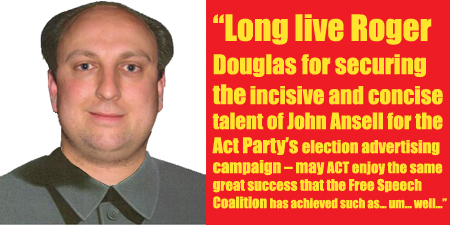
Because this morning’s post on the CERRA is nothing short of cringing, snivelling partisan apologia for dictatorship dressed up as a simplistic classical history lesson. Dictatorship, it appears, is a-ok with David just as long as the dictator wears the right coloured tie. Where now are the lofty appeals to the principles of good governance, the shrieking about attacks on the nation’s constitutional integrity, the billboards bearing the endorsements of dictators? There are plenty around, including a very explicit homage to the Free Speech Coalition campaign which David fronted, but nothing from this erstwhile and self-proclaimed champion of democracy himself.

The fact that DPF is being schooled on both the principled and pragmatic problems with this bill by some of the more wide-eyed and reactionary members of his commentariat suggests that he has taken leave of his political instincts as well as his principles; for instance, the notorious ‘burt’, who urges him to consider what might happen if (due to the collapse of ACT) National fails to win the 2011 election and a Labour minister takes over from Brownlee; a possibility he and the government had either not anticipated or don’t believe was worth considering. Nothing would be sweeter irony, but either way: David’s credibilty on these matters is up in a cloud of Tory-blue smoke; a legacy destroyed by unprincipled partisan loyalty. Such is the price of political dependence.

Update: Similar sentiments from Peter Cresswell, Danyl Mclauchlan and The Standard, from whom I purloined the image.)

Another update: More angels required to dance on DPF’s pinhead.

L

The masculinisation of this blog (or how it became a pissing match).

Over the past few months my partner has observed that KP has increasingly become a boys club. Part of that, she notes, is that I write about security things and boys like guns and war, so tend to dominate commentary on those themes. I have pointed out that I write about plenty of other things, and that Lew covers a range of subjects that are not exclusively “male” in orientation. And yet 95% of our commentators are male.  And, as my partner also observes, their comments tend to become the intellectual  equivalent of pissing matches or penis length arguments rather than reasonable exchange of views in which the worth of opposing perspectives is acknowledged. She includes me in the pissing match crowd. 

I attribute the apparent masculinisation of KP in large part to the fact that Anita’s long hiatus has deprived the blog of the gender balance it needs, in part because Anita writes from a feminist perspective and about gender issues from a wimin’s point of view. That of itself is interesting because when she does (and Anita does not write exclusively about gender-related themes), the comment threads show a disproportionate number of females in the mix. In effect, there appears to be a self-segregation going on: men read and comment about “boy” topics and wimin read and comment about “girl” themes. This can be seen on a larger scale in the topics covered by political blogs written by wimin versus those (the majority) written by men, which makes me think that the “problem” is not exclusive to KP.

This bothers me. I do like to think of myself as writing about exclusively “male” topics since I believe that subjects such as international relations, foreign policy, labour politics, democratisation and regime change, and security issues are (or should be) matters of universal interest. Likewise, I do not believe that topics such as rape, child-raising or workplace harassment are exclusively female concerns. But until Anita comes back, it appears that KP is becoming the political blog equivalent of a (somewhat polite) rugby clubhouse.

So I guess the question of the day is whether there is a self-segregation of wimin’s versus male topics, and if in fact this blog, for worse in my view, has become masculinised (sic) beyond repair.

Evaluating the KP debate experiment.

The results of the first attempt to host a debate between a right-focused blogger and left-focused blogger here at KP have been decidedly mixed. The idea was to show that reasonable people with opposing ideologies can have a civilised debate about matters of contemporary import in a common forum rather than slag each other across the blogosphere. Since I have good regard for Sagenz writing on strategic issues at New Minister in spite of the company he keeps over there (PM excepted and Gooner occasionally forgiven) and the fact that we disagree on 95% of everything political, I invited him to debate me here on the proposition that the Iraq invasion was a success. Kindly enough, he agreed, even while acknowledging that he was entering opposition turf in doing so.

I assumed that readers would focus on the merits of our arguments, using the ends-means/costs-benefits rationales that are the essence of strategic thought. I thought that the debate would centre on my short to medium negative appraisal versus Sage’s long term mixed success scenario, in which short term failures could lead to longer-term success from a US/Western standpoint. I assumed that people had read enough to look beyond the pretext for the invasion (WMDs), and that they were conversant in the ample literature directed to the topic.  I assume that people would leave their (anti-American and anti-Israeli, in particular) biases at home and concentrate on the merits of the argument as given. My assumptions were wrong.

Although there were a few good comments, what we mostly got was the usual partisan diatribes, several of which were clearly uninformed by a thorough read of what was written. Some were completely off-thread. Then there was the nitpicking troll from Japan who had little substantive to offer, another rant directed at me that actually was about something Sagenz wrote, capped off by the king of pompous armchair revolutionaries harping about me being vaingloriously mean to the troll. The bulk of the comments did not debate the merits of the arguments or even address the subject as specified. That was disappointing.

Even so, after expressing my unhappiness with Lew and Sagenz and hearing back from them, I would like to try the debate experiment again and invite people to submit topics and possible authors. I think that  because KP tries to keep things civilised, we can offer a good hosting platform for some worthwhile, stimulating and reasoned left versus right arguments. But ground rules for comments will be established so that if comments deviate from the subject matter as framed by the debate question, they will be deleted.

Surely this is a worthwhile venture and not to much to ask for people to stay within the margins of the debate as framed. If nothing else, doing so helps improve intellectual discipline because it forces both authors and readers to check their biases and assumptions at the door in the attempt to be concise and to the point.

‘Come back Helen Clark, all is forgiven’

Thus spake John Ansell, who’s back with another cracking demonstration that he’s the nation’s pre-eminent racial fearmonger. He really is peerless in this regard.

And there’s plenty more where that came from.

Incidentally, you can read Scott Hamilton’s (and others’) thorough and systematic destruction of Ansell’s rather slippery and Victorian views on race, ethnicity, culture and religion (yes, Virginia, ‘Māori’ is a religion) in the comments thread of this post at the excellent Reading The Maps.

L

Just don’t think about the offspring

Misery acquaints a man with strange bedfellows, and so it is that Chris Trotter finds common cause with Peter Cresswell in selectively revising the story of Ngāi TÅ«hoe to frame them up as our very own Khmer Rouge, and the Tino Rangatiratanga movement as the mortal enemy of civil society as we know it. I do not seek to defend Te Kooti and his followers: it’s not necessary to do so to abhor the brutality of the Crown response. But even that isn’t the point of this post: I’ve covered that ground before. The point is that their reading is anitithetical to the ongoing development of a peaceful and modern Aotearoa.

Both frame up the Crown position as a matter of swordright — TÅ«hoe ‘picked the wrong side’ in their war and were justly punished for it. Should have been punished more. Both Chris and Peter seem to be of the view that the Crown would have been entirely justified in leaving not one stone upon another, not one man, woman or child alive. And more than a century later, based on their own (conveniently one-eyed) assessment of incidents surrounding Te Kooti’s succour in Te Urewera, they argue that TÅ«hoe still deserve whatever they get: nothing if they’re bloody lucky. Frankly, I expect this sort of thing from permanent-state-of-jihad Objectivists; not so much from an actual historian claiming the mantle of a peace-loving social democrat.

Because the end justifies the means, you see. The brutal and systematic dispossession and wholesale slaughter of Māori throughout Aotearoa was perhaps unfortunate, but necessary in ‘civilising’ the uncivilised hordes of savages found here by the noble white man of 1840. I asked Chris a while ago whether he thought that NZ would have been better off if Europeans had just landed with boatloads of armed soldiers and done to the natives what they did in the rest of the world. He responded by saying I was “not mentally wired for this sort of historical argument.” But I guess I have a fuller answer now.

These are people who claim to want to ‘move on’ from our colonial history, for Aotearoa to become ‘one nation’. But doing so on the basis of swordright cannot result in a nation of two people joining together as ‘iwi tahi tatou’, but of one people who set the rules and another who live by them; the former wielding the righteous sword of civilisation, the latter’s efforts to work with the former rather than under them cut down by it, and even their efforts to work within the rules viewed with eternal suspicion and distrust. This is beyond misery — it is ignorant, paranoiac hatred and fear of ghosts long passed which has brought these two bedfellows together. Just don’t think about the offspring they might bear.

Update: Fresh approval from PC.

L

The r and the e: Lobby if you want ’em

I agree with DPF, that for the sake of historical correctness, Wellington’s Majoribanks Street should probably be changed to Marjoribanks, and Nairn Street should probably be changed to Nairne, since that’s how the names are properly spelt. This is precisely the argument I made with regard to Whanganui, and as DPF says it’s no different. But as is so often the case, the idiots of the KBR are reflexively shrieking “racism” because Wellington City Council aren’t recommending a change to the NZ Geographic Board.

The lack of a change is not racism: it’s that nobody seems to care. Whanganui Māori got their name change after decades of concerted and organised lobbying, public demonstration, private petition, backroom negotiation, research and campaigning on the topic. What would be racist is to expect that these changes in Wellington — trivial though they are — should go through as of right just because one historian thinks they should. The decision to change an entrenched name is and must remain a matter of civil society deliberation: those who favour the change lobby for it; those who oppose it lobby against it, both bring whatever evidence and principled arguments they can to the discourse, and those authorities empowered to decide the matter do so in accordance with appropriate legislation and customs. So, to those who want the names of Stewart Marjoribanks and Alexander Nairne properly recognised, I say: start lobbying!

L