Friends like these

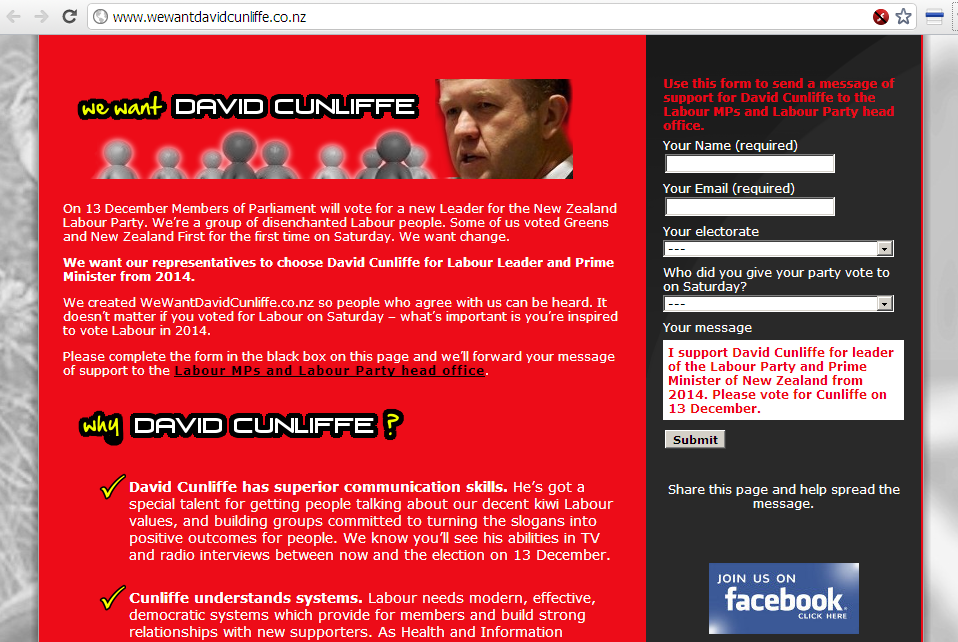
I don’t know who’s set up wewantdavidcunliffe.co.nz to lobby for his leadership of the Labour party, but I’m pretty sure David Cunliffe won’t be thanking them, despite their obvious enthusiasm. Click the image below for a full size version.

wewantdavidcunliffe.co.nz

All the information is broadly accurate (except for the idiotic scaremongering of “Don’t let the right-wing bloggers hijack your party’s Leadership election. Submit the form now!”). Cunliffe is a strong candidate with many good qualities. But I doubt many people will read that far because the site is offensive to the eye. The layout is horrible, and I know colour-blocking is meant to be in right now, but seriously — the dominant red is too much. Contrast with the text is poor, and the faux-script headings and such give the whole thing a 1990s Geocities-Angelfire feel that has no place in the 21st Century interwebs.

Worst of all is the banner — it tells us that grey, faceless bobble-headed people want David Cunliffe as leader. As a friend of mine, a graphic designer by training, said (after “MY EYEEEES”) — aren’t grey bobble-heads the New Zealand First brand?

The use of such symbolism is a slander on David Cunliffe that even a member of Team Shearer like me can’t support.

L

Know your enemy

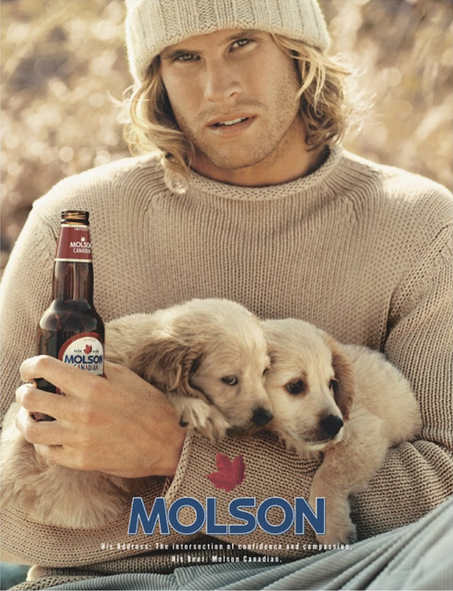
The image above is “scientifically formulated to enhance [women’s] perception of men who drink Molson […] a perfectly tuned combination of words and images designed by trained professionals. Women who are exposed to it experience a very positive feeling. A feeling which they will later project directly onto [men who drink Molson].”

That’s not my analysis; it’s what the creatives who developed the ad said about it, in another ad. The first ad, the one you see above, ran in Cosmopolitan and was pitched at women. The ad from which the explanatory text was drawn ran in Playboy under the heading “Hundreds of thousands of women. Pre-programmed for your convenience.” The full analysis is here, on the Sociological Images blog.

The lesson is essentially that propaganda relies on market segmentation; messages crafted and pitched with accuracy and intent. If you read what you’re told to read, you’ll think what you’re told to think. Avoiding such a fate means embracing diversity of input, understanding your opponents’ arguments and their reasoning even if you disagree with it. To a large extent that means consuming their media. For a rounded perspective you’ll need, at least occasionally, to read sites like DailyKos and Free Republic, infuriating and interminable comment threads on The Standard and Kiwiblog, and SOLOpassion and Gates of Vienna and WSWS and the Wall Street Journal; listen to talkback, watch Fox News and pick up both Cosmo and Playboy from time to time, for the articles or whatever. This is obviously not an exhaustive list, but the point is: read, listen, watch and discuss promiscuously. Argue with those folks you disagree with; drink beer with them from time to time. Take them seriously. Insist that they take you seriously, and give them reasons to do so.

It might hurt; in fact, it often will. But it beats being a dittohead.

L

Edit to add: Anita points out that the Sociological Images post created a bit of a stir. They write:

Apparently the company has been getting calls from consumers and reporters regarding the Molson Cosmo/Playboy ads we posted about yesterday. It turns out the ad campaign is quite old (2002/2003) and they would like to distance themselves from it now.

As you would. Not clear whether they now regret the decision to run such ads, or whether it’s a pro-forma blowback response.

Further thoughts on Team Shearer

These things occurred to me while making my daughter’s birthday cake:*

Endorsement games continue, with a range of people from across the political spectrum still out for Shearer; including Goff’s erstwhile strategist John Pagani and that notorious Mooreite Phil Quin alongside the rest of us Tory plants. Meanwhile, David Cunliffe has the endorsement of the Young Nats, here and here. Cheap shots, but it is the Young Nats after all. When they’re not photoshopping your head onto a dictator they obviously have the hots for you.

This sudden and spontaneous outbreak of public-sphere democracy is sending Labourite dittoheads into a panic; they’re convinced it’s a trap — one so cunning they can’t see what the right has to gain from it, but it must be something. It’s like they’ve forgotten what they believe; they just read Farrar, Slater, Hooton and Odgers and believe the opposite. Tragic. Those guys are good and all, but they only have so much power because so much of the NZ left is stricken with paranoiac idiotosis.

Meanwhile Trevor Mallard has it all figured out: the Vast Right-Wing Conspiracy decision to endorse Shearer is not a trick to ship Labour with an easybeat leader (or worse, a wolf in sheep’s clothing) — in fact it’s a double-bluff designed to give Labour second thoughts about choosing the obviously-best candidate. (Incidentally James Meager, formerly of the now-defunct Mydeology blog, called this on Thursday.) Someone should redo the poison scene from The Princess Bride with such rationalisations. It’s positively Kremlinesque; parallels to the well-documented phenomenon of impending-collapse paranoia within authoritarian regimes seem almost too obvious.

Nevertheless, amongst all the bogus objections, I think there are two legitimate concerns about Shearer’s potential leadership. The first I noted in the Close Up interview: his presentation is not strong. He ums, stutters and hesitates, speaks too softly and lacks cut-through. When he’s been put on the spot he has struggled. He is much better at the set-piece but that on its own is not enough. What he does have to say is often very good; he is a very perceptive listener and he has a pretty remarkable grasp on a wide range of issues. (There’s a comprehensive archive of his weekly in-depth interviews with interesting and important people on the radio here.) That having been said, our present PM is akshully not the world’s greatest public speaker, and the public may view a less-polished performance as a common touch. Whatever the case, this weakness can be overcome by training; presentation is one of the few things in politics that can really be taught. Key and Clark are both great examples.

(Incidentally, it amuses me greatly to see folk who’ve always been focused on wonkish detail and hard policy, to the stern exclusion of doing anything that might win elections, now complaining about a candidate on the grounds that he talks a bit funny.)

The second objection is a bit more substantive, and was raised separately by Anita and by Chris Trotter, and also by Audrey Young: Shearer is reputedly aligned with Damien “gaggle of gays” O’Connor, and perhaps other members of what I have previously termed the blue collars, red necks faction of Labour. Because of this, Young suggests, a Shearer-led Labour will be “a more pragmatic party, with less emphasis on gays and feminists”, or as others might say, he might mean the end of identity politics. Leaving aside the offensive dichotomy between pragmatism and support for equal rights, I don’t think this necessarily follows. O’Connor’s views as expressed in his infamous “gaggle of gays” comment were somewhat archaic, but it’s not clear they will greatly shape the party’s culture. In addition, O’Connor has a point: homophobia aside, his critique of the faction politics of the Labour party has some merit (he also criticised “self-serving unionists”, Trotter’s latest target). Absent any indication that Shearer himself shares O’Connor’s unreconstructed views I think it’s a long bow to draw. Even so, I think the priority for Labour now is sorting its institutions out, and that will mean deemphasising some other projects. I can see this being a touchstone issue for some people; vive la difference.

Lastly, what we have before us is a Labour leadership candidate that can be supported by the right-wingers and former strategists noted above, Sanctuary, AK, myself and presumably because of his potential appeal to Waitakere Man and supposed opposition to identity politics, Comrade Trotter. A person like that doesn’t come along very often.

L

* Huhu grub cake made of rolled lemon sponge filled with fresh cream and bush honey, lemon cream cheese icing. Yeah, colonial-bourgeois Kiwiana is how we postmodern Gen-X long-spoon suppers roll.

Impoverished

The other day David Farrar got in a pre-emptive whinge about Bryan Bruce’s Inside New Zealand documentary on child poverty that aired last night on TV3 (you can watch it on demand if you missed it).

Maybe the outrage expressed by David and others of his ilk is somewhat justified. This is not a grey, respectful, nominally-neutral sort of a work; it’s an impassioned and at times ideological work of advocacy arguing that New Zealand society, and in particular its governments, ought to be ashamed at the circumstances many of our children live in, and a significant portion of that burden of shame can be directly linked to the policies of National governments. It airs four days before the general election. The Labour and Green parties bought lots of advertising during it.

So if David or anyone else wants to bring a BSA complaint against the broadcaster, or — as David implies by calling it a “free hour” for Labour — if he wants to complain to the Electoral Commission that the documentary should have included an authorisation statement as a campaign advertisement, then I think they should do so. Fair enough, if they can make something stick.

But consider the response: a documentary about child poverty, covering the appalling housing, health and nutritional outcomes borne by children in our society, and the immediate response is to launch a ideological defence of the National party and deride the work as nothing but partisan propaganda. But an interview Bruce gave to Glenn Williams (aka Wammo) yesterday, before the screening, contained the following exchange:

Wammo: “Politically, though, it’s tough, isn’t it, to remove that money from the ambulance at the bottom of the cliff and put it at the top.”
Bruce: “Politically?”
Wammo: “Yeah.”
Bruce: “This is not a political question, this is an ethical and a moral question. We all have to get together and figure out how we’re going to solve this, and what I’d like to see is a commitment from all the politicians that, after the election, whatever shade of colour they are, they sit down and talk about this and come up with a long-term plan for our children, just in the same way as we came up for the over-65s with our superannuation. The only problem is kids can’t vote.”

Yeah, it’s election week, and yeah, Labour are emphasising their poverty alleviation focus on the back of this documentary. But I haven’t heard a peep out of National about what they plan to do about the problems since it aired. Isn’t it more telling that National and its proxies immediately and reflexively go on the defensive, rather than acknowledging the problems of child poverty and renewing its commitment to resolving them? As Bruce makes clear to anyone who actually watches the film, the root cause is a bipartisan commitment to trickle-down neoliberalism over the past 30 years, and indeed, the illness and malnutrition that affects these children did not happen in the past three years; these were problems under the last Labour government as well.

But National are the government now, and their defensiveness, I think, signals that they know they bear some responsibility for child poverty. And yet they’re apparently not willing to do much about it, beyond the tired old saw of “a rising tide lifts all boats”, and announcements that they will further constrict the welfare state to force the parents of these sick children to seek jobs that aren’t there. (And yes; National bought time during the documentary as well: the “cracking down on benefit fraud” ad was a particularly cynical form of irony.)

They’d rather whinge about media bias and electioneering, casting themselves as victims, than concede the problem and tell us what they plan to do about the victims of their policies. That’s what I call impoverished.

L

Teapot Tapes poll: political moral suasion

I recently tore into Chris Trotter’s argument that polls are deployed to promote a “spiral of silence”, to demoralise those holding non-majority views, and to deter them from political speech and action. I stand by that post, and I still don’t think the argument holds in the general case, but this morning I think we saw an example where polling data was used in just such a way.

National campaign chair Steven Joyce appeared on Morning Report defending the party’s handling of the “teapot tapes” strategy. Joyce came to his Morning Report interview armed with overnight polling data that he says shows 81% of people are sick of the coverage of the teapot tapes, only 13% think the issue is a big deal, and that some in the media ought to take a long, hard look at themselves. Russell Brown covers the topic in more detail; this post began as a comment there).

Leaving aside questions about the veracity of these figures (they could be utterly fabricated and we’d be none the wiser; Bomber reckons they’re bollocks), this actually is a case of a politician deploying polling data to send a message, not only to the media, but to the public: If you care about this you’re out of touch, disconnected, in the minority, obsessed with trivia, and you ought to be ashamed of yourselves. While I disagree with his assessment, what’s more interesting is how he framed that assessment: as a normative argument about what election campaigns ought to be about, and what “real New Zealanders” care about; echoing John Key’s “issues that really matter” rhetoric, which is precisely what all the National supporters I’m in touch with have been saying: nothing to see here, it’s a sideshow, can we get back to the substance, and all that.

Which is pretty ironic given that the Nats have done extremely well for most of the preceding five years by staying the hell away from policy arguments wherever possible. It’s a pretty remarkable position from a National party whose strategic success has been largely founded on a ruthless commitment to campaign realism, expressed by avoiding “noble” pursuits such as the robust policy focus and appearances in the hard-news media in favour of what is effective — personality and brand-focused campaigns, point-scoring, agenda domination, and routine appearances in sympathetic forums, for example. It’s even more remarkable since Joyce himself has been the architect of this strategy since the 2008 campaign.

So I am cynical about National’s sudden love for the “real issues”. They have touched on them before — the election-year launch of the privatisation policy that I wrote about in February is the best recent example — but this has hardly been their preferred route. What seems more likely is the “spiral of silence” imperative — marginalise, shame and heap scorn upon those who genuinely see a substantial public interest in the way the teapot tapes episode has played out, not out of a prurient interest in the contents of those tapes but because — as Danyl notes, it “keys into a huge range of really substantive issues: the Prime Minister’s integrity; media ethics; surveillance”. This deployment of normally-secret polling data — probably collected for this exact purpose using carefully-framed questions — seems like an attempt to bully into silence those who aren’t willing to ignore an unprecedented breakdown in the relationship between the Prime Minister and the media, and a nearly-unprecedented glimpse into the internal workings and political culture of the National party and its leader.

It has had the desired effect on other political parties — Phil Goff and Peter Dunne have sung from the same songsheet today, leaving only Winston Peters to reap the electoral harvest from these events. Given that, it is not unlikely that it would have a similar effect on voters, especially in Epsom. Of course, there may not be an electoral harvest; the polling data might be accurate and it may genuinely be perceived as a “Bowen Triangle” sideshow. I don’t think so, but then, I would say that.

Update: Since writing this, Fairfax has released a poll of their own that suggests the public are over the teapot tapes. Its numbers are considerably more ambivalent than those released by Steven Joyce, however; the strongest result was for the obviously-correct proposition that politicians should be able to discuss controversial topics privately (63%). On this basis Matthew Hooton is now praising the strategy as “genius”. It’s also important to realise that this isn’t a pure popularity contest, but a balance of complex factors — the intensity of sentiment on either side matters. As Danyl remarked in the Public Address thread, “If 4% of National supporters switch their vote over to Winston Peters on the basis of this affair, then that’s a strategic catastrophe for Joyce’s party, no matter what the other 96% do.” There’s no indication that this has happened, of course, but there’s no really definitive indication of the fallout from these events at all. The Herald on Sunday tomorrow will be fascinating.

L

Poll dancing

Chris Trotter suggests that frequent and heavily-publicised polls favour the right and result in a self-fulfilling prophecy, depressing support for the left. Bomber Bradbury has made similar arguments in the past.

There are two parts to this: first, the question of whether polls are inaccurate vis-a-vis the actual views of the electorate, and if so whether they do in fact favour the right; and second, whether this, on its own, has a substantive impact on actual real-world support.
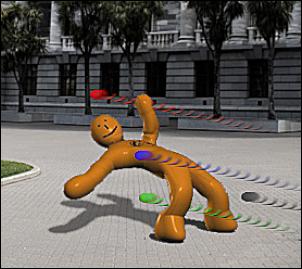
Lyndon Hood FTW

I am aware of no robust research on this topic in the NZ context (which isn’t to say that it doesn’t exist; although if it did I’d expect the many proponents of this line of argument to be citing it all day long.) So to kick off, let me concede that if there was a significant ideological bias to the polls it certainly could have an impact on voter behaviour. But I suspect any impact would be more complicated than the simple “low showing for a party causes low turnout and/or low support” reading of the “spiral of silence” model Chris cites (which is nevertheless a useful model). For one thing, it’s not clear that the impact is very strong in case of a secret ballot; also, the argument doesn’t take into account New Zealanders’ oft-cited peeriness about single-party majority governments in the wake of Muldoon, Lange and Bolger which could have a moderating effect, and it doesn’t take into consideration the usual “narrowing” that occurs in the latter stages of an election campaign as wavering voters begin to make up their minds. So I doubt the size of this effect on Labour’s polling at least; any shift should not be large, and certainly not sufficient to change the election outcome. However where NZ First is concerned it’s different — a percentage point or two makes all the difference in the world there, and whether NZ First returns to parliament or not rests on the collective spirit of Winston’s faithful. Assuming they still make up fiveish per cent of the voting population they must not waver, and must cast their votes together regardless of what they are told about the polls. If they fail to do so NZ First is out, and all those votes are wasted, and that is certainly an outcome that could result from widespread reporting of polls that show NZ First under the threshold (and one that could change the election outcome).

Note, however, that all that is contingent on those polls showing NZ First to be under the threshold actually being wrong. I’m not persuaded of this, and I’m also dubious about the contention that polls favour the right. As Bomber is fond of pointing out, the polls run in the leadup to the Auckland Supercity election favoured John Banks, while in the election Len Brown won handsomely. That’s important to remember, but it’s only one data point so I’m hesitant to draw meaningful conclusions from it, and if it’s evidence of anything, it’s against the simple reading of the “Spiral of Silence” thesis, according to which Brown’s demoralised supporters should have stayed home.

There is also some evidence out of the US to suggest that landline-only polls favour the Republican party over the Democrats (when compared to polling samples that include cellphones). It’s not clear is that this trend is also in effect in New Zealand. Based on no data, I think it has some influence, but our situation here differs in important ways; most notably, we have more than two parties so variance of this sort is more dilute and less zero-sum. And the likely effect would be ambivalent — if landline-only polls tend to exclude the young and the poor and tech-savvy urban liberals, they should overstate support for NZ First, not understate it.

The matter of bias isn’t readily testable because, as an Australian poll analyst put it recently when looking at bias between pollsters in that market, “we just don’t have elections every week to determine the true state of public opinion“.* There is also evidence to suggest that people’s voting behaviour differs in important ways from how they answer opinion polls. So we need to rely on other forms of measurement; proxies being measured against proxies. There are focus-groups, vox pop interviews and 75c text-polls and coffee-bean polls, and the Horizon poll with its radically different weighting system, but I see no firm grounds to believe any of these would be any more reliable than the major phone poll companies. One very strong point in favour of the usual sort of phone-based opinion polling is that it has remained more or less methodologically consistent for a very long time. This gives us extremely large, continuous datasets that we can plot against real-world events including policy releases, major speeches, current events and elections. In this regard they are much like audience/circulation ratings in the media. The utility of these well-established systems isn’t that they have no flaws — they certainly do, and much of the criticism is valid — it’s that they have a reasonably well-known set of flaws that are consistent over time, and we can use the historical record to make inferences about the present day (too few people, I think, are actually doing this, but that’s a different matter). By contrast other systems — Horizon, in particular — are less well-known, and serious questions need to be asked about the quality of their results. They’re worth watching, but they are not as yet a substitute for what we already have.

Returning to the argument. So if the polls systematically favour the right, and if they do so in such a way as doesn’t also favour NZ First’s older, wealthier and more conservative demographic, and if the extent of that bias is significant enough to have a significant zero-sum election night impact despite all the confounding variables of voter behaviour, then Chris might be right.

But that’s a lot of ifs, and a claim as bold as “polling companies and the media steal elections from the left” demands extremely robust evidence to be given credence. I’m open to the argument, but what we have here isn’t evidence, much less the robust kind; it’s supposition, and what’s more it’s supposition derived from partisan loyalty. The argument is unfalsifiable — if the election does deliver a substantial defeat to Labour and NZ First they will take that as proof-positive that they were right all along and the voters were robbed; if it doesn’t no doubt they will cheer those who battled valiantly and overcame the oppressive regime imposed by the forces of evil. In this regard the argument is nearly indistinguishable from that made in 2008 by the Free Speech Coalition who, despite their howls about Stalinist restrictions on political marketing, managed to help their political representatives to a handy win.

My view of Chris and Bomber’s general line of argument is that it’s more of the usual excuse-making and blame-shifting that I see from lefties who can’t bear that their tribe is staring down the barrel of a(nother) heavy defeat. It’s an attempt to make the evil media cabal responsible for poor performance, and to minimise the effect of weak leadership, institutional incompetence, lacklustre campaign and — in Peters’ case — public self-immolation during the last term. It’s a myth; something to keep the faithful warm at night, in the absence of actual victory. Myths certainly have a kernel of essential truth, but they should not be mistaken for evidence. Moreover, as regards Chris’ concerns about the election accurately reflecting voters’ wishes; these would have more credibility if his own history of respecting the solemn integrity of electoral politics was itself less one-eyed. He thunders:

hundreds-of-thousands of New Zealanders will not only be perfectly entitled to say “bugger the pollsters”, but they will also be entirely justified in asserting that the election has been stolen from them

This would ring less hollow if, following the 2005 election, he had not so cravenly excused the Labour party’s own admitted breach of electoral law as being “acceptable corruption” inasmuch as it served the greater ideological purpose of preventing National from being elected. Given that history, his complaints about polling and media conduct look like nothing more than an appeal to ideological tribalism with a bright red smear of electoral integrity lipstick on.

And yet, he has a strong point: if NZ First’s share of the party vote on November 26 comes in fractionally below the 5% threshold, democracy will have been poorly served in 2011, as it was in 2008. My personal views of that party aside, as a matter of natural justice anyone commanding a twentieth of the vote should be entitled to roughly a twentieth of the representation in Parliament. But however unsexy it might be, the solution to this isn’t injustice to attack the pollsters or the media. The argument isn’t supported by the evidence; even if it was nobody’s going to change on Chris and Bomber’s say-so, and we all saw what happened to the Clark government’s regulatory overreach. The pragmatic response here is to work towards reducing or removing the electoral threshold so as to ensure that natural justice is served and variance is less likely to simply exclude a party from representation, and to turn back to the process of returning political rigour to the political left by building competence, vision and leadership so it can succeed despite the obstacles before it. Less myth, more reality.

L

* Pollytics’ analysis plots polling companies against each other, measuring each pollster’s bias from the other polling companies. David Winter has had a go at doing something similar for the NZ context, though he has much less data to work with. While interesting, it’s important to reiterate that none of this addresses the concerns about poll accuracy vis-a-vis the electorate.)

Stop/Go

National’s initial Stop/Go TV ad is a pretty good one. Clean, to the point, not bogged down in detail but jampacked with symbolism:

Toby Manhire, writing on The Listener‘s excellent new website, has already done the analysis so I’ll quote him:

Red STOP Labour sign-guy looks a bit tense, uncomfortable, slouchily off-centre. His fist is closed, zip sloppily undone, and look at the state of those shoes.

He looks like he might just call in sick tomorrow because he feels like it, even though the country’s economy will suffer, while he just lies around, stuffing his face all day.

Green-blue GO National sign-guy looks comfortable but focused. Shoes are good. Sensible. He’s a little unshaven, but that’s because he’s a bit like the All Blacks, don’t you think? Like John Key is a bit like the All Blacks.

Check out the clouds, too. Fluffy, familiar things above Green-blue GO sign-guy; grey, foreboding, riskier bastards above that Red STOP man.

It can be no coincidence, what’s more, that the shadow GO Blue Green GO sign GO the All Blacks sign guy casts a shadow pointing where? The centre, people, the centre of the road.

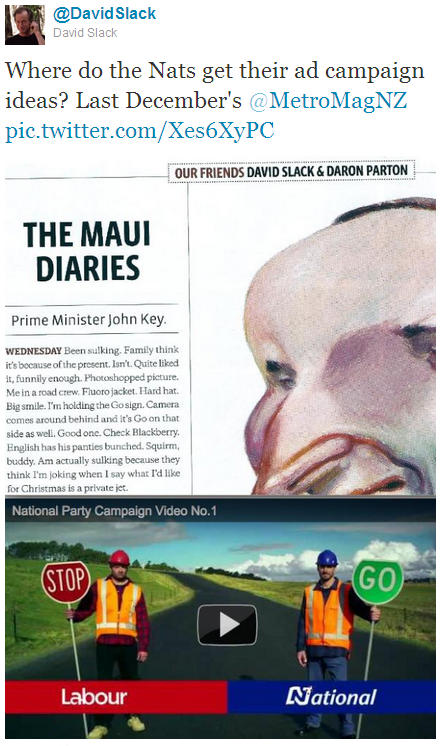
But hang on a moment. The symbolism of a lazy Labourite and a clean-cut Tory is laid on a bit thick — and the scruffy old Labour guy looks just a tiny bit “ethnic”, if you know what I mean. Moreover the whole Stop/Go metaphor is a bit trite — trite enough that it was the basis for a satirical diary piece by David Slack in December last year:

And If you think about how traffic control actually works, the metaphor has coherence problems. Last night, Anna Hodge tweeted the following observation, which in hindsight seems so obvious:

Also, does National understand road works? Or fairness? You need sign-holding dudes with both GO *and* STOP to keep traffic flowing.

Um, quite. For some to go, others must stop (at least until we get reef-fish-inspired traffic management systems.)

Anna’s tweet generated a bunch of responses as the narrative of the ad began to unravel. Mine was that if you’re at the front of the queue, only the GO sign matters; others were about the size of your SUV, the increase in inequality between north- and south-bound traffic flows, and the fact that Stop and Go signs are the same sign, just viewed from different angles.

Aaron Hicks remarked that the STOP sign at road works means that there’s actually work going on, a point you’d have thought might be clear to a government undertaking such an aggressive roading policy. And did the green of the go sign hint at a National alliance with the Greens? But they’ve spent the last decade and a half telling us that the Greens’ green means stop so green is basically red, and now their own green (not even a Blue-green!) means go?

The more you think about it, the more tangled and incoherent the narrative gets. And yet for all its flaws the ad works. It relies on people not thinking too hard about it — upon audiences swallowing whole the top-level symbolic material Toby described, making what Stuart Hall called a hegemonic reading of the text. In Hall’s model the second audience position is a ‘negotiated’ reading — such as Toby’s analysis itself, which recognises the hegemonic aspects of the discourse but doesn’t necessarily accept them, and the third position is ‘contrary’; consciously reading against the text’s hegemonic meaning — what Anna did, as did those of us who responded to her observation.

A lesson from this is that reading a tightly-encoded text counter-hegemonically is hard work. Audiences are not sponges or “sheeple”; they will often take a negotiated position, but in general such a position doesn’t prevent the text from having some impact. This illustrates a point of strategy that my regular readers must be bored tears with by now: you can’t rebut a text like this head-on with wonkish facts and figures. Dry details about Labour’s record and plans on economic progress wouldn’t make a blind bit of difference to the effectiveness of this particular ad, for two reasons: first because the hegemonic material doesn’t lodge in the head, it lodges in the guts (it’s truthiness, not truth); and second because such a rebuttal implicitly accepts the framing of the original text, and that framing is half the payload. But subverting the paradigm, man, that’s where the action is.

I’m not suggesting a comprehensive strategy to counter the National party campaign could be composed around a response to one 15-second ad, but if a counter-strategy was to be composed, that’s how you’d do it. Don’t berate people for accepting the hegemonic position, or for negotiating: find ways to make them see it in a different light.

L

A Modest Proposal, Poe’s Law and Libertarian views on welfare

I quote one of our friendly neighbourhood sociopaths from the gloriously-named SOLOPassion, in full:

NZ Politics: I Have a Cunning Plan – Tax Childbirth
I know! I’m suggesting a tax. Bear with me …
On TV3 Firstline this morning, after picking myself up from the floor when political reporter Patrick Gower dropped it so casually into his ‘reportage’ that the Green’s idea of Government setting up its own Kiwisaver scheme to distort the free market even further was a fabulous one, and he couldn’t understand why Labour and National hadn’t thought of it, it was then reported that pursuant to some overseas agency of or other that one in every four New Zealand children was living in poverty.
I don’t think it is then spurious to draw the logic line to the social welfare commentator Lindsay Mitchell statistic that 23% of all babies born over 2010 (for the State educated, that’s almost one in four) were in ‘homes’ reliant on a hard benefit to live by the end of the first year of life.
Mmmm.
That has set me to pondering. Rather than the Save the Children lady’s solution, when she was then interviewed, of spending yet more money on welfare, and creating yet new layers of bureaucracy, and working on the theory that you can’t fix the problems of welfare by more welfare, I think a radical rethink is necessary.
Hence my proposal to fix this problem in just one generation: rather than taking from all taxpayers as we do currently, and subsidising childbirth, which I pose has led to these two related statistics, I think we should be doing the reverse – taxing childbirth.
This would force parents to assess their financial ability to have children, and only start families when they could afford to. This will mean within one generation, we will have virtually wiped out the horrendous 23% statistic, and with it, child poverty, in the one blow. Further, the childbirth tax could be put toward the State functions that those children will be using: education and health.
There will be a hue and cry, obviously: babies for the rich only, Occupiers in maternity wards, all founded on the protest that governments should not decide such important lifestyle choices as who has babies and who doesn’t. The last of which I entirely agree with, whether it be via a subsidy or a tax, for therein lies my cunning plan ;)

This is a perfect example of Poe’s Law, which states:

Without a winking smiley or other blatant display of humor, it is impossible to create a parody of fundamentalism that someone won’t mistake for the real thing.

It’s a perfect example because literally the only thing about it that’s vaguely implausible is that it’s a Randroid proposing a tax.

Swift’s A Modest Proposal was far enough removed from the prevailing norms of his intellectual circle to be distinguishable from them. This isn’t. It’s in the uncanny valley of political discourse.

L

PS: Check the comments, if you think you can stomach them.

Mr Self Destruct

Labour seems to believe that it’s easier to seek forgiveness than permission. With the missing figures in the Press Debate, they’ve sought forgiveness for failing to perform on the night, with predictable effect, and yesterday on the wireless with Paul Henry, Labour’s finance spokesperson David Cunliffe remarked about Police minister Judith Collins that if she were the last woman on earth “the species would probably become extinct”. That’s a couple of pretty big steps beyond the usual (and also unjustified) fat jokes about Gerry Brownlee and others, and it’s the sort of behaviour we’d expect in Berlusconi’s Italy, from some of the viler denizens of the lunatic fringe, or perhaps from Paul Henry himself — but it is not conduct becoming a former minister and possible Prime Minister-in-waiting.

I anticipate we’ll see a cringing apology today or tomorrow once the media cycle gets hold of it, but it’s too late — the damage is already done. Some lefties will inevitably claim that having a bit of “mongrel” is crucial to win back “Waitakere Man” (more on this later), or will point to examples of comparable outrage on the other side, but again, it doesn’t matter: Labour is dead in the water if it holds itself to the standards of the rabid right, and this reeks of desperation more than it does of strategy. As Pablo wrote recently, negative campaigning isn’t always a losing strategy, but it has to be done right — and this isn’t. [Edit to add: this sort of behaviour also negates a tactical advantage of being able to criticise Key for his media engagements, such as with Tony Veitch.]

As Labour partisans take great delight in reminding me, I have no knowledge of the inside of Labour’s organisation, and all my Kremlinology about its dysfunction is based on near-obsessive observation of what public evidence is on display. With that caveat, let me advance a thesis: Goff is actually coping pretty well with the campaign so far, but Cunliffe is not. After all, Goff’s only major failure has been an inability to produce costings for the fiscal policy — Cunliffe’s portfolio. Goff, as leader, bears ultimate responsibility for not demanding a better performance from his finance spokesperson, but since Goff has enough on his plate as it is, producing those numbers was surely a responsibility delegated to Cunliffe and his people, and they did not do so. Whether we interpret Cunliffe’s outburst about Collins as (charitably) cracking under pressure or (less charitably) the mask of civility slipping, it looks like he’s feeling the heat more than Goff who is performing better than most people expected (and knows it).

Just a final word about Waitakere Man. Yesterday Stuff.co.nz ran a wee video package they called the bloke test in which journalists asked Key and Goff the same set of questions in order to measure their purported blokiness. This has been widely derided (mostly by the same people who think Labour is running good strategy) as an exercise in vapid idiocy, but that’s not so. Just as much as we have a right to demand political and institutional competence from our leaders, we have a right to judge them on their instinctive, bedrock responses; and this was a case where two leaders were asked a series of unpredictable personal questions and expected to answer them off-the-cuff.

While its utility in measuring “blokiness” is highly dubious, this exchange contained a lot of other information about how the leaders respond to pressure, to humour, their attitudes towards social transgression and their place in society and a sense of who they “really” are. In a representative democracy where voters can be expected to have neither the time nor the expertise to become proficient in every policy field that impacts them, they rely on other indicators to determine who is more likely to make appropriate decisions in their stead. I’ll leave the interpretation of who “won” the Waitakere Man test as political rorschach, but suffice it to say that anyone who thinks this sort of thing is irrelevant trivia needs remedial classes in voter behaviour.

L

By their works ye shall know them

We are presently being treated to the rather undignified and unedifying spectacle of the political right — particularly the authoritarians and liberthoritarians — crying foul because people are drawing cautious, well-documented linkages between their own rantings and those of the Norwegian killer Anders Behring Breivik. We had a dry-run of this following the Tucson massacre. Russell Brown has NZ’s most thorough treatment of this argument, and Peter Cresswell has NZ’s most succinct whine about it, with links to more examples.

One such piece bears particular mention: by Merv Bendle, it was published in Quadrant, and questioned whether Breivik’s attacks were “a covert, ‘false-flag’ operation, carried out to give just this impression that it was conducted by anti-Muslim, right-wing extremists, but actually conceived and directed by other forces?” Quadrant is edited by Keith Windschuttle, whose statements at a seminar given in New Zealand in 2006 (and chaired by Matthew Hooton) were quoted by Breivik in way that Windschuttle states is “not inaccurate or misleading. I made every one of these statements and I still stand by them.” The argument is essentially that “civilisation” is under threat from “the perverse anti-Westernism of the cultural elite”. There are many, many more such cases in overseas forums and I trust readers will have no difficulty finding them.

But Pascal’s Bookie, in comments at the Dim-Post, has found the nub:

They either need to disown the claim of existential threat, or explain why an existential threat does not justify violence.

This is exactly it. The right-wing commonplace that “Western civilisation is under threat” is at the heart of all the rhetoric being compared to Breivik’s nominal casus belli, and in many cases the similarities are more than merely cosmetic. This general line of argument has been popularised in its modern form by Samuel Huntington, but is much older in its essence (and I must note that Huntington’s theory is considerably more robust than the arguments I’m talking about here.) The problem for the wingnuts presently whining about these comparisons is that their bluff has been called. They’ve been squawking about the existential threat posed by “others”, much as Breivik has, but he has gone one better and actually done something about it. And so they must pick a side: either “Muslims” (or “Māori”, “socialists”, “teacher unions” or the “cultural elite” or whoever “Western civilisation” is at war with this week) actually are the existential threat the wingnuts claim they are, or they are not. If the former case is true, by their own logic the wingnuts would not only be justified in taking up arms in defence of their civilisation, they would be practically required to do so, as Breivik did. If the existential threat is real, they must hail Breivik as a hero. If they don’t, we can assume there is no existential threat, and that they’ve merely been spouting melodramatic masturbatory fantasy this whole time.

By their works ye shall know them. If there really is an existential threat, as they claim, then surely we can expect the rallying cry “wingnuts of the world, unite!” to go up from the towers where they reside, and their legions pour forth with tacticool assault rifles, iPods full of Wagner and Muse and Mario Lanza, and neoprene bodysuits with faux unit patches on them. And if they do not, then surely by their own admission, there is no threat, and there never was.

I know which I’m picking.

L

Update: ‘Nemesis’ at Crusader Rabbit has answered the clarion call to action with …. yet more words. But they are fighting words:

Continue reading “By their works ye shall know them”