A Culture of Impunity?

During the dark years of dictatorship in South America in the 1970s and 1980s, there emerged a phrase to capture the attitude of the elites who benefitted from such rule: the culture of impunity. It referred not only to the attitude of the uniformed tyrants who ran the regimes, but more to that of the civilian elites who gave them social and economic support, and who benefitted lavishly thanks to the repression and restrictive laws on basic rights of association, dissent and movement. These civilian elites literally lived above the law, since they could, if not be directly protected by the regime’s thugs, be immune from prosecution or liability for crimes and other transgressions they committed simply because of who they were. Murders, rapes, abuse of servants, violent attacks on members of the public–all of these type of behavior were excused, ignored or bought off rather than be held legally accountable (I do not mention justice simply because it is impossible to have real justice under dictatorial conditions). Although there was variation in the attitude of some elites and cross-country differences appeared as well, the bottom line is that during the authoritarian period in South America a culture of impunity developed that was one of the salient social characteristics of the regimes in question.

With that in mind I ask readers if such a culture of impunity exists in NZ. I ask because it strikes me that although diluted and less repressive in genesis, there appears to be an attitude of impunity in the political and economic elite. They can buy silence and name suppression when they misbehave; with a wink and a nod they accommodate employment for their friends and provide sinecures for each other (think of various Boards); they consider themselves better informed, in the know, more worldly and therefore unaccountable to the popular masses when it comes to making policy (think of the use of parliamentary urgency to ram through contentious legislation and the NZDF command lies about what the SAS is actually doing in Afghanistan); they award themselves extraordinary powers in some  times of crisis (Christchurch) while absolving themselves of  responsibility in others (Rena). They use the Police for their own purposes (Teapot Tapes and Occupy evictions, the latter happening not because of public consensus but done by summary executive fiat). More generally, think of the lack of transparency in how government decisions are made and the duplicity of elite statements about economic issues (say, the price of wage goods) and political matters (e.g., recent internal security legislation). Coupled with equally opaque decision-making in NZ’s largest publicly-traded firms, or the cozy overlap between sectors of the judiciary and other elites, the list of traded favors and protections is long.

None of this would matter if NZ was run by Commodore Bainimarama. It would just be another Pacific island state ruled by a despot and his pals. But as a liberal parliamentary democracy NZ regularly scores highly on Freedom House and Transparency International indexes, to the point that it is often mentioned at the least corrupt country on earth (which is laughable on the face of things and which raises questions about the methodologies involved in such surveys). To be sure, in NZ traffic cops do not take cash bribes and judges do not have prostitutes procured for them by QCs representing defendants, but corruption does not have to be blatant and vulgar to be pervasive. And in the measure that elite sophistication in accommodating fellow elites outside of the universal standards applicable to everyone else is accepted as routine and commonplace, then a culture of impunity exists as well.

My experience in NZ academia, two respectable volunteer organizations and in dealing with national and local government officials suggests to me that such a culture of impunity does exist. It may not be that of Pinochet, Videla, Stroessner, Banzer or Geisel, but it seems pervasive. It appears to have gotten worse since I arrived in 1997, which may or may not be the fault of market-driven social logics and the “greed is good” mentality that has captured the imaginations of financiers, developers and other business  magnates (or it could just be a product of a long-established tradition of bullying, which has now spilled over into elite attitudes towards the country as a whole).

Mind you, this does not make NZ a bad place. It simply means that there is an encroaching, subversive authoritarian sub-culture at play amongst the NZ political and economic elite that undermines the purported egalitarianism and equality on which the country is ostensibly founded (I am sure there are sectors of Maoridom who will take reasoned exception to that claim). And if so, has the corrosive culture seeped into the body politic at large so that almost anyone is a relative position of power vis a vis others thinks that s/he can get away with behavior otherwise contrary to normal standards of decency and responsibility?

Does NZ has a culture of impunity?


Alienation, False Consciousness, Passive Revolution and Reformism.

Throughout the globalised system of capitalist production, grassroots discontent with the economic and political status quo has produced a number of national counter-hegemonic mass mobilizations. All are born of alienation, but their social origins, goals, modalities and outcomes differ.

Alienation is a product of environment, natural and human. Even if conforming in the main to universal standards of conduct, individual (and later collective) social subjects become emotionally detached from the realities of everyday existence.  The causes are many–disaffection with a job or lack of employment prospects, racial difference, inter-personal difficulties, environmentally-caused psychological disorders, etc. This promotes a social outlook that grows increasingly hostile in the measure that adverse life conditions are interpreted to be the result of circumstances created or exacerbated by the socio-economic and political elite. That leads to various types of “anti-social” behaviour, individual and collective, which constitute expressions of the resentment that alienation breeds. Some of this behaviour is little more than petty acts of rebellion. Others pose a more serious threat. Individual and small-group alienation can often be treated as a psychological and criminal problem. Mass alienation resulting in grassroots mobilization is another thing because it involves horizontal solidarity and networking between self-perceived disenfranchised groups rallying in opposition to a common (elite) enemy. However, this does not mean that there is ideological coherence in the oppositional claims of the alienated.

The reason is simple. One product of alienation is false consciousness. False consciousness is a condition where the individual and collective social subject thinks about the causes of alienation in ways that run contrary to material self-interest under the assumption that the reasons for deteriorating or negative life circumstances are rooted in cultural or ideological factors rather than structural realities. Rather than confront the macroeconomic presumptions and biases inherent in a market-driven system of private (and increasingly corporate) ownership, consumption and exchange, false consciousness focuses on behavioral differences rooted in primordial beliefs, identities, ideological differences or contrary collective action.

Under conditions of collective false consciousness there is often a yearning for a return to tradition or a retrenchment of in-group identification along national, ethnic, religious or racial lines, sometimes with overtly nostalgic class content. This mainly occurs with descendent class fractions (for example, the industrial working class in the US) whose position in the social division of labour has been eroded by structural changes wrought by the globalization project. Confronted by this slippage in class status, descendent class fractions such as the white Christian middle classes in a host of liberal democracies blame their condition of so-called “others:” immigrants, religious minorities, non-traditional or opposition ideological movements, etc. In an effort to reclaim their past status, declining social groups are willing to condone anti-establishment, non-institutionalised forms of political competition because for them the threat is existential. When these forms of collective action take on a restorative or revanchist tone, they are considered to be passive revolutions.*

Passive revolutions are not genuine social revolutions. Although they can be violent, they do not destroy and transform the socio-economic and political parameters of society. Instead, they seek to use non-institutional means to reclaim a previous status quo in which they prospered. Because contemporary and future structural conditions preclude a return to a previous form of production and its attendant social division of labour, these groups are prone to extremism in the measure that they are denied their self-perceived just rewards. The starkest examples of passive revolutionary movements were European fascism and Latin American national populism. Although each had a different socio-economic core (Southern European fascism was a mixture of working class and small property owners’ movements, whereas Northern European fascism was urban middle class based, with national populism being a combination of urban working class and peasant movements depending on the specific country in which it manifested itself), they all had the commonality of being a reaction against something rather than a source of substantive forward-looking change to the basic parameters of society.

Not that all progressive counter-hegemonic grassroots movements are necessarily revolutionary. Many progressives seek to improve upon rather than transform the status quo. They do not seek to question its basic foundations but to make it more humane (hence the refrain “people before profits”). Coupled with an aversion to violence on the part of most progressive groups in liberal democratic societies, this leads to counter-hegemonic strategies that are not wars of position or of maneuver. Instead, they are collectively reformist rather than revolutionary in nature.

Given the above, from an elite perspective counter-hegemonic grassroots mobilization is best handled via state reformism and reform mongering. State reformism is the adoption of a conciliatory and concession-based policy approach by which elites give up certain prerogatives and agree to modify certain institutional frameworks in order to allow for more popular voice and benefit. Although the distribution of benefits between dominant and subordinate groups may be altered by such arrangements, overall control of material conditions, ideological context and political office remain in the hands of the elite. Reform mongering is the piecemeal allocation of concessions to social groups based upon the persistence of their demands and their strategic importance in the social division of labor (which can also be part of a divide-and-conquer strategy). Things such as civil rights and labor legislation represent examples of reform mongering in capitalist regimes, with broader programs such as the US New Deal and Great Society are examples of reformism at work.

This brings up the issue of the Tea Party and Occupy Wall Street movements in the US, the England riots and the mass mobilizations that have occurred in France, Greece and Spain among other places. While some of the mobilizations have been progressive, there has been plenty of passive revolutionary sentiment embodied in them as well. The Tea Party movement is a glaring example of the phenomena, but the rise of right-wing nationalism throughout Europe is also emblematic in that regard. Even the ethereal “Waitakere Man” has, if only latently, as much passive revolutionary as it does reformist traits, with very little progressive revolutionary consciousness evident in the collective “him.”

The dominant ideological tendency towards reactionary or reformist rather than revolutionary perspectives poses problems for progressives because the three ideological strands that are the most difficult to overcome in any parametric struggle are cultural tradition, nationalism and religion. When these are combined in a reactionary groundswell against the usurping “others,” they make for a formidable obstacle to substantive change, especially when elites tacitly support their emergence as a hedge against mass collective action that is focused on structural transformation.

The so-called Arab Spring is a variant on the theme. Although some believe the uprisings to be revolutionary, they are in fact reformist at best and passive revolutionary at worst. There is no doubt that post-Gaddafi Libya will remain capitalist, sectarian and tribal, albeit under different (most likely authoritarian) leadership. Mutatis mutandis, the same holds true for Syria, Tunisia, Yemen and other Arab states, to say nothing of Iran should popular discontent magnify to the point of unstoppable mass uprising. Revolts are not revolutions because of their reformist and passive revolutionary character.

The lesson in all of this is to recognize that alienation may be at the root of the thirst for socio-economic and political change, but false consciousness often intrudes on perceptions of the proper “solution set” to the point that the passive revolutionary option remains as viable if not more so than reformist alternatives, with the chances of genuine social revolution lessened to the extent that false consciousness, be it spontaneous or manicured, prevails in society.

In sum: passive revolutionary sentiment in the body politic in modern capitalist society constitutes the biggest obstacle to progressive change. With corporate elites dominating the media discourse and actively encouraging such beliefs, the task of the grassroots mobilizer becomes all the more difficult because the first step required is to promote an ideological conversion amongst non-believers who are indoctrinated to believe that the status quo is worth defending, even if in modified form.

Couple that with the limited revolutionary consciousness of the organized labour movement in most advanced capitalist democracies, the reformist nature of the likes of the Occupy Wall Street movement and the apathy and narcissism that is another manifestation of alienation, this augers poorly for the prospects of parametric grassroots change in the near future.

* Left for another time is discussion of ascendant class fractions in the contemporary capitalist context, not all of who (such as finance elites) embody the spirit of progressive change.


Rioting Poms.

A short while ago we were treated to the spectacle of a Royal Westminster wedding, a royal tour of Canada and the US, then another lesser royal wedding. The UK and colonial media went crazy with 24/7 coverage of the fairy tale personae involved, and the image conveyed was of stability and continuity in British foundational politics.  All was well in the Realm.

In the months since the first royal celebration things have grown dimmer. There is the hacking scandal in which politicians and the police appear to be complicit in the illegal tapping of private information by media corporations (primarily but not exclusively Murdoch-owned assets). Added to this sign of elite criminal coziness, now there is a police shooting followed by wildcat riots that represent criminal opportunism rather than outrage about the death itself. The UK media are swamped with reporters, police spokespersons and politicians all chanting in unison about the “mindless thuggery” and criminality of the youth who are widening the scope of violence beyond Tottenham and London itself.

The official emphasis on criminality cannot hide a number of things that depict a reality that s a far cry from royal bliss. The youth involved, while criminally opportunistic in their looting and vandalism, are a mix of ethnicities, but all seeming of working class or unemployed status (On TV I actually saw some young Hassidic Jews amongst the rioters in Tottenham). Some may have participated in earlier demonstrations and rioting about restrictions on access to higher education and the cost of basic services. They appear to be coordinated–in yet another tweeter and smart phone fashion–enough to stay a step ahead of the thinly stretched British Police. The fire service is not attending to full alarm fires because of fears for their security and the Police cannot predict when the next smash, burn and grab will happen. The mob is ahead of the Man, and the mob is angry.

So far the British government has declined to send in the army even though suggestions have been made that they have very robust anti-riot capabilities in Northern Ireland. The language used to justify that non-action is precious: the government states that it does not deploy such hard assets on British soil. So the riot police in London chase rioters using shields, helmets, horses and batons while the British Army uses armoured personnel carriers, water cannon trucks and live ammunition to keep the peace in Belfast and beyond. Some Imperial habits are hard to break, even though the Empire is long gone and its post-colonial consequences have come home to roost in the capital itself.

The hard fact is that the criminality of the rioters is a political act whether or not those involved or the government and corporate media would like to admit it. At a time when the PM, Police Commissioner, Mayor of London, and assorted other leading officials were on vacation in places like Ibiza, Tuscany and Milos, the youth now on riotous display swelter in the housing estates where unemployment, racial separatism, ethnic conflict and everyday economic insecurity are rife. Like their counterparts in any number of less developed countries, they can see up close the material lifestyles and commodity consumption of the royals, celebrities, sportsmen and corporate elites, but do not have (and likely will never have) the means of access to them. Worse yet, they live in a world where the institutional framework is stacked against them, leading to the violent turn inwards when the opportunity presents itself. The Police response is to ask parents to lock up their children.

Be it Marx, Luxemburg, Lenin, Guevara, Marighella, Ayman al-Zawahari, or Muqtada al-Sadr, revolutionaries understand the potential of the criminal mass engaged in collective violence. Lumpenproletarians are the street vanguard who, however unconsciously, help to bring social contradictions to a head and expose the weakness of the elite response and the inherent fragility (sclerosis?) of the status quo as a whole. Where instigated or abetted by politically conscious cadres (and there is some evidence of this at play here), their actions are designed to accelerate the organic crisis of the State, in which economic, social and political cleavages overlap and congeal into compound fractures not resolvable by force, reform-mongering or after-the-fact piecemeal pacification. Given the ongoing repercussions of the 2008 recession and the increasingly global debt crisis, and no matter how they are disguised by ethnic and religious division, the structural foundations for a larger class war in the UK may be fixing in place.

This does not mean that the British government will not be able to quell the disturbances this time around. But what these riots may be is a dress rehearsal for more to come, perhaps in conjunction with the Olympics next year, where militant planners accelerate the pace, focus and intensity of mass collective violence at a time when the British elite are exposed to global scrutiny and their security resources are already working at full capacity. That raises the issue of whether the official approach to rioters will shift to the more lethal Northern Irish “solution” set, and whether those charged with adopting a more lethal approach will have the ideological conviction to respond in such a way to the actions of fellow citizens rather than foreigners (I note that it will be possible for the official narrative  to scapegoat “outsiders” drawn from minority ethnic communities that hold non-Western beliefs, but even that may fail to overcome foot soldier or beat police reluctance to turn their weapons on their own).

In any event, we should see the riots for what they really are: an expression of mass subordinate discontent and disaffection, the product of profound alienation, expressed through collective criminal violence operating in seemingly opportunistic and decentralised fashion in the face of official incompetence or lack of will. That, by most reasoning, is a good sign of a pre-revolutionary situation, one that has the potential to become more of an existential threat to the status quo should tactical guidance and coherent ideological justification be given to it. After all, if what we are experiencing is a crisis of capitalism in the liberal democratic world, then it was only a matter of time before superstructural conditions and precipitating events would combine into a violent rejection of the system as given in countries in which the societal contradictions were most apparent. Be it in Greece, in France, in Spain or now in the UK, should these contradictions continue to fester and combine, it will not be Tea Party-type clones that will lead the insurrectionary charge, nor will they be as polite.


PS: Before Red Dave and other ideologically militant readers opine that I am belatedly joining their ranks, let me state that I do not see this as the beginning of a global revolution or necessarily of one in the UK. It is a pre-revolutionary moment, which means that the UK government still has the ability to engage in divide-and-conquer, selective application of force and reform-mongering tactics (along the lines I mentioned with regard to the Arab uprisings in an earlier  post dedicated to them). There is a fair bit of ground to cover before the Arab Spring gives way to a Red European summer.

Ten strategic communication lessons from the Alasdair Thompson fiasco

Today has been a remarkable day. Rarely do we see such an epic failure of communication as we have seen from Alasdair Thompson. Because these events have played out mostly in public, they also present an unusually transparent example.

What follows is ten specific strategic communication lessons which are clearly evident from these events. My analysis isn’t political — I have political and ideological views on this matter, and I intend to write these up after some reflection, but the purpose here is to look at things dispassionately and pragmatically and consider what was done wrong, and what might have been done differently. They are framed quite generically and can be pretty widely applied. This is a long post, so I’ve hidden most of it below the fold.

Everything here is presented on an “in my opinion, for what it’s worth” basis, and should under no circumstances be interpreted as reflecting the views of my employer, or anyone other than me personally.

Continue reading “Ten strategic communication lessons from the Alasdair Thompson fiasco”

Enough rope

On Mike Hosking’s Newstalk ZB show this morning, a discussion of the gender pay gap and Catherine Delahunty’s bill on the topic — and an object lesson in not believing your own hype:

Alasdair Thompson [Employers & Manufacturers’ Association CEO]: “Let me get down to tin tacks here. It is unfortunate, if you like, that men and women are different –“
Helen Kelly [Council of Trade Unions President]: [incredulous laughter]
AT: “– they are. The fact is, women have babies, they take time out of their careers to have babies. Women have — look, I don’t like saying this, this is how contentious this is, but here’s a fact of life. If you really want to keep some statistics, look at who takes the most sick leave. Why do they take the most sick leave? Women do in general. Why? Because, ah, you know, once a month they have sick problems. Not all women, but some do. They have children that they have to take time off to go home and take leave of. Therefore their productivity — not their fault, it’s … it may be because they haven’t got it sorted out with their partners, where the partners take more responsibility for what happens outside work. There are all of these issues, and none of this is covered in these statistics that this bill wants to sort out. Now, I’m sorry, I don’t like saying these things because it sounds like I’m sexist, but it’s a fact of life.”
HK: “Sure does, Alasdair, I’m glad you said them, it’s fantastic. I let you go on that one.”

(Audio)

Helen Kelly played Alasdair Thompson like a harp here. For a start, his argument is bogus — as Kelly says, the figures don’t back it up in the general case, and where they do back it up there’s a host of confounding variables. (For just one of many possible objections, since women already earn less than men for the same work, there’s an advantage at the margin where they retain the primary childcare responsibility, all else being equal. On the basis of this Thompson says they should be further penalised.)

But quite apart from the standard of the argument, Thompson ended up defending the indefensible in indefensible terms. It’s one thing to defend the indefensible in terms that seem reasonable, quite another to do so in terms that are repugnant. Rather than arguing the difference of interpretation and retaining the dignity of a Captain of Industry, a benevolent leader of men (and women) who cares about their wellbeing, he slipped into the worst sort of boss-man-splaining. This might work just fine in boardrooms where the interests of those present are aligned, but it’s not much good in the public sphere. He clearly realised this, but only once he had committed to it: his delivery was garbled and disjointed, clearly ad-hoc, and so heavily caveated that it’s hard to take any of it seriously.

But that’s what we must do. This guy is an experienced representative of New Zealand’s employers, speaking in his official capacity on a topic for which he had (or ought to have) prepared, in a mainstream media outlet. We are entitled to take him at his word, and we should thank him for telling us what he really thinks. And we should thank Helen Kelly for giving him such a plum opportunity to do so.

Update: Not one to do things by halves, Thompson has doubled — or, tripled down, with a press release arguing that women are paid less because they’re just not worth as much, and statements to the Herald blaming “socialists”, “Labour” and “unions” and claiming 90% support for his position. That number has now mysteriously vanished from the Herald’s story, and comments by readers of the National Business Review — Thompson’s natural constituency — are running 80-20 against him at the time of writing this update.

You could say he’s quadrupled down, even, since he’s now taken to twitter, responding to criticism and barbed quips with cut & pasted lines from his press release. A more epic fail is hard to envisage.

L

Does small always have to mean provincial?

Here is a question for readers. Just because NZ is small does that mean it has to be provincial? Having returned–and happily so–to NZ after a 3+ year absence, I am struck as to how insular public debates tend to be. Leave aside the grating RWC ads and hype. Although it makes much ado about a second tier sporting event, it is being hosted here and there is money to be made as well as sporting prestige on the line. So the hoopla could happen anywhere. I also understand the focus on Christchurch given the earthquakes, but am struck by how most attention is on the human dramas and not on the policy response and consequences of the disasters (which seem to this uninformed eye to be slow and not considerate of long-term implications). More broadly, be it in the tone of political debate, the focus of popular culture, or the economic preoccupations of the moment, it all seem a bit inbred to me. Am I just being precious or unduly judgmental?

I ask because I came back from Singapore, which is small but is incredibly cosmopolitan because of its strategic location and thriving expat culture (native Singaporeans are quite insular as well but have been forced to cope with the influx of more worldly people as part of their national transformation project). Switzerland, San Marino, Andorra, Monaco, Ireland and Malta are small but their location in Europe makes them acutely sensitive to and knowledgeable of their larger neighbour’s actions and interests. The same can be said for Uruguay, surrounded by larger States, or Central American republics, dwarfed by Mexico and the US. This is not to say that the masses as a whole in these countries are always on top of international affairs or erudite in their discussions of global trends, but that they seem to have a better appreciation of the world around them than what is evident in NZ. That seems counter-intuitive.

I say so because the tyranny of distance should have been overcome by advances in telecommunications and transportation, NZ is increasingly a nation of immigrants, including many from non-traditional source countries, its commercial ties are more varied and distant than in earlier generations, its has high standards of literacy and access to news sources, it has a good percentage of citizens returning from OE’s and its diplomatic connections reflect all of these trends. So why is it that, if I am correct, NZ remains rooted in a seemingly mythical short-and-gumboots, rugby-fixated mentality unconcerned about the larger world in which it is inserted? After all, unlike like large states that can “afford” to be ignorant of world affairs because of their economic weight and territorial size (e.g., the US), Kiwis are constantly told that their well-being is directly linked to NZ’s position in the international community. If that is true I would expect that average Kiwis would take an interest in global issues and ask questions of national elites about them.

Why, for example, has the NZ government made no public pronouncements on Syria (and muted comments about Libya) given its purported commitment to human rights? Why has issues like human trafficking, child labour and environmental degradation not entered into the debate about undertaking trade agreements with Asian despotic states? Why have tensions between Fiji and Tonga only been awarded two days of media attention, especially given the role of other powers behind the scenes and NZ’s connections to both countries? Why is there no debate about the NZDF role in Afghanistan given the beginning of the US military withdrawal in July? Why is it assumed that “privatisation” and public expenditure reductions are sacrosanct when in many faster developing parts of the world that are also commodity export-dependent (Latin America, SE Asia) such market-driven zealotry has been abandoned in favour of more judicious public management schemes that see public welfare and employment as requisite part of the social contract (and long-term stability)? Why is draconian anti-terrorist legislation and expansion of domestic intelligence powers passed when NZ security elites admit that the threat of a terrorist event is extremely low and that domestic threats are more likely to be criminal than political in nature (with some of that criminality being a direct result of NZ’s permissive attitude towards trade conditions and regulatory requirements on foreign investment and corporate accountability). Why are national leaders allowed to dismiss those who raise such concerns as extremists or unhinged?

In fact, what the heck happened to policy debates in general? Why is it that when not rugby the entire country seems to be fixated on human dramas and political sleaze rather than the pressing issues that impact they very way society is organised?

I realise that NZ may not be alone in this syndrome, should it in fact be real. It just strikes me as incongruous that a country with such an abundance of human capital should be so inward-focused, especially if it’s material, social and political status is directly connected to, and dependent upon, its ties to the outside world. Provincialism may serve the interests of elites who can govern and do business without considered scrutiny so long as a few popular sops are thrown the public’s way, but it seems to me to be an unfortunate comment on national consciousness if indeed it is a reality rather than a figment of my imagination.

The Disaster Roulette.

2011 is shaping up to be a most unhappy year. The seemingly endless parade of human misery caused by the three C’s–calamity, catastrophe and chaos– got me to thinking about which is “worse:” human-caused or natural disasters?

The answer lies in the response. In natural disasters the majority of people band together to work together for the common purpose of overcoming individual and collective hardship and tragedy in pursuit of the common goal of re-establishing normality to the lives. The solidarity exhibited during such times is born of the realisation that nature is a force that cannot be controlled and that no blame can be attributed to it or anything else. It just is, and we live at its mercy. If societies are to thrive, the only response to natural disasters has to be social union and commonality of purpose.

Human disasters, on the other hand, tend to bring out the worst in people. In fact, they are often the product of and the motivation for human cruelty, opportunism and greed. Unlike natural disasters, which are indiscriminate in application, human disasters are discriminate and often deliberate (because even negligence affects some more than others given socio-economic, political and cultural demographics). War and genocide are extreme expressions of human disaster, but the reach of malfeasance is vast and wide. Think of the looting that followed the Iraq occupation or pro-democracy protests in Cairo. Or the cynical use of false information supplied to ISAF forces to settle personal vendettas in Afghanistan. Or the wave of drug-related murders in Mexico (over 35,000 in the last five years) that rides on the back of poverty, ignorance and an unwillingness by consuming societies to recognise the demand aspect of the equation. The same willful blindness and self-serving logics applies to human sex trafficking in SE Asia, which leaves a terrible toll of human and social costs in its wake but which is allowed, even encouraged, by states simply because it channels sexual predation to foreign localised areas (such as Thailand, which is the recipient of well-advertised sex tours from countries such as Japan and Germany). Then there are the corporate disasters ranging from the tobacco industry’s lying about the effects of smoking to lax safety regulations at chemical plants in places like Bophal to the manipulation of financial derivatives by bankers that produced the global financial crisis of 2008-present and which exacted a terrible toll in lost jobs, lost homes and, in some countries, lost public benefits imposed by austerity measures prescribed by the very people who caused the crisis in the first place.

If my view is correct then the answer is clear: human disasters are “worse” than natural disasters.

But there is another scenario that brings the worst of both together: where human folly has magnified the impact of a negative natural event. That may be the case in Japan. If it turns out that concerns about nuclear safety standards were ignored or covered up by power company operators in the years before this year’s earthquake and tsunami, and/or that they are currently downplaying the gravity of the situation in an effort to save face, then the current nuclear crisis is a human add-on to what otherwise is a terrible but surmountable natural disaster. The same is true if it turns out that the supposedly “earthquake-proof” buildings in countries with known fault lines have not been built to code due to corruption or cost-cutting (this is especially true for states located with the Ring of Fire earthquake zone and Central Asia where such standards, if they exist, are haphazardly enforced). I use these two examples because they are in the news at present, but the list of instances where human failures worsened the negative impact of a natural event is long. As for the bible-bashers who place blame on victimised societies because of their supposed failures to adhere to God’s teachings: the less said the better, but they too add unnecessary suffering to those already in distress.

In sum, it seems to me that natural disasters are tragedies for which humanity is socially hard-wried to cope. Human disasters are worse because they promote self-centred advantage-taking, meanness and division rather than solidarity and unity. Human and natural disasters combined are the most calamitous of all because the presence of the former compounds and exacerbates the problem while making more difficult a common response to the latter.

All of which is to say, if I have to spin the disaster wheel given where I live, I bet on natural causes and prepare accordingly (easier to do in NZ than in SG, which is another reason to return home). However, should I ever again live in a conflict zone or where corporate and/or political corruption abounds (and that could well be most of the world), then I will hedge my bets with a human disaster contingency plan as well.

Political rights and economic rights.

Recent discussions have reminded me of the relationship between economic and political rights, and the varying interpretations of it. For orthodox Marxists economic rights supersede political rights for two reasons: 1) without an equitable material distribution of resources political rights mean nothing; and 2) with an equitable material distribution of resources there is no need for political rights.  In this view “politics” is either a status quo instrument of domination that conforms the masses to the requirements of production in a system dominated by private interests, or is a means of revolutionary challenge to that status quo. In neither case is it an end of itself. Subsequent Leninist, Stalinist and Maoist interpretations all concur with this view.

Socialists see economic rights as taking precedence over but not superseding political rights. Here the view is that economic rights are more important than political rights but the latter are needed to ensure the just distribution of material resources in a society. Even if imposed by dictatorial fiat, the maintenance of economic rights requires popular participation in the decision-making process surrounding the collective allocation of resources. That is a matter of political rights.

Social democrats see political rights preceeding economic rights. Here the priority is on gaining political rights first in order to subsequently secure economic rights to the material benefits of production. Since they see political rights as a universal good, they recognise the rights of non-socialists in the political arena, which means operating from a position of structurally-conditioned disadvantage within capitalist societies. The emphasis thus shifts from control of production to redistrubution of surpluses (via taxation and state involvement in the social relations of production, mostly).

The Right has its own interpretations of the relationship. Libertarians place the emphasis on political rights (e.g. the right to do as they please so long as it harms no other) and, in the most extreme version, do not believe in economic “rights.”  Beyond that, the Right gets a bit fuzzy. Some free-marketeers assume the precedence of economic rights over political rights, so long as the rights conferred are market-driven in  nature (i.e., the “right” to make a buck without government interference). Other conservatives see political rights trumping economic rights (e.g. “no taxation without representation” or the right to mandate morality on a collective scale). The Right notion of economic rights differs from the Left notion, as it is not about material redistribution but about unfettered access to and freedom within an economic system controlled by private interests. Likewise, the Right view of political rights is more about freedom of choice and expression rather than about vehicles of collective redress and representation.

Showing my colours, I subscribe to the view that political rights are required for economic rights to obtain. The formation of unions, the extension of suffrage, the recognition of indigenous claims, the redress of past injustices, the acceptance of  universal “human” rights and the very ability to speak truth to power and challenge the status quo or elements of it all hinge on the prior granting of legal authority, or at least recognition, to do so. That is a political act, and legal recognition is the certification of political rights. That makes the move to secure political rights the precondition for the eventual recognition of other rights, to include those of an economic nature.

This is the hidden factor in transitions from authoritarian rule. The transition is most fundamentally marked by the extension of political rights to previously excluded groups, who in turn use the opportunity to agitate for previously unobtainable economic rights. The more the extension of political rights is achieved by force and economic rights redefined as a result, the more revolutionary the character of the regime change. The more negotiated the extension of political and economic rights, the more reformist the change will be.

This is just a broad sketch and not meant to be a definitive pronouncement. Readers are welcome to add their own intepretations as they see fit (within the bounds of civility, of course).

Underclass Redux


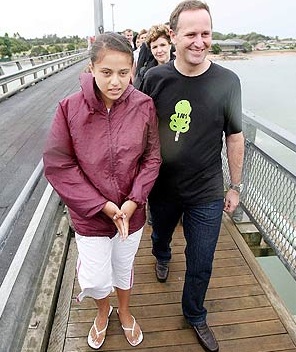
Campbell Live tonight returned to McGehan Close (see the report, by Tony Field, here). This street in Mt Albert — on the boundary of Helen Clark’s and Phil Goff’s electorates — was visited by then-opposition leader John Key before Waitangi weekend 2007 for a particularly cynical stunt. This was Key’s first big symbolic play as leader of the opposition, and it was a hum-dinger. He had already singled out the residents of this street in that year’s State of the Nation address at a whitebread rugby club in faraway Christchurch, branding them archetypal members of the New Zealand ‘underclass’, and the visit saw him glad-handing and patronising a bunch of poor brown people who’d already been used as shot in the National party propaganda cannons.

The purpose of the speech, and visit, was to install one of the core planks of the National party narrative about the Clark government — that it was at best unconcerned with the plight of said underclass; and at worst, actively cultivated such a demographic, which would be permanently dependent on Labour’s welfare policies and would therefore be a permanent source of electoral support for the Labour party. (So the ‘bribing the bludgers to breed’ theme goes, rarely uttered by anyone with authority in public but a commonplace among the usual proxies; check almost any General Debate thread on Kiwiblog from around that time for instance.) This is absurd in more ways than it’s feasible to explain here, so I won’t bother. Let’s just leave it at ‘the underclass doesn’t really vote’.

Nevertheless, the visit was a roaring success. Key, bearing smiles and gifts and wearing a tiki t-shirt, charmed the residents of McGehan Close and evidently persuaded them both of his party’s goodwill toward them and of its social and economic plan to lift them from their grim circumstances. The event culminated in Key taking 12 year-old Aroha to the Waitangi Day celebrations — a move full of potent symbolism, even if it was seen to be somewhat exploitative. Drawn out over a full week of coverage (at the time a rare commodity for Key, who had replaced Don Brash as leader just before the Christmas break) this was a highly successful stunt and should have been an early warning of Key’s great talent for making cheesy set-piece events ‘work’ and feel human. The sentiment he evoked in the people of McGehan Close was certainly real.

It’s just a pity the ‘ambitious’, ‘aspirational’ policy programme Key promised them wasn’t.

Joan Nathan, Aroha’s mother, remains on the DPB (having been let go from her hastily-arranged job working for National MP Jackie Blue) and struggles more than ever to cope, now with a sixth child. Aroha, now 16, is living in the care of Child, Youth and Family, which Joan says is the best thing for her, since she is unable to provide a decent life for her daughter. Nathan and others, although they believed in and voted for Key, are now disenchanted and universally express the sentiment that the government’s policies favour the rich, not the poor, and that they haven’t been helped one iota by the change of government; in fact, things have gotten worse. Not much of this is different than it was this time last year, when the Sunday Star Times visited the Close.

So far, so obvious, you might say — and it is; indeed this sort of outcome was very widely predicted at the time. But this is important because it is as strong a counter-narrative as exists for the opposition in this election year. It reframes Key as a faker, a charlatan, an opportunist who’ll exploit whatever circumstances will advantage him, without loyalty or the willingness or ability to follow through on his word; as someone whose focus is on boardroom issues rather than on peoples’ wellbeing. Discussing and reading around the topic on twitter this evening I’ve seen considerable criticism of this Campbell Live story as a cheap human-interest stunt, as opportunistic and exploitative (or moreso) than the original event. I couldn’t agree less. It is a clear, unambiguous example of an investigative journalist simply revisiting a story where much was promised, and measuring it against what has actually happened. This is crucial to its narrative value: these events reframe Key by measuring his own defining stunt — his signature trick — against the objective reality of lived experience. Theory and rhetoric versus real people, living in the real world governed by the policy built from that theory and rhetoric. It is a reality check in its purest form.

There are disadvantages to this narrative line, also, and the virulent responses to the Campbell Live report this evening — I believe I saw presenter Rachel Smalley shudder a little whilst reading some of them out — hint at them. One is the obvious suggestion that Joan Nathan and the other residents of McGehan Close could have done better for themselves, but have chosen not to; the victim-blaming routinely visited upon the poor by the less-poor. A more serious and related line of critique is that there’s a recession on, and everyone’s hurting. Or that it’s only been three years, and change takes time.

But hang on a minute — wasn’t the point of the whole point of electing a Key-led National government to take advantage of the resulting step-change which would boost economic growth, job growth, provide better opportunities, an end to welfare dependency, safer communities and a general increase in general socio-economic mobility and wellbeing? Key made all these promises quite explicitly, not just in person to the residents of McGehan Close, but to the whole nation throughout the campaign and at almost every opportunity since. There are no jobs. There are no higher wages, and without these things you can’t exactly buy shares in SOEs. There is no greater social mobility. The ‘underclass’, as exploitatively defined by Key, still exists.

Having failed McGehan Close, John Key has failed all of us. Quite apart from the fact that we were all promised these things, or things like them, and by and large have yet to receive them, a central theme of the ‘underclass’ policy argument was that by lifting people out of poverty and bringing then into the ‘overclass’ (? — this shows just how meaningless ‘underclass’ is except as a propaganda term), the government would make society better for everyone. This is a noble goal, and one I agree with in its idealistic entirety. I think you would go a long way to find someone in a position of any political credibility who’d publicly disagree with it. The first order of business for any opposition should be to hold John Key to those promises, and demand of Key the wealthier, more mobile, and socially healthier society we were promised.

But the most vicious response will be the one which the initial stunt in 2007 was meant to evoke — the notion that the ‘underclass’ are breeding in order to get more welfare from the Labour party. The core of this line of reasoning, if I may call it that, will be attacks on Nathan herself as a mother, having had a sixth baby and having had Aroha, the subject of the initial stunt, removed from her care. The attacks will be highly personalised, racist and gendered, and they will be lashed closely to Labour party policy and doctrine. But, assuming a competent and spirited opposition, that’s ok — the National party aren’t in opposition, 18 months out from an election; they’re in government in election year. Having been elected on a moderate, sympathetic platform with strong support from women and Māori, and looking to consolidate that platform into a strong and honestly-won mandate means that the government no longer has such freedom to dog-whistle. Particularly given that an opposition counter-narrative would cast doubt on all those sympathetic characteristics, the resort to the divisive tactics of 2008, such as trying to wedge ‘hard-working kiwis’ against the ‘underclass’, and so on, would be extremely risky for the government.

In light of my last post, perhaps it is a little glib to assume a competent and spirited opposition, and in perfect truth I don’t really think Labour has this fight in them (although Grant Robertson saw the Campbell Live piece and seems to have had a similar response to mine, which is heartening). But it is an argument waiting to be had, and one which must be had sooner or later. The boundaries are drawn up; media interest is already piqued, and this is a bread-and-butter social and economic justice issue for Labour. There’s a wealth of symbolic material and slogans to employ — ‘reality check’ and ‘by failing McGehan Close Key has failed us all’ are two they can have for free, and if a Labour party can’t base a campaign around ‘underclass‘ then they’re not worthy of the name.

Time to engage.

L

Expecting too much from the Tunisian crisis.

The lack of understanding of what the Tunisian political crisis represents has been alarmingly evident in the media coverage of it. Journalists have said such inanities as “until a couple of days ago Tunisia was a beacon of stability in the region…” and raised the possibility of a so-called ripple effect spreading from Tunis to other North African states. They have called the popular uprising against the ousted president Ben Ali the “Jasmine Revolution,” thereby demonstrating their profound ignorance of what a revolution really is. The truth is that Tunesia was a small powder keg waiting to blow but no one wanted to state the obvious about it, and when it did blow the reaction has been to over-estimate its magnitude and repercussive effects. 

Let me dispel some of these misrepresentations. First, the uprising in Tunisia is not a revolution. A revolution is an overthrow of the state by a mass-based, ideologically-driven and collectively organised armed resistance movement that results in parametric change in the political, economic and social institutions governing society. In Tunisia what occurred was sometimes violent popular demonstrations against an unpopular and corrupt long-serving despot which precipitated an inter-elite crisis that resulted in the exile of Mr. Ben Ali, his family and close allies. The regime did not fall, the military has re-gained control of the streets and the protests have not coalesced into an organised, focused, counter-hegemonic opposition that poses itself as an alternate sovereign and has the capacity to engage in a war of maneuver against the repressive apparatuses of the state. All the demonstrations and protests have done is allow the Tunisian regime the opportunity to reform-monger in order to placate popular discontent while shifting the focus of blame on the disgraced former president. The “opposition,” such as it is, has no plan for taking control of the reigns of state, has no program for governing, and is in fact mostly made up of jobless youth aimlessly venting their rage at symbols of power rather than constructively organising am effective counter to it. Given those facts it is naively optimistic to expect that the crisis will result in major change of a democratic sort. It may be the impetus for a political opening, but it is no guarantee of it.

As for the “ripple effect” of the purported “Jasmine Revolution.” Undoubtedly the Arab street has taken notice of the Tunisian crisis and oppositions in places like Egypt, Algeria, Jordan, Morocco and Libya have been encouraged by the events in Tunis. But the elites in these countries have also taken notice and have no doubt shared information with each other on the nature and threat posed by their respective domestic oppositions. Largely disorganised and ideologically heterogeneous, Arab oppositions also often have overt Islamicist tendencies in incipient leadership positions (and in some cases, like Algeria, an active Islamicist armed resistance tied to al-Qaeda), something that will prompt Western backing for the political status quo in these countries even if they go about re-shuffling their own leadership cadres as a result of the warning provided by the Tunisian crisis. Where these oppositions do have an organisational core, it is more often than not undemocratic in nature and, in the case of Islamicists, explicitly opposed to democracy and supportive of a return to theocratic rule (in states that by and large have worked hard to promote a measure of institutional secularism that coexists with religious hierarchies operating in parallel spheres of influence).

Then there is the lesson of other so-called “colour revolutions” such as the Orange Revolution in the Ukraine, Rose Revolution in Georgia and Tulip Revolution in Kyrygyzstan. These have resulted not in democracy in these states but in the emergence of electoral authoritarian regimes that, if better than the former Soviet republics that they replaced and certainly more pre-Western in nature,  do not come close to offering the full measure of voice, representation, transparency and accountability that their adherents so fervently hoped for during the heady days of street protests that ushered in regime change in each.

Thus a sober assessment of the Tunisian crisis should see it for what it is: a wake up call to the Tunisian and other Arab political elites that ignoring simmering popular discontent and failure to engage in macroeconomic and socio-political reforms will ultimately cause tensions to boil over, and such popular boil-overs pose the risk of regime change if well-organised and supported in the face of regime paralysis. It also means that just because a regime is pro-Western does not mean that a blind eye should be cast on its excesses and exclusions, if for no other reason than doing so will encourage the type of leadership behaviour that gives ideological ammunition to extremists who otherwise would not gain the support of the majority.

For Arab oppositions, the lessons are also clear. “Spontaneous” revolts may garner media attention, but nothing substitutes for ideological consistency, collective organisation and the cultivation of mass appeal in preparation for the moment when what Rosa Luxemburg called the “mass strike” is to be launched. And that, of course, is exactly what the Arab political elites are already keenly focused on preventing with the aid and assistance of their Western counterparts, all under the guise of the so-called “war on terrorism.” Even so, the intelligence failures, particularly by the French and the US, to even remotely predict the unrest in Tunisia speaks volumes about Western lack of understanding of the real dynamics on the ground in North Africa. I mean, how hard is it to assess that a long-lived, openly despotic kleptocracy with repressive contempt for its own citizens would engender popular resentment against it, especially with unemployment levels running at 15 percent of the adult population and more than 20 percent for males under the age of 30? Or does being “pro-Western” absolve such regimes of all sins? Is this what passes for “stability” in the myopic eyes of the Western press and diplomatic corps, or is the mere lack of an organised opposition that gives such regimes a mantle of legitimacy they neither deserve or have in practice? In other words, does the absence of a viable opposition by default grant authoritarian regimes legitimacy (at least in the eyes of the West if not their own people)?

This is not to say that all opposition is futile. To the contrary. But incipient democracy movements in these countries need to refine their message into a clear ideological counter to the status quo, seek to establish broad based constituencies based upon coherent platforms for policy reform, and look to each other as well as viable interlocutors in the West so as to jointly press for substantive reform of their respective political systems while deflecting accusations of ideological extremism and inflexible militancy. Until they do so they will be seen as a rabble rousing mob rather than as a viable political alternative.

That is why the Tunisian crisis, while significant for both its domestic and regional implications, is more of a false hope than a first step in the democratisation of North Africa. For the latter to happen both elite and popular attitudes towards governance will need to change, and nothing in the character of regional oppositions or the tone of their approach to organised resistance, to say nothing of government responses to popular discontent, indicates that is about to happen anytime soon regardless of the immediate impact of the winter of Tunisian discontent.