The real enemy within.

Rather than a measured analysis delving into complex and intricate political issues, this post winds up being a bit of a rant. That is because the subject is simple and deserves our disdain. I shall start out gently, then get to the heart of the matter. Here goes.

One unfortunate human trait is to not learn the correct lessons from history or from personal experience and past mistakes, and to instead draw different conclusions that end up compounding the original problem or creating new ones. In politics one of the more loathsome traits is for politicians to observe what works in a different political context and then try to transpose that behaviour onto their own approaches regardless of whether the local political history and culture remotely resemble that of the different context . Another is to think that an original sin (say, genocide) can be improved upon or go unpunished with better preparation, determination and technologies, and so rather than avoid committing a similar transgression, the actor in question seeks to improve upon it. These are particularly noxious forms of conceptual stretching because they have real-life consequences rather than just be a methodologically improper substitute for legitimate conceptual transfer.

One tried and true example of this unfortunate syndrome is the “enemy within” attack on domestic political “opponents” (although in truth these “enemies” most often tend to be scapegoats and marginalised social groups). Most people are aware of the Nazi use of the term to justify their approach to Jews, Roma, Communists and homosexuals. South American dictatorships referred to dissidents and political opponents in such terms as well, labelling them a “cancer” that had to be “forcibly extirpated” in order for the body politic to survive. This led to torture, “disappearances” and mass murder as tools that enforced social compliance with regime edicts.

In NZ we now have a Kiwi version of the “enemy within” trope. It is part of a broader borrowing of US and other foreign rightwing concepts. For example, ACT emulates the Elon Musk/DOGE and Argentine president Javier Milei approaches to public sector dismantlement in the name of cost-cutting. NZ First leaders Winston Peters and Shane Jones have opted for importing US culture wars while disregarding basic environmental science, discovering that “woke” is bad and that scapegoating immigrants and non-binary people is good cover when helping pad the bottom lines of their industry benefactors (fisheries and mining, specifically). National opts for US-style corporate welfare and voter suppression ploys, trying to outlaw prisoner voting and reduce or eliminate Maori wards.

The structure of parliament helps in this regard because minor parties only need to focus on gaining five percent of the popular vote in order to achieve representation and, should the National Party win a plurality of seats and reach agreement with its minor ideological counterparts, be part of a coalition government such as the one that governs now. In short: appealing to base retrograde prejudices and ignorance works well as a MMP threshold target strategy for rightwing parties. Leftwing parties? Not so much (although te Pati Maori is doing its level best to emulate their rightwing antagonists when it comes to performative politics for their target electoral demographic)

Although the why in “why do they do it?” is pretty clear (hint: because it works), the use of US political culture imports in Aotearoa is problematic because it is underwritten by violence and the threat thereof. There is nothing debatable about this. The US has a long sordid history and culture of political violence, something that has been exacerbated in recent times by Trump’s malevolent personality and MAGA’s mean mendacity, traits that are echoed by a legion of rightwing enablers in and out of public office, cheered on by “influencers’ and commentators in the corporate and social media landscape/ecosystem.

This sewer is awash in conspiracies, disinformation, misinformation and outright lies seeking to foment social division and partisan advantage. It revels in dog-whistling, stochastic violence and projecting evil character and intent to ideological rivals when in fact, it is the Right that commits the majority of political violence in the US (and arguably NZ as of late. Think of our local neo-Nazis). And as the Charlie Kirk murder and repeated attacks on liberal-progressive “enemies” of Trump have shown (including elected officials) , it can be deadly (interestingly, after denouncing Kirk’s murder, the attack on a Mormon temple in Michigan and the staged attack on Trump in Butler, PA as the work of leftists, the US rightwing–including the White House–has gone very quiet once it was revealed that in all three instances the perpetrators were MAGA adherents and/or held extreme rightwing views).

The influence of US non-state ideological actors like Steve Bannon, Curtis Yarvin, Jordan Peterson (although Canadian born), the Atlas Institute and Koch brothers front agencies first came to light in NZ during the pandemic and run-up to the 2022 parliamentary protests. Although Australian, the Christchurch terrorist had a sympathetic circle of Anders Breivik-worshipping fellow travelers who, although unmentioned in the whitewash that was the Royal Commission Report on the attacks, were well-known to security authorities (even if he was considered a minor player before he made his move). These various ideological strands came together to meld anti-vaccination, anti-Semitic, male supremacist, QAnon and Deep State conspiracies into a broad anti-government message tailored to the NZ context.

With a mixture of foreign and domestic funding and massive coverage from local news outlets, rightwing extremist views were then mainstreamed in parliament and in corporate media megaphones. People like Winston Peters rubbed shoulders with conspiracists who brandished signs calling for Jacinda Ardern and Ashley Bloomfield’s executions. Racist agitators like David Seymour spoke of Stalinist “gulags” and loss of individual freedoms due to Covid lockdowns and vaccination mandates while seeking to upend the nation’s foundational documents enshrining Treaty rights for Maori. Lesser bozos (e.g. Peter Williams, Sean Plunket, Michael Laws and various bloggers) were given platforms in the media landscape regardless of the truth behind their arguments (social media was and is the worst in this regard). For media bosses, (themselves rightwing-adjacent in spite of accusations of “leftist bias”), clicks and eyeballs mattered more than the content of the conversations themselves.

More broadly, if we consider the term “demos” (people) as the root concept in our understanding of democracy (as rule of the people), NACTFirst policies are anti-demos at their core. Denying pay equality to women, refusing to negotiate in good faith with nurses and teachers on matters of wage and working conditions, cutting health leave for non-permanent (annual contract) workers, removing nicotine and fossil fuel taxes while ending electric vehicle subsidies, raising speed limits, opening conservation land to invasive mining, loosening fishery regulations, re-opening off-shore gas and oil exploration, trying to make English the only official language of NZ and removing te Reo from official documents and public spaces, and of course the assault on Treaty rights and attempts to enshrine the primacy of private property rights rather than the collective good in law, these and other usurpations of the demos commonweal in favor of the narrow-minded desires of special interests–most of them pushed under urgency without proper consultation and deliberation—demonstrate a callous indifference, even disdain, for the people of NZ at large, especially non-dominant and marginalized groups.

Lately the ogres have turned their dark attention to non-binary people, “wokesters” of various stripes, feminists, environmentalists, immigrants (not just Muslim) and assorted “communists,” “Marxists” and “socialists” that they see as NZ’s subversive “enemy within.” And when the targets of their malevolent attention push back, the Right go all snowflake and complain about harassment, cancel culture and intimidation. We must say it again: projection much?

The move from calling people “woke” and hippy-dippy luddites who do not share NZ “values” to calling them perverts and domestic extremists is a dangerous slope towards incitement of violence against them. It is also hypocritical. Let us be clear. The NZ Right are not directing their venom at seditious outfits like Voices for Freedom or Counterspin media or astroturf disinformation organisations like Groundswell, the Taxpayers “Union” and Free Speech Coalition. To the contrary, these entities constitute part of the rightwing hate network that includes media like The Platform and Reality Check Radio, to say nothing of the more subtle reactionary messaging on mainstream outlets like Newstalk ZB and Stuff.

The NZ Left need to stop being defensive, get their shambolic houses in order, grow some spine and call out the rightwing hate-mongers for what they are. National may be more incompetent than intolerant, but ACT and NZ First are more intolerant than incompetent. Their use of US culture war language provides excellent recruitment material for narrow-minded, prejudiced and ignorant people on their side of the ideological street, but also works insidiously to incite violence against the supposedly extremist progressive enemy on the other side of that street. This gives the NZ Left a window of opportunity in the form of speaking the truth about Peters, Seymour, Luxon and their lesser associates. They are petty tyrants whose interest in democracy is instrumental, not intrinsic, and who are quick to drop democratic niceties if they feel that their social and political status is challenged by “woke” progressives.

Put another way. When a militant or agitated Left protester wants to send an ideological message, they put a crowbar or an axe through a politician’s window or pour syrup on a foreign agitator. When a Right protester wants to send a message, they seek to hurt someone by words and deeds. They say as much, and as the Christchurch massacres, attack on James Shaw and recent arrest of a murderous punk demonstrates, they are prepared to assault and kill for their “cause.” The parliamentary protests were a good example of that simmering hate and violence eventually spilling out into the open.

When it comes to political violence and rightwing claims of victimhood, the proven truth is contrary to their claims. The real snowflakes are those who specialise in race baiting, xenophobia and misogynistic insults who now cry crocodile tears about opponents “inciting” violence against them. Their hypocrisy is real and the double standard is evident.

In the end, under the cover of their vacuous rhetoric and mean-spirited actions, it is actors like ACT and NZ First who are the worst enemy of NZ democracy. They corrode it from the inside, playing by the rules as given where they are exploitable, but at heart are an anti-democratic, foreign-inspired and -supported enemy inside the walls of NZ political society that try every means possible to rig and play the political system (say, by exchanging political donations for narrowly focused political favours and by trying to alter basic constitutional principles) in order to thwart the fair and equitable distribution of scarce societal resources for the benefit of the common good.

They can shout US derived slogans and point their fingers at opposition parliamentarians as an invitation to intimidation, but the hard truth of NZ politics is palpable and cold. The enemy within NZ politics does not come from the Left. It comes from an increasingly anti-democratic Right influenced from abroad and corrupted at its core. It has a visible name in ACT and NZ First, and a willing accomplice in an enfeebled National leadership.

Shame on the lot of them. They need to be electorally booted to the curb. It remains to be seen if the parliamentary Left, such as it is, has the starch to do so.

Comparative value versus comparative worth.

Recent NACTFirst government assaults on female pay equity, public sector employment, labour regulations and other worker’s rights (to say nothing of trying to roll back Maori Treaty rights and enshrine the primacy of property right in NZ law), got me to thinking about how we measure value and worth in society. I tend to think of society being made of contributors and freeloaders. Contributors add value to their communities, be they large or small. They can be paid or unpaid, employed or volunteers, able-bodied or disabled. To me, these people are of high value and therefore of high worth. Freeloaders, on the other hand, are those who ride on the backs of others’ contributions. They can be criminals or hedge fund managers, financial advisors and consultants, rightwing bloggers and conspiracy theorists, gossip columnists or politicians. They do not create value in or for society. They appropriate worth when they can by appraising and selling themselves for more than their real value.

To be clear, this measure is not about surplus value in production and by whom it is appropriated. It is about the relationship between real value and actual worth, which may or may not be related.

Three illustrations of the spurious relationship of value and worth come to mind. There is an old saying in Latin America that a great bargain is to buy a person for their real value and then sell them for what they say they are worth. On another front, someone I know runs a financial advisory service where he caters to what he initially called “high value people.” When it was pointed out to him that he was conflating material worth with human value, he changed his firm’s logo but we have not had a good relationship since (he caters to clients with disposable investment assets of USD 10 million or more, including professional athletes). In a similar but opposite vein, my late mother, an organic intellectual if there ever was one, used to say that our wage scales are completely upside down. We should pay rubbish collectors and sewer cleaners the highest salaries and pay professional athletes and entertainers the minimum wage. Her reasoning was that athletes and entertainers provide some value to society but will receive many more benefits, material and otherwise, from the public adulation that they engender, and they will receive these benefits long after their active careers are done. Their material worth far exceeds their social value.

Conversely, those who do what in India is considered Untouchable work are essential to the good functioning of modern society and in fact critical to maintaining public health and well-being. Because of the nature of their work and the negative exposures involved in it, their careers are short and often brutish. And yet in modern society the reverse is true when it comes to their value and worth. They are paid far less (as a measure of worth) than their actual value to society. Why is that? Even if we factor in things like education, entrepreneurship and other intervening variables and admit for the existence of objectively fair measures of value and worth (and by this I do not mean the stupid comparisons of nurses and teachers versus cops and firefighter’s pay or any other gendered work comparisons), it seems that oftentimes the relationship between actual societal value and perceived worth is perversely skewed in inversely proportional ways.

That brings me back to the secondary teacher’s strike this past week. Although I left academia over a decade ago before the academic Taylorists turned universities into scholastic sweatshops whose focus is on revenue generation rather than intellectual advancement, and who believe that Science, Technology, Engineering and Mathematics (now sometimes replaced by “Economics and Management” as the back end of the “STEM” mantra) should be the sole focus of university research and teaching (eliminating the Arts and Social Sciences), I maintain contacts with a number of academics who have managed to keep their jobs and still pursue the life of the mind while teaching within the limits of current Taylorist curriculum paradigms and business models.

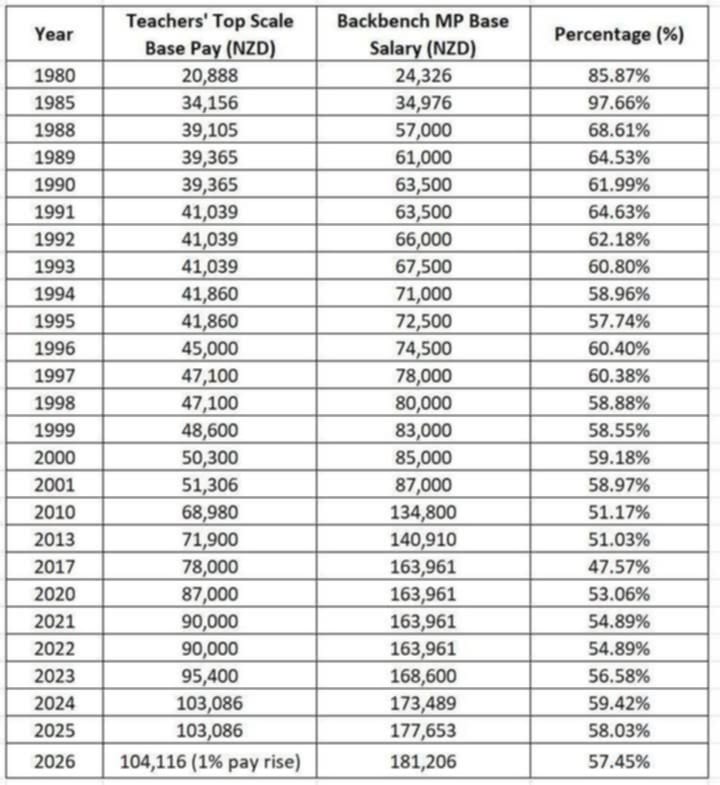
One of these contacts has just been made redundant by the NZ university to which they are affiliated (which is in the process of dismantling its social science programs while still recruiting students for admission in to them), so is considering turning to secondary school teaching as a new career path. They are also thinking about working in a policy analyst role, including in a parliamentary or political party setting. As part of the research and preparation process for that transition, and in light of the current stand-off between the government and secondary teacher’s union about cost-of-living (COLA) wage increases, they reached out to fellow colleagues who do research on related subjects in order to get a comparative idea of wages in those career fields. Although there are a number of interesting facts that came from the materials that my contact received that are worth discussing at another time, this one was shared with me. It involves the comparative base remuneration of backbench MPs and the upper end of teacher’s pay scales.

The data begs some questions. Who brings more value to NZ society, MPs or teachers? How is their value measured? What is worth more to NZ society, politicians or teachers? How is their (comparative) worth measured? Comparatively speaking, in terms of their contributions to NZ society, who is valued more and who is worth more? More broadly, is there a relationship between value and worth in NZ?

As for the specifics of the chart. Why is is the worth of backbench MPs (as measured in wages) significantly higher than that of the most experienced and well paid teachers? Since MPs also receive non-wage benefits such as accomodation and travel allowances and are often “comped” by lobbyists and other interlocutors in the form of meals and other incidentals, why is the wage gap between them and the most experienced teachers so significant? As for work equivalence, it can be argued that both MPs and teachers work long hours beyond their assigned time in class or in the parliament debating chamber, and both sacrifice family life and other leisure pursuits in order to do so. Both have formal work hours and yet engage in much informal work (say, coaching sports teams or participating in civic groups). Both MPs and teachers have invested much time and resources into their own educations and qualifications as well as through practical experience. So why the difference in worth if their value to society is similar if not equal? Or is their value not equal and hence their worth simply reflects the difference?

That last question is key. Does NZ society value MPs more than teachers and thus pay them more as a measure of their worth? Admitting for a degree of autonomy in setting institutional wage standards, are the average parliamentarians worth that much more than the most experienced teachers? Is their comparative worth–and that of teachers–based on any measure of value?

Perhaps there is a market-based answer to the question such as “politicians are rare gems that are hard to find while teachers are a dime a dozen because they are like pebbles on a beach, etc.” But even if this were true, perhaps scarcity of a resource is not a true measure of value. Memecoins such as $TRUMP may be worth much (+USD8.36/coin with a market cap of over USD 1.6 billion) but do they have any intrinsic or tangible value?

I will leave it for readers to ponder these questions and the more general question about the relationship of social value and material worth. However, one thing should be clear. Only when that relationship is defined and put into practice can we begin to speak of working towards a fair and equitable democratic capitalist society.

A culture of cruelty.

In February I wrote a post about “the politics of cruelty” in which I highlighted the mean-spirited commonalities of recently elected rightwing governments in the US, NZ, Italy and other democracies. In this post I shall expand on them with reference to some of the authoritarian features that I researched and wrote about when I was a young academic.

In the 1980s and early 1990s when I wrote about Argentine and South American authoritarianism, I borrowed the phrase “cultura del miedo” (culture of fear) from Juan Corradi, Guillermo O’Donnell, Norberto Lechner and others to characterise the social anomaly that exists in a country ruled by a state terror regime like the “Proceso de Reorganizacion Nacional” in Argentina from 1976 to 1983. In those circumstances individual psycho-pathologies are often rooted in the pervasive feelings of dread, vulnerability and hopelessness brought about by the regime’s use of death squads, disappearances and other violent authoritarian measures to enforce public compliance with their edicts. That pervasive sense of fear extends to collective life, something that was and is a deliberate objective of authoritarians because it produces a sense of survivalist alienation and social atomisation in the body politic, thereby disrupting basic horizontal bonds between and within groups in civil society (you can see one of my essays that uses this concept here: https://www.jstor.org/stable/2111080).

In recent years and especially since Trump’s re-election in the US, Javier Milei’s election in Argentina and the election of the right wing “chaos coalition” in NZ, I see an extension of this concept in what I will call the culture of cruelty. A culture of cruelty is one in which social groups and organisations, including governments, engage in particularly cruel behaviour in order to punish, humiliate and revel in the plight of others, particularly political opponents and scapegoated social out-groups. We only need to think of Trump’s deportation policies and the behaviour of his immigration Gestapo, ICE, to see the culture of cruelty at work. We can see it is the DOGE chainsaw approach to public sector employment and federal regulations. We can see it at MAGA rallies. It is personalised in the behaviour of Trump advisors like Stephen Miller, Karoline Leavitt and Tom Homan, who show utter contempt for the suffering their policies have caused and in fact appear to relish being able to rub in the fact that they can act with apparent impunity due to the weakness of the courts and congressional or partisan complicity. 

In fact, the “culture of impunity” is another characteristic of authoritarianism that I and others wrote about three decades go, and it goes hand-in-hand with the culture of fear because it is the feeling of impunity that leads dictatorships to use wanton repression as an instrument of subjugation of the popular will. In other words, the culture of regime impunity leads to the imposition of a culture of fear in society. That is what is at work, to various degrees, under Trump, Milei, the evil clown circus currently ruling NZ (especially in the ACT and NZ First parties) and in other former liberal democracies today.

This culture is mean-spirited and malicious. In many instances it is fuelled by hatred of “others,” be they immigrants, indigenous people, people of colour or different faiths, those who are sexually “deviant” from “traditional” norms (i.e. non-binary) and others who do not conform to a given set of social mores or expectations or are simply easy scapegoats given public attitudes. It is facilitated by the increased vulgarisation of social discourse and erosion of societal norms regarding behaviour and civic exchange, now megaphoned and accentuated by social media. It is cruelty for cruelty’s sake, and uses cruelty as a punishment, as an intimidation tactic and as a dark reminder of what is possible when one is targeted for any number of perceived transgressions

Cruelty can be physical, mental, emotional, social or any combination of them because its impact is not confined to just one dimension or aspect of human existence. It is “unusual” in that its objective is to cause disproportionate anxiety, anguish, stress and suffering to targeted people and groups beyond whatever duress might (or might not) be warranted under the circumstances. The term “scarred for life” is an accurate depiction of the broader long-term effects that cruelty can have on the human subject. And when it comes to public policy or social exchange among groups, that is exactly what perpetrators hope to achieve via its use: it psychologically traumatises people and groups in the moment as well as their individual and collective memories, something that renders asunder the social fabric into which they were previously woven.

As is the case with torture (which is inherently cruel), social and political cruelty works. Not so much as an instrument to induce cooperation from those otherwise disposed not to give it, but as a disincentive, revenge or retribution tool against them.

I could write more about the subject but this is not the place to do so. However, I hope that the notion is clear. We are now in an era where the culture and politics of cruelty have become integral features of democratic politics in at least some Western societies (I will leave aside for the moment the fear that exists in countries ruled by authoritarian regimes like those in Russia, China or Nicaragua). And if the cultures of impunity that have led to the imposition of these growing cultures of cruelty and fear in Western societies continues unchecked, then another social pathology will follow–the reaping or harvesting of fear (“cosecha del miedo,” in O’Donnell’s words) in the form of a legacy of damaged people and institutions resultant from the practice.

Should that happen, then democracy as a social construct and a method of governance will never be the same.

School meals as human capital investment.

Although I do not usually write about NZ politics, I do follow them. I find that with the exception of a few commentators, coverage of domestic issues tends to be dominated by a fixation on personalities, scandals, “gotcha” questioning, “he said, she said” accusations, nitpicking about the daily minutia of pretty trivial matters and clickbait hysteria about usually inconsequential issues (such as the recent freedom of navigation/power projection exercise conducted by a small Chinese flotilla/task force that in no way presented a serious threat to NZ interests). The world is blowing up before our eyes and NZ media fixates on parliamentary bullying, politician’s name-calling, assorted partisan spin attempts and even the rhyming word salad vitriol spewing from one bloated onanist’s mouth. Rarely is there a reflection on the why of some policy controversies that extend beyond the immediacies of the moment. Worse yet, what starts out in corporate media coverage then gets siloed and echo-chambered down into social media cesspools where hatred and contempt for “others” is the most salient distinguishing feature of discourse.

As a short response, here I would like to very briefly do a reflection on the why of school meals.

Here is why: The most precious resource that a country has is its human capital. The creativity/productivity of its people are the true measure of its strength. Investment in human capital involves short- and long-term direct and indirect costs in human capital development, one of which is schooling. Since it is proven that well-fed kids do better academically and are more socially adjusted than hungry or poorly fed kids, school meals have long been considered to be an integral part of the indirect investment in (future) human capital. If for whatever reason parents cannot provide nutritious school meals for their kids to take to school (there are many, most not due to parental negligence), most societies accept the need to provide them in the school system using taxpayer-provided funding. This is not just a trait of democratic educational systems, Authoritarians well understand the concept of human capital development so are often just as prone to providing nutritious school means (often with propaganda associating the regime with school meal-provision programs).

For example, Argentina (where I was raised asa child), Brazil and Chile (where I researched and worked as an adult) all provide school meals at no or small cost to caregivers. This happened during periods of democratic rule as well as dictatorship, with the exception that the Pinochet dictatorship in Chile selectively closed entire schools and health clinics in working class neighbourhoods in order to weaken what it considered to be sources of class resistance to its murderous neoliberalism (from which NZ took many lessons, including its Labor Law reforms of the late 1980s and early 1990s, the legacies of which remain to this day). Similarly, some of the biggest protests against the chainsaw cost-cutting approach adopted by ACT Party favourite Javier Milei in Argentina involves cutting back on school meals, something that because of its extensive history in Argentina is considered to be a birthright, especially amongst the working classes. Along with other socio-economic indicators like the over-all poverty rate (now nearly 60 percent of the population), child malnutrition has surged in the (again, poor and low income) areas where school meals are the most needed and yet where meal cutbacks have been zealously applied.

That may be by design, like in the Pincohet regime’s approach in its day. Milei’s sociopathy simply sees the lower income strata as vermin that should be eliminated, not nurtured. Parsing David Seymour’s rhetoric on his school meal program and leaving aside the dubious circumstances in which the contract for his program was let, one gets the impression that he shares Milei’s Social Darwinistic worldview. We can only hope that he does not share Milei’s view that “blue eyed people” are “aesthetically superior” to dark-eyed folk (true story: Milei actually said this in a country where the majority of the country do not have blue eyes). But then again, Seymour’s attacks on the Treaty and adjacent attacks on Maori “privileges” seem to be cut from the same cloth as Milei’s.

That having been duly noted, the bottom line is that in most countries and certainly in the developed world, current tax dollars are used to invest in pursuit of future human capital returns. It complements immigration policy in that regard, as immigration provides short-term human capital inflows that over time can be transferred into inter-generation human capital development through education and the infrastructures that go with it (like school meals). In fact, dividends on this investment come in the form of productive adults upon whom less public money is spent on welfare, health and crime mitigation services, and who in fact pay more in taxes than those who wind up as dependents of those public services. Surely the trade-off is worth it.

It is therefore mistaken and short-sighted to claim that it is not the NZ school system’s responsibility to provide student meals. Those meals are a collective good that serve both the present and future commonweal. As such, they should be nutritionally sufficient to help a young person’s development, not just a cost that must be kept low. Scrimping on meal costs and arguing about parental responsibility at the expense of boosting NZ’s future human capital is folly.

But that is where NZ is today.

Political societies and economic preferences.

Much discussion has been held over the Regulatory Standards Bill (RSB), the latest in a series of rightwing attempts to enshrine into law pro-market precepts such as the primacy of private property ownership. Underneath the good governance and economic efficiency gobbledegook language of the Bill is a desire to strip back regulations in order to give capitalists of various stripes more latitude of action.

The RSB is interesting for two reasons. One, it is the type of omnibus bill that is designed to supersede other legislation in the policy enforcement chain. It is a “mother of all laws” or foundational stone type of legislation that its proponents hope will serve as a basis for future legislative reforms and policy-making and to which all existing laws must be retro-fitted. Although it varies in its NZ specifics, it emulates the “Ley Omnibus” (later named “Ley Bases” (Base Law) pushed through by Argentine president Javier Milei last year, which basically allows for the dismantling of the Argentine State bureaucracy, reform of labor and environmental laws, slashes the public budget, and opens the economy to foreign investment.

As a result, although the inflation rate has been drastically reduced and some foreign investors have taken interest in the Argentine economy, the poverty rate now reaches nearly 60 percent, health indicators (and facilities) have cratered, pension and social welfare plans have been decimated, unemployment and crime have risen, and basic public services are on life support (including power and water provision in some areas). Despite these deleterious effects, Milei’s “chainsaw” approach has been celebrated by the ACT Party, sponsor of the RSB and its predecessors, so here again we see an example of NZ politicians borrowing concepts from similarly-minded foreign governments.

They are not alone: the incoming Trump administration’s Project 2025 and Project 47 copy aspects of Hungarian president Viktor Orban’s authoritarian-minded constitutional reforms (since it centralises power in the Executive Branch and restricts civil liberties and opposition rights). More ominously, because it is an omnibus bill that redraws the NZ constitutional map in a preferred image, it echoes the Nazi “Empowerment Law” that Hitler pushed through in the German parliament after the was named Chancellor in 1933, albeit without the repressive powers later confirmed upon him. As in the case with Milei and his Base Law (and Hitler at the beginning of his legislative campaign), the RSB depends on securing a slim parliamentary majority in order to to pass into law.

What is important to note is that such omnibus legislation is most often used in democracies by authoritarian-minded politicians who are afraid that they cannot get their policy reforms passed and accepted otherwise. It is a soft form of constitutional coup whereby the “rules of the game” are stacked via legislative reform in favour of a specific set of interests, not the public good. It is a “soft” type of coup because it uses lawful/constitutional means to achieve its ends. In a perverse way it is a sign of weakness that its proponents do so, as if they know that their preferred policy prescriptions will be rejected by the electorate in the absence of an overarching law forcing the public to follow them.

To be clear, here the focus is on omnibus or foundational laws, not more specifically drawn laws that follow from them. For example, commercial and environmental law cover aspects of social and economic life but are not “foundational” in the sense that they do not provide cornerstone underpinnings to civil and criminal law, which in turn address detailed and specific rights and obligations regarding various aspects of social life, including enforcement of those rights and obligations by an independent judiciary. “Penalties under the law” refer to this level secondary of judicial oversight, which in turn is governed by foundational principles enshrined in omnibus legislation (which is the province of constitutional law).

There is a second, more fundamental problem with this approach. It involves the distinction between political society and economic society and why they should not be intertwined.

Political societies are aggregations of people within given physical boundaries who agree upon or are forced to accept certain universally-binding rules regarding representation, leadership and collective decision-making. Because NZ is the subject of this post, we shall leave aside for the moment various authoritarian political communities. As a liberal democracy, NZ has a form of rule based on majority contingent consent to the system as given, formally expressed through elections but more granularly in the everyday actions of voters who accept their positions in the social order. People go to work, play, attend school, have relationships and generally comport themselves as members of society in accordance with commonly accepted notions of acceptable behaviour (e.g., “live and let live,” “due onto others as one would do onto oneself,” respect difference and the rules of the road, etc.). But that majority consent to any given democratic rule is contingent on public expectations being met, both materially as well as politically. Political and economic societies are formed to address (and shape) those expectations.

Economic societies are aggregations of people operating within a given productive structure, making things and generating surpluses from their labor and labor-saving inventions while exchanging goods and services. “Homo economicus” is non-political. S/he maximises economic opportunities in order to pursue material interests. The ways of doing so are many and can involve collective as well as individual effort, which is often determined by the type and modalities of production (industrial, agricultural, mixed, etc.) and the material goods being pursued.

Vulgar structuralist thought holds that the type of economic society determines what type of civil and political society emerge from it. To this day, proponents of things like (neo)modernisation theory adhere to this belief. But such views offer a simplistic read on the interplay between economic and non-economic factors, so claims such as “free markets lead to democracy,” and ” political parties are the political equivalent of economic agents in the productive process” are overdrawn at best. A more nuanced take is that civil and political life may have a grounding in economic life but are not reducible to or epiphenomena of it. In some instances, say in the cultural sphere, human behaviour is not a surface reflection of an underlying economic reality or framework.

Political society is about collective governance and civil engagement. In democracies it involves a “legal” agreement, compact, or contract about the way in which the political order should be governed, which involves ostensibly neutral institutions and processes, As such, it can co-exist with a number of economic arrangements and is not inherently linked to any one. For example, over the years democracy has coexisted comfortably with varieties of capitalism and socialism. Authoritarianism has also co-existed with capitalism and socialism. The particular combination of economic framework and governance structure defines specific variants of regime type: NZ is a “liberal” democracy because it is based on a capitalist economic foundation (first settler colonialist, now primary good export, real estate ownership and services dependent production). North Korea is a Stalinist country because it combines one-party authoritarian rule with State control of the mixed industrial/agrarian economy.

What this means is that laws in a democracy are basically a means of adjudicating disputes, avoiding collective conflicts and regulating individual and collective behaviour regardless of economic status (think of the “justice is blind” adage). Ideally, they should be agnostic or neutral with regard to economic preferences because it is possible that future generations of voters will elect to support different types of economic arrangements that they believe suit their collective and individual material interests better than current schemes.

But that is not what has happened. In NZ and elsewhere in liberal democracies, things like private property rights have been enshrined in law and thereby protected by the State. The evolution of this marriage of political and economic societies is complex but the bottom line is that NZ is a capitalist society governed by a democratic capitalist State that enforces the primacy of capital above all other things. To be sure, much lip service is given to civil liberties, human rights, equality before the law, even adherence to the principles of Te Tiriti o Waitangi. But the foundation of the modern NZ State is not based on a contract between interested parties such as the agents who signed the Treaty, or on respect for the rule of law per se, but on the structural dependence of NZ society on capitalism. The role of the NZ State is to help resolve the contradictions that inevitably emergence in a political system where a minority of voters control major parts of the productive apparatus but rely on the labour of others (wage labour) in order to generate the material surpluses (profits) that allow them to exercise (indirect) political as well as (direct) economic control in NZ society.

The RSB seeks to further deepen that structural dependence of NZ society on capital by giving certain capitalist fractions more leeway in the conduct of their self-interested affairs. When fully implemented it will atomise wage-labor both in and out of production while consolidating specific types of capitalist structural control. In that light the RSB codifies the State’s role (or non-role) in facilitating capitalists’ (aka businesses) self-interested pursuit of profit. From then on self-interested maximisers of opportunities, individual and corporate, will seek comparative advantages in the deregulated marketplace.

The problem, again, is that enshrining a specific set of economic preferences or biases in a political charter interferes with voter’s freedom of choice when it comes to their own economic interests and desires. Depending on their circumstances and structural location in the productive apparatus, not everyone may be a fan of capitalism or accept the primacy of private property rights. Some may even prefer socialism, however that is defined. Prioritizing and facilitating the pursuit of specific economic preferences contravenes the commonweal (public interest) basis of democratic political charters such as that governing Aotearoa. Instead, it rigs the societal “game” in fair of a select few.

Other, more astute minds have already voiced their opposition to the RSB on a variety of grounds. Here the point is to remind readers of why omnibus bills are inherently anti-democratic even if they are legally constitutional, and why democratic political society is distinct from and should remain “above” economic society however construed. The former deals with universal values and interests; the latter involves specific sectorial interests and their material objectives in a system structurally based on the pursuit of profit. Although they may be overlapped in fact because of NZ’s history of structural dependence on capital, the public good is best served when the political/legal framework is agnostic or neutral when it comes to sectorial interests. That is what democratic collective bargaining systems are for and why political lobbying needs to be tightly regulated. Instead, the RSB seeks to tilt the game board in the direction of a specific set of interests, not the public interest at large.

Alas, although it is not meant to be, the rightwing NZ economic and political twain have met, and the outcome is the RSB. For the reasons outlined above, that is why it should be opposed.

The disinformation grift in NZ.

A while back I was engaged in an unpleasant exchange with a leader of the most well-known NZ anti-vax group and several like-minded trolls. I had responded to a racist meme on social media in which a rightwing podcaster in the US interviewed one of the leaders of the Proud Boys movement (in 2017) in which the Proud Boy made claims that 55 percent of UK Pakistanis were in-bred (“consanguineous” in their pseudo- scientific terminology) and that 50 percent of the births by women in such relationships were still-born. The IV was reposted late last year as a way to link the incidence of inbreeding to the “Pakistani gang rape networks” stories circulating in the UK and picked up by white supremacists the world over. The local anti-vax leader reposted the IV approvingly.

I made a comment on the thread about how if their data was true they should have nothing to worry about since a 50 percent stillborn rate pretty much is a path to extinction, especially when half of the surviving in-bred children would be too mentally incapacitated to do anything dangerous and pose a threat to the UK status quo (which was the implication in the IV). Because the Proud Boy leader showed photos of supposed official medical data charts to back up his views, I questioned if he had data on Mormons or Hasidic Jews in order to make cross-religious/ethnic comparisons. Instead, one of the trolls on the thread posted an official looking chart (but with no title, source or other information) listing a number of Muslim majority nations with their respective “consanguineous” birthrates. When I noted that the data presentation look cherry-picked because it only covered Muslim majority countries, the respondent insisted otherwise. So be it. The best response I got was that Pakistani Muslim in-breeding in the UK was a problem because they would burden the health care system. Fair enough but that was not the thrust of the discussion, which again was focused on social issues related to Muslim immigration in the UK. In any event, after that the argument descended into personal insults, ridiculous claims and, well, racism.

I have chosen not to identify the NZ anti-vax group or the referenced particular leader other than with generic “woke” pronouns because they are not worth the energy. People who follow the NZ anti-vax movement will know who the person is. So why expend oxygen on them and give them more attention, especially since that is what they crave? Also, when I refer to the “disinformation grift” I am not referring to the government-funded anti-extremism and radicalization entities that sprung up after the March 15, 2019 rightwing terrorist attacks in Christchurch, which have been falsely accused by rightwing mouthpieces of being opportunistic troughers pilfering from the public purse. I give no credence to those accusations and instead will focus on those who deliberately spread lies and falsehoods about vaccines, the nature of government health edicts, health indicator demographics and assorted other seditious claims among the tinfoil hat brigade.

The exchange with the anti-vaxxer and racists got me to thinking about how it appears that this NZ anti-vax leader has materially benefitted from arguing against government pandemic mitigation efforts, health authority mandates, “socialist” or “fascist” infringements on individual rights (of movement and assembly), forced introduction of foreign materials and nano-technologies into humans via the “jabs,” and imposition of quarantines and travel bans while vilifying Jacinda Ardern as being a modern day Hitler or Stalin with Ashley Bloomfield (and Dr. Anthony Fauci in the US) being her Dr. Mengele, among assorted other lunacies.

The twist is that I know this person because “they/it” live in my small community and was a teacher’s aide at the local primary school that my son attended. They/it was known in the community for their/it’s anti-vax views (for diseases like measles) well before the pandemic, but back then they/it took a relatively low profile and did not proselytize their/it’s views until Covid struck. This is not to say that these views were unknown, since they/it used personal social media accounts to post about their/it’s beliefs. These include a well-known antipathy towards large people, particularly those of colour, seemingly due to they/it’s healthy diet and “wellness” lifestyle (let’s just say that they/it does not like people who enjoy KFC).

Unfortunately, in the exchange following the racist IV post they/it accused me of stalking and being “weird and creepy” because I could see they/it’s comments even though I had blocked them a long time ago (that is actually part of the blocking policy on the social media platform that we were using). The resort to personal attacks is of course taken off the rightwing playbook where, as Steve Bannon recommended, “you flood the zone with crap” by hurling false accusations and smears at detractors, who you then accuse of censorship, de-platforming and attempting to shut down free speech rights. I told they/it to not flatter themselves thinking that they/it was worth my attention. Ultimately the whole thing turned into a circle-jerking waste of time so I blocked them again and left the discussion.

They/it’s move into rightwing racial politics reminded me of they/it’s past comments and those of other anti-vaxxers on the subject. In fact, if I remember correctly, members of this particular anti-vax group appeared at anti-mandate rallies alongside neo-Nazis like Kyle Chapman. In that light I continued to reflect on how they/it’s material fortunes seem to have improved since they/it founded their group and began soliciting funding for it (some which is allegedly from foreign–mainly US–sources), to the point that they/it now appears to have moved well beyond the knitting circles and reading to kids line of work that they/it had before the pandemic arrived. They/it was, unsurprisingly, part of the 2022 Parliament demonstrations but fled before the rioting began, and continues to agitate for their causes on social media and radio, including doing an interview with Infowars, the US-based conspiracy podcast website run by the attention-seeking cur known as Alex Jones.

They/it’s messages overlap with other “cookers” such as the now separated duo of lunatics at Counterspin Media and the seemingly deranged Liz Gunn, and their/it’s focus has evolved to include anti-Maori, anti-immigrant and the usual Deep State BS that gives rightwing extremists fever dreams. That is interesting because it appears that concerns about vaccines are not the only thing that they/it fears, which might explain their approvingly re-posting about Pakistani in-breeding in the UK and the general reproduction rates of Muslims world-wide. It seems replacement theory is on their radar, which is odd because one way to get ethnically replaced is to stop taking vaccines for previously common diseases while other groups follow the science of vaccinations. That is an irony lost on white reproduction-obsessed cookers.

Anyway, what struck me is that the entire anti-vax movement not only overlaps with other causes based on prejudice and “othering” of targeted scapegoats, but also is a source of grift for those who lead them. Gosh, who would have thought it? As that wretch Jones has proven, there is money to be made in disinformation if you are just dishonest and unethical enough to do so. From what I have discerned and without wanting to waste further time and energy on this sorry subject, here is how I see the disinformation grift progression as a crude flow-chart:

Prior anti-vax beliefs+general discontent with authority–> anti-vax disinformation riding on concerns about Covid mitigation efforts–>Deep State conspiracy theories (Ardern as Hitler/Stalin, bureaucrats trying to control everyone, etc.)–> Big Pharma/globalist machinations (dove-tailing with Jewish) conspiracies–> racism (anti-Muslim, anti-maori, anti-immigrant)–> homo- and transphobia–> climate change denialism–> defence of “free speech”–> pleas for money–> foreign funding–> realisation that fund-raising surpluses can be appropriated as personal rents= the disinformation grift.

The idea is to keep spreading lies and fomenting hate and division, make money off of the effort, put some money back into public information campaigns and pocket the rest. This could well be a lucrative business model for those so inclined. I do not know the tax status of this particular anti-vax group but would not be surprised if it claimed charitable status. As mentioned earlier, its sources of funding may include foreign donors as well as mum-and-pop subscribers/donors. But there does not appear to be any public auditing of the group’s accounts, including the remuneration of its directors and amounts spent on luxury items (as opposed to public information materials regarding the supposed dangerous of vaccinations).

As far as I can tell, no media investigations have been launched into the tax status, revenues and expenditures of this group or similar astroturf (as opposed to genuine grassroots) “interest group” cons like Counterspin, Groundswell or Brian Tamaki’s personal “church.” I shall leave aside for the moment alleged grifting at places like the Waipareira Trust simply because the Trust’s stated objectives are not based on abject lies and disinformation and they do deliver real tangible community services, so whatever grift that may be occurring there–and legitimate questions have been raised to that effect–is not a disinformation grift.

Presumably an OIA request might pry open some information about them from the IRD and other pertinent authorities, but that is beyond my forensic capabilities at the moment. Any investigative reporters willing to give it a go (if there are any left, other than Gordon Campbell, Nicky Hager and Matt Nippert)?

In the end, my suspicion is that even if there was legitimate vaccine skepticism before the pandemic arrived that carried over into some of the opposition to the Covid pandemic mitigation efforts in NZ and elsewhere, it has morphed into a broader-focused globally-networked rightwing money-making scheme based on the propagation of dis- and mis-information about health matters, social issues, culture, demography and identity. To make matters worse, the disinformation being peddled by “cookers” has crossed over into mainstream political discourse thanks to it being parroted and mainstreamed by some corporate media, most rightwing social media and ignorant and/or opportunistic politicians doing so for partisan gain.

None of this is good for democracy (the abuse of rights to free speech is part of the grift) or social cohesion. But that is the state of play as we begin the second quarter of the new century.

PS: Now that the Disinformation Project and the Violent Extremism Research Centre (sic) were defunded by NACT and have ceased to exist, is there any other dedicated research agency looking into the activities of group’s such as those mentioned above? Both of these entities had their flaws but at least kept their eyes on the ball when it came to political extremists in Aotearoa. But what exists now? Just curious.

Differentiating between democracy and republic.

Although NZ readers may not be that interested in the subject and in lieu of US Fathers Day missives (not celebrated in NZ), I thought I would lay out some brief thoughts on a political subject being debated in the US. It seems crazy but there seems to be some confusion on what a the terms “democracy” and “republic” mean.

There are (MAGA) right-wingers and conservative media commentators who claim that the US is a Republic, not a Democracy. They are either cynical or ignorant. The two are not antithetical. Democracy is a means of giving political voice, selecting political representatives and granting social (and often economic) equality. It comes from the Latin word “demos,” or polity.

Republics (from the Latin res publica) are a type of political governance where, unlike monarchies or other forms of oligarchical rule, leadership purportedly derives from or is delegated by the sovereign will of the people (which may/may not be voiced democratically). There are democratic republics and there are authoritarian republics, so the two terms–democracy and republic–while having different specific meanings, may or may not be overlapped when it comes to a given political framework.

In fact, as the old saying goes, any country with “democratic” in its name is likely not regardless of whether it has “Republic” in its title. For example, the Democratic Peoples Republic of Korea (DPRK) is anything but. The Peoples Republic of China (PRC) holds elections (in the Chinese Communist Party (CCP)), but is certainly not democratic in the liberal (universal, free, fair and transparent elections) sense of the term. Argentina under its dictatorships remained a “Republica Federal.” In fact, Republics can be federal in nature, where political administration is decentralized and broken into constituent parts such as US or Brazilian states, or unitary in nature, where the central government has administrative jurisdiction over the entire country (as in NZ). In neither case does this necessarily involve democracy as a concept or practice. It is simply a type of governmental administration within given territorial limits, to which different types of political voice, representation and accountability are attached.

Again, democracy is about political expression and social equality; republic is about political organisation. The US was founded and has been broadened via much struggle and conflict as a democratic republic (first for some, eventually for all). The process involved two parallel processes that were not always congruent or synchronised, which consequently has led to repeated conflict (think Civil War and the Civil Rights movement). In fact, the broadening of “democratic” rights within the US over the years has produced backlash from small and large-R “republicans” who believe that the awarding of rights to previously marginalised groups and non-citizens somehow infringes on their existing rights (which assumes that “rights” are an indivisible pie where awarding some to one group means that other groups will lose their fair or previously allotted share). This has extended into discussions of “states rights” versus those accorded by US federal law, where advocates of the Republic versus Democracy designation argue against democracy because it interferes with State’s autonomy over their internal (political, economic and social) affairs. In this view, a US Republic leaves the issue of individual and collective rights to be decided by States under their own self-made laws. Democracy removes that prerogative by federal fiat, subjugating states to the dictates of a federal overseers (who in turn are seen as pawns or tools of nefarious elites). This view is deeply flawed, if not dishonest.

The “states versus feds” debate has been rehashed endlessly and largely settled as a matter of US constitutional law. Despite ongoing efforts by groups like the Federalist Society to redefine the relationship between the central government and states, it has never really been framed as a “Republic versus Democracy” issue. But in the hands of malevolent or ignorant actors, this adversarial distinction contributes to the false dichotomy between and binary juxtaposition of the two different but often compatible terms.

It would be a pity if the narrative that democracy is antithetical to being a republic begins to take larger hold in the US in the lead-up to the November elections. Perhaps some of those who espouse such a view really would prefer that the US become an authoritarian republic. But what the very presence of such views does show is that when it comes to fundamental concepts underpinning the US political order, there sure are a lot of misinformed if not downright stupid people out there–and plenty of others who wish to exploit their ignorance for myopic partisan gain.

Te Pati Loco?

Normally I would not write about Maori issues. I may have been living in NZ for over 25 years but I do not feel that it is my place to opine because I am not an expert on Maori history and politics and do not speak Te Reo (because as anyone who seriously studies comparative politics will attest, foreign language proficiency is a bottom line requirement for scholarship in the field unless you only study countries and cultures that speak your mother tongue). Hence in the past I deferred to Lew to write about Maori issues here at KP, but since he has departed there is no one left to do so.

However, in light of the recent carkoi and protests organised by Te Pati Maori (TPM) in response to the Coalition of Cruelty’s budget, I thought I would touch briefly on a matter of Te Pati Maori praxis. I was dragged into the debate about the protests when I noted on social media that the use of the term “strike” to characterise the direct action was done in error or for dramatic effect since “strike” is codified in employment law as a collective withholding of labour services by employees from employers in the context of workplace disputes. If the labour service withdrawal is called by collective agents and follows the procedures for engaging in such action (giving notice, etc.) then it is a strike “proper.” if it is done by individuals or groups of workers without collective authorization, then it is a “wildcat” strike that may be deemed unlawful by employment courts. A general strike is a labour service withdrawal across economic sectors done for economic and/or political purposes, which is difficult because it requires unity of purpose and action by employees working in different productive areas, which in turn requires agreement between union agents and agent/principal agreement in every union on the action. That is a big ask.

Taking a day off from work to go to a protest, be it by using paid, unpaid or medical leave or no leave at all is not a strike no matter what one calls it. Workers assume the employment risks associated with such actions. Employers can weigh their responses according to the law and their relationship with employees. That could even include giving people the day off or paying them overtime to stay on the job, among other options. Again, the nature of the relationship between boss and worker outside of the legal framework can influence an employer’s response for better or worse.

I figured that since I have written two books and a dozen or so scholarly articles about comparative labour relations, including the subject of strikes and State responses to working class collective action, that my neutral if pedantic observation about the proper use of the term “strike” would be as unremarkable as it was incontrovertible. I was wrong.

To be sure, the use of the term “strike” in the Te Pati Maori protest literature, which explicitly references it as a display of Maori economic power, lent itself to the view that Maori were going on strike. As such, right-wingers seized on the term to call for employer retaliation against those who joined the protests. There was much agitation on the Right about violations of contract (individual or collective) and the penalties that should be levied. The PM weighed in with the comment that workers should be careful about striking and that strikes should be done on weekends because that way they would not be as disruptive.

Besides the fact that a PM should know the difference between a strike and a protest (rather than cynically feed into the “strike” narrative), it is pretty rich for him to suggest that strikes are best done on weekends. As I said on social media, by that logic we should take our holidays on weekends as well. The whole point of strikes, protests, demonstrations and other types of direct action is precisely to be disruptive of the status quo as given in defence of a cause or to air grievances. A protest without disruption is like an army without a fight, full of rebels with causes but no stomach for consequences. Protests and strikes are about assuming collective and individual risk. The risk may be large or small depending on circumstance, but in one way or another it hangs over acts of “unauthorised” direct action in most every instance.

Having said all of that, I understand the call to strike in the Te Pati Maori literature as using the original sense of the term, which means “to deliver a blow.” The protest was organised as a symbolic blow against the reactionary anti-Maori thrust of the Coalition of Cruelty’s policies. It was not about Maori labour service withdrawals per se.

For my troubles in clarifying what is and what is not a strike and how the term was misused in the call to action by both supporters and opponents of the protests, I was called condescending, paternalistic, pompous, a lightweight, and best of all, a “racist c**t,” the latter by a lady who surely must kiss her mum and perhaps children with that mouth. As I wrote to her, she must be fun to be around.

All of that aside, I then got the pleasure of watching Te Pati Maori leaders speak in and outside of Parliament on the subject of the protest and much more. Although Ms.Ngarwera-Packer presented her views coolly, her counterpart Mr. Waititi was at his bombastic, hyperbolic best, taking the tradition of Marae oratory to a level that even that tax-funded weiner-tugger Shane Jones cannot match. He threw out gems such as “if Maori are 60 percent of the prison population then (we) deserve 60 percent of the Corrections budget,” a feat of logic so extraordinary that it would be akin to saying that NZ should pay the PRC, Russia and rightwing extremists most of the intelligence budget because they are the ones being spied on. To be frank, I have always found Mr. Waititi to be a bit of a buffoon and charlatan, but then again, that is probably the old Pakeha racist codger in me doing the assessment (I have been characterised as such before).

Which is why I paused to reflect on my reaction to his rants. Others have already noted the hypocrisy of TPM being funded by taxpayers and gaining prominence via “Pakeha” procedures and institutions. They have noted with alarm the seditious rhetoric of Mr. Waititi’s wife, the daughter of none other than that paragon of indigenous resistance, John Tamihere (although Mr. Tamihere’s management of the Waiparera Trust, for whatever its faults, was first rate during the pandemic and is widely respect in the West Auckland community). Now the TPM is calling for a separate Maori parliament, presumably to run in parallel to the “Pakeha” parliament and be equal to it. I am not sure how it will be funded and what outcomes it hopes to achieve, but it provides some food for thought about political alternatives even if it has a snowball’s chance in hell of materialising while the current government is in power.

The proposal is interesting in part because one of the features of a Mixed Member Proportional (MMP) democratic system like that in NZ is that it allows small, narrow-focused or single issue parties to get elected and press their interests within parliament, using coalition-building and vote-trading as a means of doing so. The ACT and Green Parties started out this way and have now widened their political appeals beyond their original core policy platforms. Whether that is for better or worse is for others to decide, but the general thrust for both of them was to start narrow and then widen their platforms via the incorporation of other agenda items and constituencies. ACT has gone with the gun rights crowd, incels and racists; the Greens have gone with identity issues, animal rights and rainbows. Both have had success by doing so. NZ First has done something a bit different, using malleable nationalist populism as a vehicle for Winston Peter’s political aspirations. To his original xenophobia and self-loathing Maori appeal (to blue rinse Pakehas), he has now added anti-vaccination conspiracy weirdness and slavish “anti-woke” corporate bootlicking to the party repertoire. Like the broadening shifts undergone by ACT and the Greens, it has served his party well and allowed it and ACT to become the tail-wagging rump ends of the Coalition of Cruelty dog.

Te Pati Maori is a different kettle of fish. Gone are the days of Pita Sharples and Tariana Turia, who tried to play the centrist–some might say assimilationist–parliamentary game.They supported both Labour and National-led governments while confining themselves to practical pursuit of “reasonable” goals, that is, objectives that could be achieved by and within the system as given. Truth be told, the Maori Party record was mixed at best, but one thing that did come out of its emergence on the political scene is that outside of Maori-related issues (say, rural health and lower-income welfare support), it had zero to little impact on NZ government policy. The “big” policy decisions were made by Pakeha-dominated parties, including things like foreign and defence policy (I wrote about the Maori Party’s lack of consequence in NZ foreign policy other than on international indigenous affairs in this scholarly article).

Today’s Te Pati Maori is different. More than a just a party name change, it is overtly anti-Establishment and “progressive” in orientation (whatever “progressive” means to them, which may not be what other “progressives” think that they are). As the proposed Maori parliament suggests, TPM rejects the system as given. That is why it uses the word “strike” without regard to the Pakeha convention known as Employment Law. It’s spokespeople openly speak of “revolution” and government overthrow even if it is unclear what they actually mean when they use those terms. What is clear is that TPM is more about political theatre and symbolic politics than delivering tangible policy outcomes to and for their constituents. If anything, its marginalization within the political system has increased along with its militant rhetoric and actions. It might be too early to tell, but the carkoi protests could be seen in that light: as a lot of bluster and fanfare but no tangible impact or results to show for them. In fact, the response from most other parties was to either lambaste or shrug and ignore Te Pati Maori’s antics. Time will tell if the impact of the protests are more subtle and longer-term in nature but for the moment TPM stands alone, seemingly barking into the wind.

Again, that got me wondering as I stopped to check my white privilege. Am I being unkind to TPM? Or am I just another racist cracker bleating about the rise of a righteous and strong indigenous voice?

I found my answer in Gramsci. It occurs to me that, because TMP often refers to its actions and rationales in neo-Marxist terms with a smattering of Paulo Freire, Franz Fanon and Norm Chomsky thrown in, that Te Pati Maori sees itself waging a war of position within the “trenches” of the NZ Pakeha State. That is to say, it is working from within to disseminate its “counter-hegemonic” vision and policy prescriptions in civil and political society. Its focus is on grassroots organising, starting with Maori and reaching out from there into other “progressive” communities such as those grouped under the Green and Left Labour banners. It is not worried about converting the old Pakeha elites or engaging in parliamentary compromises because, as the recent census shows, Maori are growing in demographic numbers while Pakeha are declining. Given the structure of MMP, that growth can translate into increased seats in whatever parliament they chose to stand in, and given the youth appeal that they presently feel that they have, time is on their side. Along with forging alliances within the Labour and Green parties, unions and other civil society organisations, TPM is using a long-game strategy where what it is doing now sows the seeds for its successes down the road.

They may not be so loco after all.

So what to make of Te Pati Maori? Are they just nuts (as the term “loco” implies)? Are they communists, extremists and separatists as Winston First and Tugger Jones claim them to be? I would argue no to both suggestions. What TPM is doing is a time-honoured yet new form of politics in a social media age, where their theatrics are part of a grassroots appeal to marginalised and disaffected (not always the same) groups, especially proletarians of colour. By working “in the trenches” TPM can slowly promote an ideological re-orientation away from neoliberal vestiges (because neoliberalism is not just an economic doctrine but has become over the course of two generations a social construct that frames our way of life) and towards a type of post-modern indigenous-centric perspective infused with working class-based values and perspectives. This view is self-realised and awake rather than woke, defiant but not always disrespectful, confrontational but not conflictual, independent rather than (Pakeha) dependent, cooperative and collective rather than corporate in organization. It may take time for the TPM-led movement to congeal, but the stirrings are there and the people are ready for generational change to take effect. That is the plan and TPM sees itself as the instrument for converting that plan into praxis.

Or so they hope.

A NZ Identity Crisis?

Some time ago a veteran journalist interviewed me about “foundational myths” and why the US and NZ were different in that regard (by “veteran” I mean a journalist who does research on stories and has some background in the fields pertinent to them, which are then used to write in-depth reports). Although I am not an expert on foundational myths, he had seen something that I had written back then and, having just returned from a trip to the US, his interest in the subject was piqued so he decided to give me a call. We did a compare/contrast exercise that he wrote up for a conservative news outlet.

I was reminded of that exercise by recent events involving ACT Party challenges to the Treaty and the Waitangi Tribunal settlement process. It occurred to me that not only does the Treaty (te Tiriti) serve as a foundational charter for NZ, it is also from whence NZ’s foundational myth comes from. This is not a criticism, just a personal observation, and there clearly is much more to a foundational myth than a grounding in a political contract between indigenous peoples and colonialists. I believe that foundational myths, especially those that are subject to different interpretations, are important for national unification and self-identity because the very differences in “reads” offer a broader canvas upon which to paint a picture of a nation’s collective identity. These myths do not have to be completely true or factually based–after all, they are myths–but are justified and considered worthwhile because they serve the larger purpose of speaking to a polity’s common aspirations, collective history and shared ideals.

As a child I was socialised in contexts that included the foundational myths of Argentina and the US. Both were originally crafted by dominant groups that among other things justified the status quo that they benefitted from, and to which over time other groups were assimilated in whole or in part (if at all). Both myths were symbolised in national anthems replete with words of heroism and sacrifice. Both glorified the constitutions to which pledges of allegiance were sworn (yes, even as kids!). Both myths were perpetrated by dominant groups whose positions of power were born out of conquest. The myths became a type of indelible water mark on my psyche even though, as I grew older, I came to see them for what they were: ideological devices designed to promote a unification narrative rather than objectively present actual historical events (for example, in both Argentina and the US. the “conquest of the West” is celebrated as part of their respective foundational myths even though the treatment of indigenous peoples in both was often barbaric and therefore whitewashed in most instances until very recently).

New Zealand has a different historical trajectory because the Treaty is a different type of foundational charter that is closer to a pure social contract between very distinct groups rather than a compact between relatively homogenous elites. Hence the Treaty creates the basis for a different type of foundational myth, one that is arguably closer to the historical truth than those of Argentina and the US. For one thing, it is not born of conquest. Consequently it is different in that it is not one coherent story imposed by dominant group interpretation, but instead includes several (often competing or opposing) takes on a common starting point (including events leading up to it) and its subsequent legacy. Over time the myth behind the Treaty has slowly seeped into the popular as well as the political collective conscience, creating a cultural amalgam that is considered the essence of what it is to be “kiwi,” be it Pakeha or Maori, Pacifika or Asian in genealogy. This has happened over generations of ethnic engagement and intermixing and is a process that is far from complete. Of course people retain their ancestral identities, some more so than others, but the inexorable march of time forges an intergenerational progression towards a common yet flexible identity in which the foundational myth embodied in the Treaty is seen as the “grand unifier” of a heterogenous assortment of distinct ethnographic groups who share a specifically common Antipodian history. The myth is malleable and subject to interpretation by various parties, but its core unifying properties are very much like those of other countries.

It is that unity that David Seymour’s racist attacks on the Treaty are aimed at. Foreign influenced and funded by well-monied rightwing outlets with international reach, Seymour’s is a type of white supremacist revanchism designed to roll back social gains made by traditionally subordinate groups under the guise of promoting “individualism” and freedom of choice. But what it really is, is an attempt to reassert white capitalist cultural, economic, political and social supremacy on everyone else, and to do that it must destroy NZ’s foundational myth by attacking and dismantling the Treaty using the argument that rather than a cooptation device designed to secure intergenerational social peace, it has created a race-based hierarchy in which Maori are granted privileges unavailable to everyone else. It is an odious project at its core, odious because it is hateful in intent and therefore hate-worthy as an approach to social issues.

Seymour is aided in his project by political opportunists in National and NZ First who cater to what used to be the fringes of NZ society–anti-vaccination groups, conspiracy theorists and, most central of all, racists. He is abetted by a clickbait-focused media that, unlike the veteran that interviewed me, ignores or chooses not to explore the deeper background behind the ACT Party manoeuvres, including its funding and logistical ties to various rightwing astroturf organisations. Between them, what should be a subject of alarm–a frontal assault on the foundational charter and the myths that have been ideologically constructed upon it–have become mainstreamed as merely critical reappraisals of rights and responsibilities emanating from the Treaty and the tribunal settlement process.

That is disingenuous in the extreme. The Waitangi Tribunal settlement process is of itself a critical appraisal of rights and responsibilities conferred by the Treaty as well as the modes of redress for past injustices committed. And as mentioned, it is a cooptation mechanism designed to secure and reproduce social peace along lines promoted by the NZ foundational myth.

In his repugnant actions, Seymour and his acolytes are not only attacking the foundational charter and the foundational myth that is its ideological superstructure. They are questioning what it is to be a New Zealander. For them, the preferred Kiwi identity is white capitalist supremacist, rugby-playing and agrarian in its foundations (this, despite taking money from non-European business interests). Others may opt for social democratic indigenous reassertion and still others may prefer the cultural amalgam that I mentioned earlier. As it turns out, this questioning of Kiwi identity may be a good thing because, if a referendum is held and the proposal to review the Treaty is resoundingly rejected, it could serve to marginalise the likes of Seymour and his band of racist pimply-faced incels (even if they have some political cover via ACT’s party vote and its female representatives, and are provided platforms and money by influential patrons). ACT’s heart is dark, and that darkness needs to be exposed.

So perhaps there is some good in undergoing the exercise of questioning what constitutes a “NZ identity” or what it means to be a “kiwi.” On the other hand, if the assault on te Tiriti continues it could fracture the consensus on NZ’s foundational charter and its surrounding foundational myth and thereby open the door to a crisis of identity when it comes to defining what it means to be a child of the land of the long white cloud.

That would not be good, and yet that is what is exactly what Seymour and company are pushing for. Or as Hillary Clinton said when referring to the MAGA Morons, he and his crew are truly deplorable.

The New Zealand Junta.

Some readers will remember that I spent 25 years in academia researching, writing and teaching about authoritarianism, among other things, and that I was a foreign policy practitioner in/for the US government for a decade, a fair bit of which was dealing with authoritarian regimes and working to promote liberalisation within and eventual democratization from them. Readers also will recall that I have written here about “constitutional coups,” which unlike military coups do not involve the threat of or acts of violence to remove a sitting government. Instead, legal mechanisms and institutional procedures are used to achieve the same end–the removal of a duly elected government, from office most often but not always before its constitutionally-defined term is completed.

It may seem like a stretch, but New Zealand has had a constitutional coup of sorts. In October an election was held in which the major rightwing party (National) did not reveal its true policy intentions, preferring to instead focus on the usual canards of lower taxes, high crimes rates and too many regulations and bureaucratic red tape on property owners. They were assisted by a compliant corporate media interested in generating clickbait material rather than dealing deeper into party policy platforms, and who supported the “change for change sake” attitude of the NZ public by focusing on personal scandals within the (then) Labour-led government ranks. It mattered little that, in public at least, the major rightwing party had virtually nothing to offer. What mattered was that it win, be it in coalition or outright. As it turns out, it needed coalition partners in order to do so.

The more extreme rightwing parties, ACT and NZ First, were a bit more honest in their campaigns about their reactionary intent, but the corporate media chose to ignore the extent of their connections to extremist groups and foreign donors/patrons such as anti-vaccination conspiracy theorists and Atlas Institute seed-funded astroturf groups such as the overlapping Free Speech Coalition/Taxpayer’s Union that contributed to their campaigns. Nor did the political press seriously look into the worrisome backgrounds of candidates in these parties, instead preferring to focus on the leaders and their immediate subordinates.

What that made for was the instrumental use of the October election by the NZ rightwing in order to gain enough votes to cobble together an authoritarian-minded government coalition that would impose regressive policy prescriptions without full public scrutiny or consultation. It did not matter that the two extremist parties received less than 15 percent of the popular vote, or that National received just 38 percent. What mattered was the win, which was the instrument by which the coalition could impose its political will on the +45 percent that did not vote for them.

Sure enough, the new government has gone about imposing policy reforms that basically amount to dismantling much of the social legislation enacted over the last decade, including that of previous right-leaning governments. Smokefree legislation, diesel and petrol taxes, EV purchase rebates, commitment to rail and cycleway building projects (some already underway), rationalisation of water provision services via three-tier regional management–these and many more forward-thinking policies were repealed, and more backtracks (such as eliminating excise taxes on cigarettes) are on the way. It also proposes to implement wholesale redundancies in the public sector, especially in agencies that are focused on Pacifika and other minority group service provision. More existentially in terms of New Zealand/Aotearoa’s self-identity as a nation, the elected authoritarians are proposing to review and repeal sections of NZ’s foundational charter, the Treaty of Waitangi/Te Tiriti, because they supposedly give “too many” rights to Maori, thereby effectively disenfranchising the non-Maori (mostly Pakeha) majority (or so they say).

However, as political scientist Kate Nicholls pointed out to me, the assault on Te Tiriti has the potential to be an own goal of epic scale. The Waitangi Tribunal was instituted to peacefully settle disputes emerging from different interpretations of the Treaty’s clauses. it was created in 1975 in the wake of numerous protests in the late 1960s and early 1970s stemming from disputes about interpretation of rights and responsibilities conferred by the Treaty, especially about land ownership and access rights, some of which, to quote the Waiting Tribunal History page, took place “outside the law.”

That is the crux of the matter. The Tribunal calls itself a “standing commission of inquiry” but in fact is a means to peacefully settle disputes about the Treaty that could otherwise turn violent or be subject to direct action by aggrieved and often competing interests. Seen less charitably, the Tribunal is way to buy off or divide-and-conquer Maori, or at least Maori elites, so as to give them a slice of the NZ economic resource pie, stop extra-judicial protests (since the Tribunal is in effect a court with legally-binding authority) and thereby achieve social peace. In other words, the Tribunal is a co-optive device, not an instrument of revolution, reform or comprehensive redress. It is designed to preserve a (Pakeha dominated ) social status quo, not undermine it.

The direct attack on Te Tiriti, be it by putting a review of the Treaty to a referendum or by some other means (say, by legal challenges to Tribunal authority and decisions), has already occasioned Maori-led backlash, something that promises to intensify the more the elected authoritarians push their racially-motivated project. That could well mean that rather than the peaceful and legally binding settlement process overseen by the Tribunal, we could see things settled in the streets via direct action. Given how fundamental the Treaty is to NZ self-identity, at that point it is an open question whether the repressive apparatuses of the State–the police, the courts, the intelligence services, even the military–will side with the elected authoritarians. Stay tuned.

Another thing about the new government is its utter disdain for the public. Polls only mattered in the election campaign but now are ignored. Fighting crime was a priority before the election, then it was not. It did not reveal its full coalition agenda during the campaign and did not consult with other parties or the public in the implementation of its first 100 day plan of action. Instead, the coalition has rewarded its donors and supporters in (among others) the fossil fuel and tobacco industries even though their repeal policies are unpopular and in some instances detrimental to public health, environmental and other social outcomes. This is truly a government for and by the few, even if it was able to claim an electoral victory as its legitimating mantle.

For this reason I prefer not to call them something silly like the “coalition of chaos.” They are that, to be sure, because to put it kindly the talent pool in the coalition parties runs very thin while the egos of their leaders and lieutenants run very deep. This could eventually lead to their collapse and downfall, but for the moment what strikes me is their despotic dispositions. In other words, it is their way or the highway, minus the resort to repression that we see in military dictatorships.

For this reason I choose to refer to the National-ACT-NZ First triumvirate as New Zealand’s junta. In the broadest and original sense, junta refers to a military or political group ruling the country after it has been taken over. Merriam-Webster Dictionary defines it as “a council or committee for political or governmental purposes.” What is important is that it does not always have to have a military component and it does not always involve a violent accession to power and usurpation of previous authority. A junta, as it turns out, can be installed constitutionally, peacefully and via normal political institutions and procedures.

It is the way how these mechanisms of political succession are manipulated that determines whether a constitutional coup has occurred. If that indeed has been the case, and I believe that in NZ it has, then the recently installed coalition government is in fact a junta. This NZ junta is comprised of the three authoritarian party leaders followed by their fawning acolytes and lesser supplicants, cheered on by rightwing media and corporate and ideological interest groups as well as revanchist voters reacting to what they see as challenges to their privileges by an assortment of “woke” and uppity usurpers. But at its core, the junta represents a coordinating committee of elite capitalist and ethnographic chauvanist (f not supremacist) interests, not the public at large.

To reprise: given the circumstances surrounding it, the October election in NZ was a type of “soft” or constitutional coup in which an authoritarian coalition gained a majority of votes without revealing its full policy agenda. It is now implementing that policy agenda by rewarding its allies and ignoring the public good. That approach–working solely for the benefit of allied groups while claiming that it is doing so in the public interest–is precisely how juntas govern.

Perhaps we should start addressing Mr. Luxon. Mr. Peters and Mr. Seymour each as “mi Comandante” or “mi Jefe” because 1) those Spanish phrases for “my Commander” or “my Boss” seem more suited to their personalities and politics than the term “Honourable;” and 2) they nicely fit with their junta-style approach to governing. In any event, the proper approach when greeting the junta members is to bend at the waist and make sure that one’s nose is pointed squarely at their footwear. Also, following established authoritarian protocol, Luxon can be called the Comandante Supremo or Jefe Supremo because he is supposedly the first amongst equals in the NZ junta, but that will likely increase the intrigue, scheming, plotting and knife sharpening within the coup coalition. If so, things could get pretty chaotic, indeed.

From somewhere in Hades, Pinochet and countless other authoritarians must be having a good chuckle at NZ’s expense.