All’s fair, even when it’s unfair

As much as it pains me to say it — having long hoped against hope for the illusory Liberal Democrat rally which would see the Conservative party locked out of the British government for another five years — on reflection, I think the result of Thursday’s election in the UK was a reasonably fair one.

That’s a bizarre thing to say for a bunch of reasons, so let me explain. I don’t mean it’s fair in the sense that the views of the electorate were adequately reflected. Hundreds were turned away from polling stations or otherwise prevented from voting, but that pales into irrelevance compared to the fact that somewhere north of 40% of electors who did manage to cast their votes legitimately had no influence whatsoever on the makeup of the parliament. Spare a thought for the 15,903 Lib Dem voters of Camborne & Redruth, whose incumbent candidate lost by just 66 to the local Tory. It’s certainly not fair to the “Celtic fringe” and other minor parties whose candidates were excluded from the main electioneering set-pieces. I’m frequently on record saying that politics isn’t fair, and it isn’t — you don’t get out what you put in, there are no guarantees and sometimes the righteous are not rewarded nor the wicked punished. But from time to time, despite its unfairness, democratic politics does cast a thin, pale shadow of justice, and this is just such a time.

The Labour party betrayed the trust of its electorate in myriad ways. Most egregiously by blindly backing Bush rather than undertaking its own due diligence on the Iraq war; more insidiously by quickening the pace of Britain’s march toward a surveillance state; and most materially by claiming to represent the caring face of modern compassionate capitalism while permitting the barons of the banking industry to make out like bandits to everyone else’s cost. The handover from Blair to Brown was slickly managed but its slickness betokened a deep rot within: a reluctance inside the party to interrogate and dispute and disagree on crucial matters of policy and principle. The absence of any such critical engagement with the big issues of our time during a period when those issues were front-and-centre for the first time in a generation was clear in that nobody challenged Brown, even for show — and it was evident in Brown when he spoke to the electorate. He was a leader who had been given his place; he had not earned it, and it showed. New Labour was deservedly rejected for their performance over the past three terms, and I do not rue its loss greatly.

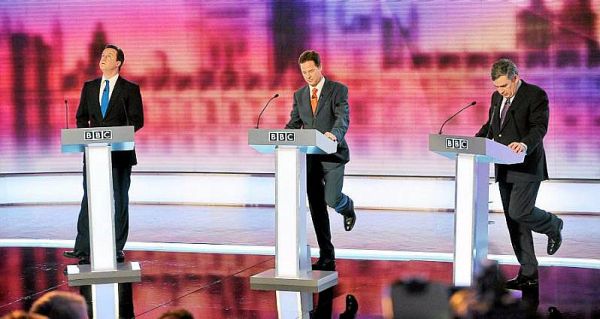
The Conservatives, on the other hand, were little more deserving. Cameron is unashamedly Blair-like, even describing himself as Blair’s heir. But although early in his leadership he has more characteristics of the later Blair, lacking much of the political verve which marked Blair’s inspirational early career. He is a self-declared moderate, which seems to mean he doesn’t really believe much of anything; he claims to be a “compassionate conservative” but speaks fondly of Thatcher. He derides parliamentary politics as a circus — which, to me, is an indicator of authoritarian managerialism, the preference to stitch up faits-accompli in smoke-filled rooms rather than submit ideas and policy programmes to the chaos of public dispute and scrutiny. For all that, he is an extremely intelligent and politically astute man; his former Oxford tutor speaking of him with surprisingly high regard during the BBC election broadcast. He is in some of these regards deeply reminiscent of our own Prime Minister. His party, however, do not seem to be of this standard; certainly not in terms of ability, and certainly not in terms of ideas. They struggled to keep pace with an ideologically bankrupt Labour party throughout the campaign and preceding term, no doubt just thanking their lucky stars that they were not having to make any of the hard decisions throughout the financial crisis. They were deservedly kept from securing government on their own, although they probably consider that they’ve been robbed, given how deeply loathed Brown and his Labour party are.

But the Liberal Democrats were robbed, although not so much as comparing their share of vote to their share of seats might suggest. They were much less to blame than either of the other two parties for abusing their expenses, and have proposed a much more thorough programme of economic and social reforms to present to an electorate clearly displeased with the tired and mediocre offerings of the mainstream. In a loose moral sense, they deserved more than they got from this election, not simply on the numbers but on the basis of their performance. But they were also the architects of their own misfortune to some extent. They unselfconsciously tried to drive a “sensible moderate” path between two parties whose electoral programmes were positively defined by stultifying sameness and a refusal to commit to anything which might make a blind bit of difference. There was too small a space between those two for anything to properly bloom. They targeted the young, immigrants, and the otherwise marginalised for votes — groups who might respond to polls, but never really turn out on election day. Clegg also played with best-of-both-worlds populism, and his “I agree with Nick” slogan is now being cruelly mocked — as it perhaps always would, given that not even the most generous projections had them winning more than an eighth of seats.

Nick Clegg and the Liberal Democrats hold an ace, and that is proportional representation. Now Labour, which has long had the political capital to implement a proportional system but has consistently chosen not to even consider it, declares itself in support of electoral reform. Blair, for all the great things he did in his first term, could potentially have saved his hapless successor’s — and his party’s — hides in this election by starting the PR reforms when he could act with impunity. I hope he regrets the decision not to. Even David Cameron, an avowed opponent of PR and representing a party with a deep, even tribal opposition to such measures, now claims to support “reform of the political system”, though — remaining true to form — he has been carefully circumspect on what he actually means by that. I reckon he means “make sure all the polling stations have enough ballot papers”, which is admittedly a good start. But PR is the only way to end the electoral corpulence of the two major parties; while they remain insulated from the challenges of lesser parties there will be no genuine improvement.

So the Liberal Democrats have to go for bust to get proportional representation, now. That, paradoxically, means supporting the Tories to the minimal extent necessary, in the classic sort of compromise that leaves neither party happy. (Though it does mean that the Lib Dems must rebuff as much of Cameron’s “big, open and comprehensive” coalition deal as they can get away with.) For all that it seems, on paper, like a wonderful idea for the Liberal Democrats to give Labour the chance to build a coalition out of the the minor parties — everyone except Sinn Féin and the DUP would be needed — such a course of action would lead to proportional representation being robustly rejected by the British electorate. To stitch together all of these competing interests and Quixotic crusades into a cooperative which can agree on a seating plan, let alone draft constitutional reforms as important as devolution wast would require a bona fide political genius. Gordon Brown is not that genius, and nor is Nick Clegg. If such a person existed in Britain at present, he would probably be the leader of a very much more substantial majority in the House of Commons already. The inevitable, catastrophic failure of such a merry band of jokers would paint for the British people the worst possible picture of what proportional representation parliaments would look like, at the worst possible time, and would leave the Tories free to simply sit on the sidelines and shake their heads knowingly. For all that it’s a self-serving platitude to excuse a deeply undemocratic system, “strong, stable government” really is quite useful during times of such deep economic crisis. Not only would these events drive the electorate into the arms of the Conservative party (who would not even need to change their slogan), but it would sink any chances of PR being adopted for a generation or more. On the other hand, to force the Conservatives to permit even a discussion about PR could grant Labour a new lease on life. Once it’s cut away the extensive dead wood, the party would be in a strong position to stand against the nay-saying Tories trying — and likely failing — to limit their exposure to the public’s will and to make a decent fist of their time in government (in that order of priority).

Probably the most memorable quote for me from this election coverage was “the voters have spoken: we just don’t know what they’ve said”. Well, it seems to me that what they’ve said is “screw the lot of you”, with the perhaps unspoken exhortation to “sort your bloody act out”. I hope that’s the message received. That means the death of expressionless, gutless managerialism in politics, and it means a genuine engagement with the electorate on electoral reform. Neither can come soon enough.

L
MMP in NZ is safe

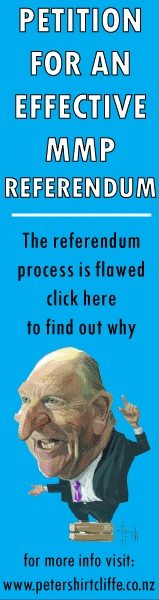
shirtcliffe ad
Evidence:

  • It has been found to work pretty well and all parliamentary parties except ACT support it.
  • The UK election is about to remind people how perverse FPP is.
  • Peter Shirtcliffe is spamming people in order to gain support for his anti-MMP campaign.
  • His google ad campaign looks like this ====>

Seriously. That’s him. A ranting white middle-aged elderly patrician of the sort New Zealand’s governments were almost exclusively composed before the change in electoral system — and on a soap-box, for goodness’ sake. A starker warning of what’s in store should the electoral system change is hard to envisage. Also: it’s visually busy and garish. The blue is neither National-party royal blue, nor ACT-party aqua-blue, nor flag-Navy; it’s nothing. The message is over-long and confused (campaign for an effective referendum? Don’t you mean to campaign against the electoral system? No? Ok then.) And the cartoon …

Thanks, Peter, you’re doing your country a great service.

(Thanks to Lyndon Hood in the comments to Russell’s thread linked above for the pic.)

[This line inserted to fill whitespace].

L

Fire in the House

The opposition was strong in Parliament today. I’m stuck for time, so what follows is somewhat stream-of-consciousness.

Front and centre was the government’s failure to perform on unemployment and wage growth, the subject of criticism from both flanks. Bill English had led off with “the budget will be about the many, not the few”, and then “but seriously …”, to a stinging rebuke from David Cunliffe, who listed the government’s failings as he saw them. This adoption by the government of Labour’s own tagline looks like an attempt to muddy the counter-campaign and poach their emphasis, trying to set up National as the party representing “the many”, rather than the policy merits of the government’s program, but if so it’s a fairly ham-fisted one. While “the many” looks on its way to becoming this election cycle’s “hard-working Kiwis”, the government’s attempt here to muscle in indicates that National has accepted Labour’s rhetorical framing, although they disagree with it. If you adopt your opponent’s narrative, you need to be able to make it your own — either that, or you need to dismantle and discredit it. English did neither.

Cunliffe was strong, also raising the variance between English’s aspirational and controversial “Plain English” ad and the policy track he has delivered. Sir Roger Douglas also took aim, and was forced by the Speaker to rephrase the question (to Paula Bennett): “Which is more important? Young people getting jobs, or pandering to the Left?”.

Bennett also took a bit of a pasting on the matter of the identity of one Peter Saunders. The Standard has picked this up so I’ll not elaborate more. Wayne Mapp, standing in for the Minister of Agriculture also stumbled on a line of questioning from Sue Kedgley regarding AgResearch’s GM cattle trials. Not exactly a shock since, not being the minister himself, that information wasn’t top of his mind, but it contributed to the general atmosphere.

Then it was all on in General Debate, with Goff, King and Cunliffe leading off on the same topic matter (jobs/wages) with a couple of fiery speeches, and re-emphasising the “smile and wave/photo-op/government by poll” meme and the retrenchment of the government’s mining plans. Judith Collins concentrated on David Cunliffe’s lack of orthodox economic credibility, and purported concern for Goff having to shoulder the dual burden of leading a party in which Cunliffe was both the finance spokesperson and a leadership contender. Nice concern troll, but what’s more interesting is how much she was looking forward to seeing Cunliffe’s expenses records — and the threats hurled across the House while she thought she was not miked — “You wait, just you wait! …” Some irony in this given that it was just yesterday Collins raised the most threadbare defence of her (or someone else’s) extensive use of the ministerial self-drive car: “All the travel is within the rules – that’s all I’m prepared to say on it.”

So, while superficially an ordinary sort of Wednesday (albeit one where the Member’s Day was not clobbered by urgency), I think this has provided a few glimpses of the 18 months to come: a robust focus on core materialist issues from the Labour party, ahead of the budget, and a clear desire to debate the policy merits; combined with continued attacks on the credibility and perceived competence of English and Bennett in particular; the government attempting to subvert the opposition’s framing rather than exclusively arguing the merits; Collins v Cunliffe shaping up as a key battle. Nothing flash, but it’s starting to look like something resembling a threat. Most importantly, something to require the government to rethink its own gameplan. Until now they’ve had the ability to act almost with impunity, their errors going unpunished. If today’s performance is any indication, no longer.

L

Public airwaves talkback


Normally Radio NZ National’s The Panel is a pretty sound — if somewhat fluffy — current affairs show, in which the panelists are ideologically fairly diverse (though not occupationally diverse; mostly celebrities, PR flacks, or newspaper columnists). They tend to leave aside their more extravagant views to engage in a fairly civil and reasoned manner.

But when The Panel happens to have two people of similar ideological views or a common background, it tends to turn into an echo-chamber of congratulatory backslapping. Today it’s nothing more than talkback for self-righteous wealthy middle-aged people who — since they’re listening to National Radio — think talkback is beneath them, but like to have a good whinge about how society’s going to the dogs anyway. The guests are private investigator Julia Hartley Moore and former cop and current Police Ten-7 presenter Graham Bell, and the topics for discussion (and general timbre) are as follows (From memory, so I may omit some, but you get the idea):

  • TV harmful for very young children: “We never had TV in my day, we went outside! Parents are using TV as a babysitter! Never did that in my day! TV is rotting childrens’ brains! There’s no excuse for ever doing anything other than what’s perfect, we always did!”
  • Cellphones used to arrange and record fights: “I told you cellphones were bad, never come to any good, those things. We never had cellphones in my day, and even if we had them we’d never have gotten into fights. And even when we got into fights, it was all posturing, really, and nobody ever actually got hurt. It’s the parents’ fault, letting their kids watch TV.”
  • Kent State massacre 40th anniversary: “Yeah, that was pretty bad.”
  • People throwing litter from cars: “I can’t believe people do that, and people with flash cars as well! Never would have happened in my day.”
  • Young people should be allowed to drink because they can vote and fight for their country: “I don’t think they should be allowed to do any of those things! In my day we got a bit pissed, and some of us still do, but that was different. These new alco-pops are ruining society! I blame the parents, what are they doing about this? Disgraceful.”
  • No service at service stations: “PC OSH nanny state gone mad! Old ladies having to check their own oil and water? Total bollocks! Teenaged attendants who only take your money, was never like that in my day. And don’t get me started on pre-pay pumps…”
  • Hypochondria: “I blame the internet, and the expectation that the medical profession can just provide a magical pill which will fix everything!”
  • Roman Polanski reckons he’s done his time for drugging and raping a 13 year-old girl: “No way, he’s been living the good life. Throw the book at him — hang him high!”

Well, I sort of agree with the last one. But this is the sort of reactionary love-fest we expect from the rest of the opinion media, not from Radio NZ. It’s not the conservatism I can’t stand; it’s the absence of reflection and the naïve belief that the world really is that simple.

Update: To demonstrate the extent to which I’m not exaggerating, you can listen here.

L

Organic protest, and reframing the mineral debate

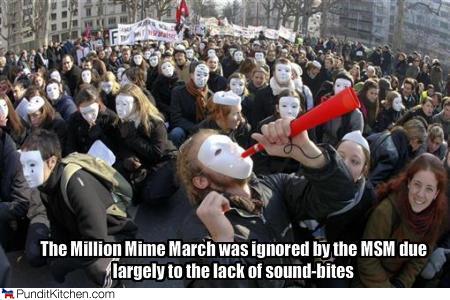
political-pictures-mimes-million-march

Like many others, I was amazed at the turnout for the anti-mining protest in Auckland on Saturday. That 50,000 people would turn out for such an event is remarkable in itself — the NZRU’s financial problems would be solved if they could attract so many people to half a dozen rugby matches each year, and we’re currently rebuilding Eden Park so they can seat that many a dozen or so times next year, and then maybe once or twice a year thereafter.

But the more remarkable thing about this march was its apparently organic nature. From my read — based only on the media coverage, mind — this was not a visually and ideologically cohesive, “branded” demonstration such as “enough is enough” and the more recent child discipline march, which were more or less Boobs On Bikes without the boobs or the bikes, advocating the wholesale adoption of a political product. It was not a heavily stage-managed piece of public theatre as the Foreshore and Seabed hÄ«koi was, and it was not a set-piece undertaken with a specific tactical purpose such as the most memorable marches of the Springbok Tour were. There were t-shirts and banners and so on, but these were not issued like uniforms with marching orders and approved wording for slogans, imagery and talking points. These were not rented crowds, seas of mime-like bodies serving as a vehicle for someone else’s words and sentiments. This was a genuine all-comers march, and if its almost unprecedented turnout did not bring genuine authority, then its authenticity surely must.

The response from the usual authoritarians has been a heady blend of confusion, disbelief and denial — the same sorts of delusions I normally accuse Labour partisans of falling prey to, when the observable data fails to conform to ideological modelling. This is bad for them, and good for those who oppose the government’s mining plans: if the government persists in believing the models instead of the data, it will go the way of the last government which did so.

But I don’t think this government will do that. I think it will see the writing on the wall, and reframe the mineral debate. Key and Brownlee have surely now seen their error: addressing mining in Schedule 4 as a national economic development issue rather than as a set of regional development issues. Going for it all in one bite was greedy, and as Danyl says, reflects the sort of complacency which creeps in when your opposition isn’t up to the task of opposing. But as strong and authentic as the Auckland march was, it has a weakness, and that’s that it’s composed of Aucklanders. Mining schedule 4 as a national strategy has failed, and likely at the cost of the opportunity to mine in the Coromandel and on Great Barrier Island, but it has thrown into sharp relief those areas where local views are less opposed — such as Paparoa, and possibly Mt Aspiring. As I commented on The Standard earlier, West Coasters are overwhelmingly in support of extended mining, a solid turnout in Nelson notwithstanding. Portraying Nelsonites as latte-sipping greeny liberal lifestylers begrudging their honest hard-working brethren on the other side of the hill a chance at the riches of the land will turn this into a classic town/country divide of the sort National and its mining allies are very skilled at exploiting. So watch for a few hundred — or maybe a thousand — Coasters marching in Westport to support the mining proposal being equated to this weekend’s demonstration in Auckland, and watch for well-meaning Aucklanders, Wellingtonians, Nelsonites and those from elsewhere being told in fairly certain terms to butt out of their regional business.

The government will be taking a risk if it proceeds with this plan, even in a regional form, because it has already permitted the debate to be established as a national issue about national parks in which everyone from the Cape to the Bluff has a stake — but it has amassed plenty of political capital, and now is the time in the electoral cycle to use it. Particularly with the Australian federal government unveiling a new resource tax, New Zealand just got more attractive for mining interests, and the imperative to dig, baby, dig will be stronger than ever.

L

Cannabis bust news coverage bingo

Here’s a fun game. Watch tonight’s TV news (either channel) and count the following tropes.

Update: I did this — both channels, since they were conveniently on at separate times, and was pleasantly surprised by reasonably sober tone of coverage. Comments in italics.

  • Gratuitous display of cannabis leaf or other marijuana iconography
    Four times on One and thrice on 3. Mostly in the display of the “Switched On Gardener” signage.
  • Gratuitous display of drug porn (huge quantities of plants, or egregiously sticky buds, etc.)
    5 times each. TV3 used this as their studio backdrop, otherwise it was the same stock footage throughout, obviously supplied by the police. A distinct lack of additional file footage and High Times-style images of the sort which are usually stock-in-trade for this sort of coverage.
  • Police casually destroying huge quantities of same
    None! Only some police confiscating computers, other equipment in the TV3 footage.
  • Tenuous linkages of marijuana with other drugs, violence or terrorism
    None! Some passing mentions and image of other drugs, firearms and references to organised crime, but nothing tenuous or unjustified.
  • File footage of a shadowy person smoking a joint — None!
  • If it’s clear despite anonymisation that the person is brown-skinned
    None of these either.
  • Footage of people being arrested or detained
    No images of people being arrested. One shot of an unidentified (white) person walking down the street as the voiceover informed us that those arrested were appearing in court.
  • Footage of supposedly ill-gotten gains: flash cars, etc.
    Twice each, references to property being seized under proceeds of crime legislation. Nothing major.
  • Smug, serious middle-aged white people expressing deep concern.
    The only examples of this in both cases were press conference shots of the senior police officer.
  • Triumphal statements that this has broken the back of the cannabis industry, with no supporting evidence
    Again, just what the police told us. Reporters stuck generally to the facts.
  • Reporter looking smug and saying words to the effect of “we can’t reveal which garden centre at the moment …” with the clear implication that it’ll all become clear pretty soon, and anyone who’s anyone already knows
    Well, although National Radio didn’t report (and the police refused to say on-air) which gardening shop chain it was, it was no secret, so none of this.
  • Breathless revelations that people who aren’t beneficiaries or gang members are involved in cannabis production and consumption
    Mentioned twice on One and once (but more extensively) on 3 — the fact that “managers and directors” of the company were among those arrested. But in general, not a big deal made of this fact.
  • Implication that schoolchildren might have been in danger
    Not mentioned or implied at all.
  • No mention of the fact that alcohol causes orders of magnitude more harm by almost every indicator
    Not mentioned or implied either, but on both channels, the booze story took precedence, occupied considerably more screen time, and was covered in much more depth.

So, all in all, nothing much to separate the coverage on One and 3 news. Both items were characterised by a heavy (almost total) reliance on official source material and footage — although both did a field cross, TVNZ’s was the usual pointless live cross, while TV3’s reporter didn’t even make the screen, with the field shots showing police hauling stuff out of a building. Both used similar (probably supplied) footage and images as background, and emphasised the length of the investigation, the number of people involved, and the impact the bust would have on the cannabis industry. Neither report was journalist-centric, with both reporters essentially relaying facts with a minimum of editorialisation. Both reports showed a distinct lack of sensationalised narrative, imagery or suggestion, lacking the usual devices employed to propagandise and pad out this sort of topic matter.

So: well done One and 3 News :)

L

As advertised

Late last year, when the ACC ructions were underway, the professionals working in the sector warned that people would die as a consequence of the reforms mandated by the new Clinical Pathway on the assessment and treatment of sexual abuse victims.

Since then, and on the basis of the pathway, ACC has taken to declining claims despite publicly claiming consistently throughout the past six months and as recently as today that there was no cost-cutting imperative. This has resulted in a drop of more than 90% in the number of claims approved year-on-year. Explain that, if you can. Nick Smith couldn’t, though he tried to do so during Question Time. It has also caused a chilling effect in which people are simply not applying, since they’d have to undergo the trauma of the exhaustive documentation and excessive review required by the pathway only to have their claims declined.

It’s impossible to separate these reforms from the overarching government plan to privatise — partially or wholly — ACC, and when viewed in this light it becomes clear what’s going on: this is how insurers make their profits. And, just lilke it said on the box, people are dying. It’s a good thing there’s going to be a review, but what’s better is that the sector is organising their own review in parallel. Should make for an interesting compare-and-contrast. I am aware that certain senior National party MPs are aghast at the conduct of ACC, so there may begin to emerge some pressure from within the party for change, as well as from outside. We’ll see.

L

Current events

I was reluctant to post while I had the chance on ANZAC day, since there was such a good debate going on, and now I’ve (temporarily) run out of time again. So just a few quick observations.

  • Phil Goff’s one-two punch on the top tax rate and Auckland governance is solid, and both are good orthodox Labour positions for him to take. But it’s more of the same: lacking verve and failing to get cut-through as a consequence. I mean to post on the positioning of the taxation pledge at some stage, but in case I don’t get to: this is a good opportunity for Goff to demonstrate compromise as well as differentiate himself, by coupling a reimplementation of the top rate with an increase of the threshold.
  • Even without Sunday’s tragic helicopter crash, Goff’s timing was poor in making these two announcements before ANZAC Day. I guess you take the opportunities you can get, but delaying things by a week would have been more useful in my view.
  • As an aside, my mum knew the three late airmen vaguely through Search and Rescue, and confirms the universal sentiment that they were of the very best sort. I’m pleasantly surprised that the crash hasn’t turned into a witchhunt about why we’re still using Vietnam-era hardware; as true as the sentiment might be, we can all do without people thundering “if we’re going to have a military, we owe it to our troops to have it decently-outfitted” under circumstances such as these. Such is the power of ANZAC day, I suppose.
  • On a related point, the discipline with which the military, government, police and media have adopted the Air Force’s framing terminology in this event is remarkable. All four groups are talking about “the Air Force family” and exploiting the metaphor for all it’s worth. Those words are used almost every time one of these people stands in front of a microphone, and in addition the three deceased are “brothers”; Mark Sainsbury reported live last night from the family’s “lounge”, the squad room at Ohakea air base; all four have referred to the Iroquois as being like “your grandfather’s axe” — the reference being that, although it’s very old, when the handle is worn it gets replaced, and when the head is worn it gets replaced, so while it’s his axe in spirit, it actually contains no parts of the original tool and is as good as new in function. On the one hand, this is compelling symbolic stuff: nobody who deviates from this framing can really be said to be showing the proper sort of respect and deference; on the other hand, it’s a bit creepy for everyone to be falling into lockstep behind Defence HQ communications. There are ways of saying these things without using the exact same words, and the constant repetition spooks me. Maybe I’m just sensitive. [Edit: There was a clean sweep for “Air Force family” or something similar in speeches supporting the Prime Minister’s parliamentary motion of condolence. No shock there, I suppose.]
  • On a somewhat lighter note, Councillor Tony Jack has picked the wrong district council to put a motion banning macrons in council materials. This is the Kāpiti Coast District Council, who moved to put the macrons into Paekākāriki and ÅŒtaki only a month ago. Jack’s motion was voted down, at which point he predictably declared that PC had gone mad. Bless. Of course, the Stuff article doesn’t contain the macrons, so I guess he wins as far as that goes.
  • Tim Watkin at Pundit continues to write excellent sense and ask smart questions about race relations in Aotearoa New Zealand. I think the emphasis in Tim’s piece is just right — there is a legitimate claim to indigeneity for non-Māori, but it’s not so obvious as Trevor Mallard’s “I was born in Wainuiomata”, and there’s a lot to work out before such definitions can be settled upoin comfortably. I’m all for having this discussion. I particularly like the ornithological allegory drawn by commenter “william blake” — we are all PÅ«keko!
  • Also on a lighter note, a (very) atheist friend whose six year-old daughter has chosen to go to Bible study classes recently asked him if, because Jesus had risen from the dead, that meant he was a zombie. It apparently took every ounce of his parental commitment to letting his girl make up her own mind to explain the origins of zombie stories, how myths come about, etc. rather than just saying, yes, Jesus is a zombie. Good on him — not sure I would have had the fortitude.
  • Speaking of things biblical, and of belonging, Joanna Newsom has a new album out, and here’s the first single — about tilling one’s own bit of the Garden of Eden:

Ok, so not so brief after all. Discuss. I’ll dive back in as I can. You can treat this as an open thread as well: post what you want to talk about.

L