Brief considerations on Korea

Normally I would leave discussion of this sort of topic to Pablo, whose expertise is much greater than mine (and I expect he will weigh in with his own thoughts on the topic too). But I lived there for a few years and had a great deal of time to ponder the security situation there, both through my own research and in discussion with several groups of former soldiers and senior businesspeople whom I was teaching English whilst there, and I think I have a handle on it.

A bit of background. The DPRK (North) and ROK (South) Korea remain officially at war; the armistice agreed in 1953 after the Korean War was not a peace treaty and signalled only a cessation of hostilities which has been accompanied by significant military and intelligence preparations on both sides. It is a tense situation, but it is at a fairly stable equilibrium because the mutual assured destruction principle still holds to a large extent. The ROK and its allies understand that the DPRK and its primary military and command assets are sufficiently well-defended that an assault from the South would draw a counter-attack which would inflict massive civilian, military and infrastructure casualties — estimates range in the hundreds of thousands of deaths in greater Seoul alone, which is within easy artillery range. And that’s with conventional weaponry alone, not taking into consideration the possibility of chemical, biological or nuclear weapons (the regime certainly has the former two; it’s generally agreed that it also has the latter, but not in a deliverable form). For its part the DPRK understands that such an assault on the ROK would spell the end of its regime at the hands of a US-led NATO force.

There is a sense among people responding to the the news that yesterday’s exchange of artillery fire at Yeonpyeong Island in the West Sea is qualitatively different from the dozens of other skirmishes which have taken place over the past 50-odd years of this cold conflict. It is true that this is one of the more serious engagements of that war, but it essentially follows the same pattern. Some action by the ROK and its allies (in this case a joint US-ROK naval exercise) granted the DPRK a pretext to rattle its chains; it fired a few rounds and some fiery rhetorical statements and the ROK does likewise. Two ROK soldiers have died, a dozen or so soldiers and a few civilians have been injured, and more civilians from the region have evacuated to the mainland. The casualty count is higher than usual, but so far, so typical. Late last night (NZ time) the DPRK released a statement alleging that the ROK had fired first. This is almost certainly false — the ROK rarely instigates these sorts of engagements — but that doesn’t matter. The purpose of the statement is to raise questions as to the ROK’s moral standing in the engagement, and to provide the ROK government with cover to stand down on the basis that it’s not worth going to war over a misunderstanding. If they do stand down the ROK government risks a minor loss of face, but since they are a liberal-democratic state whose populace has no appetite for war (and for the strategic reasons mentioned above) then barring much more serious provocation they will do so, President Lee Myung-bak’s own florid rhetoric about “enormous retaliation” notwithstanding.

Again: business as usual. While this latest event is perhaps quantitatively more serious than some previous events, it is qualitatively no different. This is the same strategic posturing game which is played out every crab fishing season in the West Sea, and year-round on the land border between the two states. The most serious mistake most of those who are now calling this the start of World War III are making is to try to understand this event in customary diplomatic terms as they would the relationship between two liberal-democratic states in good international standing. The DPRK’s actions and motivations make no sense when viewed in this light, because the DPRK is not, and never has been such a state. The explanation of these events are to be found, if anywhere, in an examination of the DPRK’s internal regime dynamics. Pablo has written about this topic recently with regard to the sinking of the ROK naval vessel Cheonan in March, and I urge you to reread his post in light of these most recent events.

So I don’t think there’s anything much to this. Due to the DPRK’s military doctrine of total war, an invasion or genuine commencement of hostilities would not begin with a few mortars; it would start with a massive and rapid deployment of force, targeted at the most vulnerable civilian and infrastructure targets, likely in the middle of the night and preferably during an adverse weather event or some sort of civil unrest. None of these conditions abide at present. But the fundamental point is that the tense yet stable strategic situation on the 38th has not changed, so it is very unlikely that either side will choose this juncture as the hook upon which to hang the possible demise of their state. There have been some recent developments in that strategic situation — the probable elevation of Kim Jong-Il’s son to a senior position in preparation for ascent to leadership of the regime; fresh concerns about the regime’s nuclear weapons program, and so on — but I believe these are too minor and too recent to have wrought the sorts of changes to the internal DPRK dynamic and to the cross-border dynamic which would be required for a substantial change in posture.

Of course, you never know. I have no special inside information or insight into the strategic situation there, and it may be that events of which few people are aware are driving this situation. But on the face of things this has been just another day on the 38th Parallel.

L
Isolated

This brief report from Radio Waatea brings into crispish focus a few issues regarding the māori party’s support for the new Marine & Coastal Area (Takutai Moana) Bill, and perceived collaboration with the National-led government against its constituents’ own interests:

Sharples upset at Maori Media Ingratitude
Maori Party co-leader Pita Sharples says he’s disappointed at the heat coming on him from the Maori media over the Marine and Coastal Area Bill.
Criticism of the bill by iwi such as Ngai Tahu and Ngati Kahungunu and from Taitokerau MP Hone Harawira has been extensively reported.
But Dr Sharples says it’s better than the existing Foreshore and Seabed Act, and the Maori media should reflect that.
“They forget we’re there on their side to do stuff for them. Instead of sort of helping us knock down the barriers, they try to knock us down as the barrier. And yet without as it were the initiation of us in there, there would be no efforts at all and in the context of past Maoris in government, we have really achieved outstanding results,” he says.
Dr Sharples says the Maori Party hasn’t got enough credit the whanau ora welfare delivery model and for his rehabilitation units in prisons, which will open next year.

Sharples is right in several important respects. The role the māori party party has played in getting take Māori and tino rangatiratanga on the government agenda has been crucial. The māori party really does have a unique claim to an “authentic” kaupapa Māori politics, and this should make Māori media such as Waatea, Māori Television and TVNZ’s Māori programming division (which produces Te Karere and Marae) should be strongly sympathetic towards their policy programmes. Should, I say, if the end policy result was seen to be consistent with those kaupapa.

But these agencies do not owe the māori party any favours. As media outlets their job is not to shill for a party line but to present a considered view of current events in context, and by reporting the deep dissatisfaction within Māoridom regarding the MCA bill they are doing just that. Māori media have generally shown a strong commitment to independence and impartiality — which is a particularly tricky thing to do given their cultural focus — and their coverage of the māori party’s policy platform is simply an extension of that commitment. Long may it continue, and would that it were more broadly shared.

What this episode really illustrates is the extent to which the māori party is isolated from its support structures with regard to its position on the MCA bill. Just as the party has failed to persuade its own constituency, and indeed its own caucus, that the MCA bill is worth supporting, it has failed to persuade the only media establishment which might be sympathetic to its cause as to the merits of that cause. All this illustrates one of two things: either the party is way off base; the strategy of supporting the bill is bad for Māori and Māori know it; or that the strategy of supporting the bill is actually a great deal better than anyone knows, but the party has largely failed to articulate this.

I know which I’m tending toward, and I invite readers to argue their case. But no matter which you believe, I think it’s clear that attacking the media is neither a mature nor a useful response. Successful actors in modern democracy lead the media, like they lead their electors — in the knowledge that both must follow willingly, by consent (however grudging), or not at all. If, as a politician, you ever find yourself running a sustained campaign of trying to shove either the media or your constituents in a certain direction against their will, berating or harassing or whipping them for their stupidity or intransigence or for simply failing to follow instructions — then you have very probably already failed.

L

On a lighter note: Machine of Death

Not that the Rolling Stones have destroyed us — I mean, you can’t always get what you want. You know what I’m saying? Brown sugar. I have no idea what that means.  -- Glenn Beck, The Glenn Beck Program, October 27, 2010

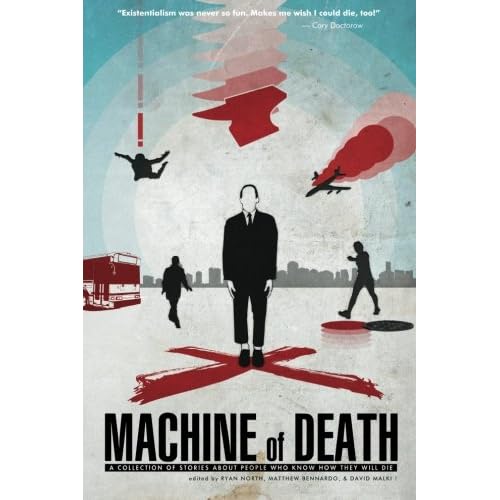
On 26 October 2010, the guy who writes the marvelous Dinosaur Comics and a bunch of others self-published a book (because nobody would publish it for them) of short stories based around the idea of a machine which could tell you how you would die. The book is called Machine of Death. They happened to choose October 26 as the publication date without knowing that Glenn Beck’s latest tome of dangerous absurdities with the suitably loony title “Broke: The Plan to Restore Our Trust, Truth and Treasure was to be released on the same day. While it’s nice that Machine of Death pipped Beck’s book in the amazon.com sales rankings on opening day (proof), what’s most wonderful about this little episode is that it so incensed Glenn Beck that he had a wee rant about the book on his widely syndicated radio programme. It’s so gloriously insane, there’s nothing to do but quote it in full:

And I want to tell you that, um…our books are ALWAYS #1. And I find it REALLY fascinating, FASCINATING, that if you go to Amazon.com, Broke is number THREE. And the two books that are ahead of it — one is Keith Richards’ Life, which is getting a TON of — you know, that’s everywhere.
But this is a book about, you know, how he snorted his father’s ashes, after death. (sarcastically) THAT’S cool. This is the SDS [Students for a Democratic Society] book. This is for all of the — this is for [union leader] Andy Stern who’s all, I guarantee you he’s on the phone and has been the last few days, you know, with people like, you know, Bill Ayers going “All right, DUDE! Ah, do you remember when we were rolling around in the mud like animals? Remember that? This guy was smoking ash — you know, smoking his dad, and, and, popping stuff into his veins? Ah, those were the DAYS, man.” And then William Ayers was like, “Whaddaya mean, those were the days? I’m still doin’ that stuff, man!”
So that… “culture of death.” And it’s an escape into the past, of, you know, the Woodstock stuff.
And then, the #1 book — TODAY, at least — is Machine of Death. And it’s a — collected stories about, you know, people who know how they’re gonna die. Haowww!
So you have DEATH — I know it’s called Life, but what a life it is, really! It’s a culture of death! OR, “How do we restore ourselves?”
These are the — this is the left, I think, speaking. This is the left. You want to talk about where we’re headed? We’re headed towards a culture of death. A culture that, um, celebrates the things that have destroyed us. Not that the Rolling Stones have destroyed us — I mean, you can’t always get what you want. You know what I’m saying? Brown sugar. I have no idea what that means.
— Glenn Beck, The Glenn Beck Program, October 27, 2010

This, as if it needs to be said, is the other side of the Angel of Death ad I wrote about the other day; what happens if the font of inchoate hatred which powers the Tea Party movement isn’t carefully channeled through propaganda wizards and filmmakers and spin doctors. Wonderful. Frightening.

L

Class, identity, solidarity and dissent

Recently commenter Tiger Mountain raised the parallel between solidarity with Actor’s Equity regarding The Hobbit and support for the māori party given their coalition with National and sponsorship of some bad legislation. I explained how they’re not equivalent, but leaving aside the main difference of mandate (which the māori party has and AE doesn’t) the wider issue of critical solidarity is an important one, and one which has been raised several times recently. In the wake of The Hobbit fiasco matters of class, identity and solidarity are high in everyone’s minds, and I think in spite of our many differences, we can agree that’s a good thing.

Another contribution to the wider debate is by Eddie at The Standard. For once I find myself agreeing with Eddie’s opening sentence about the māori party, which is:

The problem with any identity-based political movement is it pre-supposes that the common identity of its members surpasses their conflicting class interests.

It’s true, although I would have phrased it as follows:

The problem with any class-based political movement is it pre-supposes that the common class of its members surpasses their conflicting identity interests.

I wrote at length about this dynamic tension at a time when it looked like Labour was going to force Māori to choose between their class identity and their identity as tangata whenua — and how foolish forcing such a choice would be. (It’s still not clear whether Labour has abandoned it, but it at least seems obvious that they don’t have a full-blooded commitment to the blue collars, red necks strategy. But that’s by the way.)

What tends to follow from statements like that one is a series of value judgements about which set of interests ought to take precedence. This can be valuable, but is often tiresome, particularly when those making the pronouncements are “fighting a corner” for only one half of the equation (usually, it must be said, the “class” corner). But Eddie has mostly (not entirely) resisted the urge to do so and focused on the internal dispute within the māori party, and in particular the rather dictatorial stance taken by Tariana Turia regarding opposition to the new Marine & Coastal Area (hereafter MCA) Bill. That’s an important debate and examination of it is valuable, but what’s not really valuable is Eddie’s attempt to frame Turia’s stance as a matter of māori identity v class identity. It’s not. It’s a matter of the tension between moderate and radical factions within the movement; part of the internal debate within Māoridom.

Class is an element of this internal debate, but it is not the only element, and I would argue it is not even the predominant element. I think it’s clear that the conciliatory, collaborative, third-way sort of approach to tino rangatiratanga taken by Turia and Sharples under the guidance of Whatarangi Winiata (and whose work seems likely to be continued by new president Pem Bird is the predominant force. I also think the main reason for the left’s glee at the ascendance of the more radical faction is largely due to the fact that there’s a National government at present (and recall how different things were when the boot was on the other foot from 2005-2008). Those leading the radical charge against the MCA bill — notably Hone Harawira, Annette Sykes and Moana Jackson (whose primer on the bill is required reading) are not Marxists or class advocates so much as they are staunch advocates for tino rangatiratanga, who oppose the bill not so much for reasons based on class, but for reasons based on kaupapa Māori notions of justice. The perspectives of all three are informed by these sorts of traditionally-leftist analyses, but those analyses are certainly not at the fore in this dispute (as they have been in some past disputes). In fact, the strongest (you could say “least refined”) Marxist critiques of the bill advocate for wholesale nationalisation of the F&S, unapologetically trampling on residual property rights held by tangata whenua in favour of collective ownership.

For Eddie’s caricature of the dispute as “identity” v “class” to hold strictly, Turia, Sharples, Flavell and Katene would need to occupy the “authentic” kaupapa Māori position, the legitimate claim of acting in the pure interests of mana motuhake and tino rangatiratanga; while Harawira, Sykes and Jackson (among others) would need to be largely denuded of this “identity” baggage, and be more or less pure class warriors. Neither is true; Harawira, Sykes and Jackson’s critique of the bill isn’t a Marxist critique; they’re arguing that the bill doesn’t serve the imperative of tino rangatiratanga and is therefore not an authentic kaupapa Māori position; an assertion that Sharples has tacitly accepted with his response that the Maori Party must accept compromise. (This is true, of course; I agree with Sharples and Turia as far as that goes. I just disagree that this bill is the issue upon which to compromise so heavily. Because of that, I come down on the side of Harawira, Sykes and Jackson.)

The other misguided thing is how Eddie frames Turia’s insistence that Harawira and others adhere to the party line as some sort of manifestation of Māori over class identity within the party — the quelling of dissent and insistence on loyalty to the leadership elite’s position as a “Māori” way of doing things, opposed to a “Left” way of doing things. This is absurd. The “left” does not automatically stand in defence of dissent or the public airing of heterodox views, much though Eddie (and I) might wish that it should. As I already mentioned, this is shown by Labour’s response to Turia in 2004 and the māori party’s first full term, suspicious at best and hostile at worst. The AE dispute is also an excellent illustration. In that case, the prevailing, “authentic” left position (including that taken by many writers at The Standard, though not — as far as I can recall — by Eddie) was to insist on total public solidarity with the union. In other words, precisely what Turia is insisting upon. I disagreed with this position in AE’s case, and I disagree with it in the māori party’s case. Dissent of this sort (or the imperative of its suppression) is not some innate part of “the left”, nor is it absence a characteristic of “identity politics”. It can exist or not in movements of either type, depending on the merits and specifics. It’s my view that such dissent is the beating heart of a movement, and it is peril to quash it. It is a shame that Turia seems to be making the same error as Helen Clark made regarding this issue in 2004.

But despite these objections, ultimately I agree with Eddie about one other thing: the dispute is really interesting, and the emergence of radical critiques and challenges within the movement is exciting and important. The māori party has a mandate to agree to the MCA act as drafted; after all, according to Edmund Burke’s famous saying, representatives owe their constituents not only their efforts but their judgement on what is just and right and possible. They’re not elected to always take the easy route of political martyrdom, and because of this they may find themselves staring down their constituents. Sometimes they may win. But nowhere are representatives guaranteed that those constituents must not try to stare back. If those who oppose the bill can raise a hÄ«koi in support of their cause, then let them do so, and more strength to their waewae. And let members of the “left” movements, if their enmity to the bill is genuine, rather than a reflexive attack on a National-led government and the māori party orthodoxy which supports it, march alongside them in solidarity. That will be some sort of justice.

L

Enemies like these

I’m getting used to being vilified by the orthodox Marxist left, such as in the latest round of debate with Chris Trotter and some of his commenters, and to an extent in the response by Scott Hamilton. I don’t mind all that much, but it’s rather aimless. The critique that I’m not orthodox enough, not a proper red; that my sense class consciousness is atrophied — it all misses the point somewhat. I’m not a socialist; never have been. I’m a liberal social democrat, with strong emphasis on the “democrat”.

I’m a trade unionist because of this commitment to democracy. Unions, properly run, are strongly democratic — and their democracy enhances the more usual parliamentary and representative forms which govern our society. The question in the AE case, the matter over which I disagree with Chris and Scott and the orthodox Marxists is: from what does a trade union derive its moral authority? From the democratic mandate granted it by the workers it represents and the extent to which its actions serve their interests, or from its ideological rectitude and adherence to Marxist doctrine? I’d argue that both are necessary; the movement’s activities must be informed by a class analysis, but fundamentally the union exists to enact the wishes of its membership. The job of union organisers and so on is to educate and motivate that membership to commit to class struggle. The argument Chris and Scott are making, as if it’s an irreducible truth of trade unionism, is that the ideological rectitude on its own is enough. The quality or value of a union’s actions must not be assessed or tested against their workers’ stated needs, they say; if whatever a self-declared union and its handful of activist representatives decides to do passes the Marxist sniff-test, then anyone who fails to fall into lockstep behind it is a scab, and mandate be damned. (I’m not sure they even believe this, really; I think there would be some things even the most die-hard socialists would balk at — which would mean we’re simply disagreeing over the merits of AE’s case, which I think is a much more useful argument to have. I posed a hypothetical question to this effect on Bowalley Road this morning, but have received no responses at the time of writing this.)

But falling automatically into lockstep behind a union’s actions without consideration of whether they’re any good, or whether they serve their industry’s stated needs is bad for society, and it’s dangerous for the unions.

In our liberal democratic society, the right for workers to join a trade union and bargain collectively derives from the democratic nature of union movements; the fact that they enact workers’ wishes. This is the basis of the strong and very legitimate democratic Marxist critique of corporatism; that businesses in a democratic society ought to be democratic. It is also one of the chief arguments deployed in unions’ defence, and it is a very good one in a social and political context where the idea of democracy occupies such a powerful symbolic position. Unions do not enjoy any legitimacy by virtue of their ideological rectitude; in fact, their commitment to Marxist ideological doctrine is a considerable disadvantage in terms of their survival. Because of this, the trade union which relinquishes its commitment to democracy also risks relinquishing its claim to legitimacy, and if trade unions as a whole start to cut corners on democracy, then the movement as a whole risks granting anti-union governments a pretext to weaken and outlaw unions on the basis that they don’t actually represent workers’ interests. This is quite apart from the points I made in my last post on this topic, to the effect that non-democratic institutions tend to make bad decisions because they lack robust internal processes for developing and enacting their agendas.

So my overarching problem with Actor’s Equity acting without a mandate is that they risk the legitimacy of the trade union movement at large. (I initially predicted, in comments at the Dim Post, that the fallout would be contained by the wider movement — how wrong I was.) I try never to give my allies a pass for incompetence. Doing so breeds more incompetence. I didn’t give Labour a pass for the Foreshore & Seabed Act and I’m not giving a pass to the māori party as they look to be supporting a similarly expropriative replacement bill. So there’s no way I’m going to overlook the real and serious damage caused to the trade union movement and the cause of workers’ rights by this upstart union who took excessive action without a mandate. They’ve done real and genuine harm to the trade union movement and they’ve made industrial relations — which should have been a Labour’s trump suit — an easy source of tricks for the government. And this at the very time the union movement was beginning to gather strength again! There was an anti-union protest on Labour Day — how much worse do things have to get? Sure, blame the Tory government, or the ‘right-wing media’ or the falsely-conscious running-dogs; and to an extent this is justified. The government must bear sole responsibility for the legislation they’re passing, for instance; the details of that bill cannot be blamed on AE. But AE provided them the cover to pass it without much controversy; and indeed, none of these agencies enjoyed the political and symbolic freedom to unleash the sort of anti-worker tirades they have in recent weeks until AE’s egregious overreach — all with the full blessing of Trotter and Hamilton, almost everyone writing and commenting at The Standard and all those orthodox Marxists who claim to be champions of the worker. With enemies like these, Key and his government — and their ideological fellow-travelers — have no need of friends.

L

Lessons from The Hobbit: more unionisation, not less

The Hobbit saga has been an ugly but edifying lesson in the realities of how industrial action interacts with political posturing and national identity. My own view is that Actor’s Equity did their industry and their country — I would say ‘their membership’, but when they set this ball rolling they didn’t have one — an enormous disservice. Lacking a mandate and any legal standing, they undertook almost the worst possible course of action of calling an international SAG boycott. They attempted to hold a national icon and his nationally-iconic production to ransom at the apparent behest of an Australian union (the MEAA) with a history of this sort of aggressive mismanagement and who stands to gain from any reputational damage suffered by the New Zealand film industry. Their cause is worthy, but they picked the wrong fight with the wrong person at the wrong time, on the wrong basis, employing the wrong tactics, and did so without the support of their industry. Almost everything they could do to lose this battle, they did.

But too much has already been written on that topic, and I won’t add to it any further. The point I’d rather make is that the incompetence shown by AE in this dispute would never have thrived in a more robust industrial relations culture: that is to say, one in which union membership and participation was the norm rather than the exception, in which more workers had an understanding of what their union was there for and the union in question understood their industry’s needs and agenda better.

Fundamentally, the entire problem here is AE’s lack of a mandate: even leaving aside the fact that they had no legal standing as a NZ union until this time last week, the trouble is that they represent a tiny fraction of the actors who form a tiny fraction of those responsible for the production of any film, and yet they have the apparent ability to blacklist that entire industry (whom they don’t represent). Even the most ardent trade unionist can surely see the moral hazard here. All those who we’ve seen fronting AE have been the best-respected and most-established actors; actors whose careers aren’t in material danger regardless of the outcome of The Hobbit. But what of those actors who are genuinely struggling, whose faces don’t appear in tens of thousands of living rooms every Tuesday night, and who don’t top “best-of” lists? And what of the silent legions of drivers, designers, artists, labourers, riggers, electricians, carpenters and caterers who are the real motive engine behind the film industry? Are their needs well-served by the actions of a few prima donnas who represent them without their consent? Apparently not, which is why a thousand of them turned out to protest the actions of that unelected few. Orcs, Chris Trotter called them; useful idiots said Idiot/Savant.

To an extent it’s their fault for not being adequately organised to mount a counter-insurgency against AE’s hijack of their industry. And that’s why my suggestion is for film industry workers to arm themselves and prepare to fight for their needs. Whether it’s in separate unions by sector or a single, unified screen workers’ union doesn’t much matter, as long as there is strong and robust organisation behind it which elects leaders who hold a genuine mandate to speak for the real needs of their industry. Nature abhors a vaccuum, and the only way that a handful of pretty faces and household names with little or no industrial relations experience and an Australian carpetbagger with a reputation for mischief-making get to speak for an entire industry is when the alternative is nothing. Conventional wisdom — particularly from the government — is to de-unionise, and already the veiled threats about the consequences of a general strike during the 2011 Rugby World Cup are beginning. But de-unionisation at a time like this simply cedes the field. Efforts must be redoubled — not only to negotiate the sorts of concessions gained by Irish actors for collective bargaining among independent contractors, but to ensure that whoever claims to have a union mandate in future has the crowd with the torches and pitchforks following them, rather than chasing them.

L

Coming this Fall: the Battle for America’s Soul

Imagine that title in scary-movie-narrator-voice. Via Pascal’s Bookie, a simply magnificent piece of propaganda from Personhood USA.

This two-minute ad is superbly done. It frames Colorado’s 1967 abortion law as the beginning of the end, and Amendment 62 in Colorado, which aims to declare that personhood begins at the moment of fertilisation, as the beginning of the battle to save America. Amendment 62 is up for the vote at the mid-term elections in November.

What we have here is clearly not the work of amateurs, nor of itinerant cranks in trailer parks, as many (including myself) have mocked the Tea Party movement. It draws together all the conventional Tea Party wisdom about what’s wrong with America into powerfully truthy narrative: start with a misappropriated Jefferson quote; follow up with Semitic “men in black robes” who hate truth, justice and the freedom and “legislate from the bench”; portray the fringe radical rump of conservative white folk as a valiant oppressed minority group; intolerant millennial-cult hypervigilance as the American Way; Obamacare as morality and human life being bought and sold as a commodity (oh, the irony!); and most crucially, Obama himself as the Grim Reaper, the lynchpin of it all, with the caption “Then the Angel of Death arrived, and Hell followed with him”. The whole thing is capped with fireworks and the Statue of Liberty, a Daisy-esque girl fading to black and a fist-pumping don’t-tread-on-me baby. And the soundtrack really just speaks for itself.

The whole thing is absolutely barking. In the cold light of day it’s nothing more than a Dan Brown plot. It’s fevered stuff, wound up to eleven to inflame passion and suppress reason. But that’s the whole point: this ad is basically the movie trailer for the upcoming battle for America’s soul, coming soon to a screen near you. Just sit back, let it wash over you, and marvel at what that country has become.

L

The Perils of the Dark Side

Via 3 News journalist Patrick Gower on Twitter, the news that Pita Sharples is the keynote speaker at the Destiny Church annual conference this Labour weekend. Concerning news.

Except I’m not sure it’s completely accurate. According to the Destiny press release, Sharples is the keynote speaker at the Friday night Awards & Recognition event which kicks the conference off, while (who else) Bishop Brian Tamaki is the “keynote preacher” for the weekend-long event. I think this is an important distinction: it’s appropriate for Sharples, with a lifetime of support for Māori excellence, to be present for an event which celebrates achievements in “business, management, the health and social services sectors, Pacific arts, family breakthrough and contribution to at-risk youth” for a large and largely Māori organisation, featuring pasifika and kapa haka performances to boot.

But that’s quite a different thing to lending the imprimatur of his status as the co-leader of a government party and Minister of Māori Affairs to the shady cultishness of Destiny’s main event. This is not to say that Sharples should shun Destiny outright: after all, as a kaupapa Māori politician he does represent some of the group’s members, and many non-members who share some of their values. Such ‘Dark sides’ of support exist for almost every party; the Greens have their crazed dark-green environmentalists; Labour has the blue-collar rednecks about whom I’ve written previously; ACT has mostly sucked away the white-collar rednecks (and doesn’t mind admitting it) from National, but the Nats still have the worst offenders among the farming lobby and many of the least-savoury Christian sects (much of Destiny undoubtedly included). For all that they might be abhorrent to some, these are all legitimate interest groups and — within reasonable bounds — they must be tolerated and their needs entertained in a free society. Their members have as much right to democracy as anyone else, but (as with any fringe group) politicians must be extremely circumspect about the type and quantity of support that they grant.

There is a danger that Pita Sharples will be seen to pander too much to Destiny; and indeed a danger that he does pander to them. The māori party paddles turbulent waters at present; having compromised very heavily on the Marine & Coastal Area/Takutai Moana legislation to replace the Foreshore & Seabed Act, and now finds that Faustian bargain under attack both from the ACT party without and from Hone Harawira within. Despite the former, and probably because of the latter, they have been very quiet lately. Although they — ironically — share some common ground with Labour on the Takutai Moana bill, there remains a very large gulf between them; not least because Labour’s own conference signals a much more classical materialist direction than that which has previously obtained. Sharples and Turia are no fools, and can see that remaining a client of Key’s pragmatic-instrumentalist National party is a hiding to nothing — even with the ACT party likely out of the picture after the next election, the likelihood that they can maintain common cause once the other has outlived its immediate use seems slender. So they feel like they need another support base, and it must be very tempting to team up with a charismatic leader such as Brian Tamaki at a time like this.

It would be ruinous to do so. Most obviously, this is because outside of his most loyal followers — his 700 Sons — Tamaki’s is an illusory sort of strength, based on the smoke and mirrors of a showman’s art rather than upon deep loyalty and conviction. This much was clearly shown in the 2005 and 2008 elections, where the Destiny Party (and later the Family Party with Destiny’s express endorsement) failed to come close to success, due largely to a lack of internal cohesion. Destiny has failed to demonstrate — even at the height of its profile five years ago, under a government largely hostile to it — that it could mobilise a meaningful number of votes.

The second, and by far the more important reason, is the abhorrent nature of the policies and principles Destiny stands for — crude Daddy State authoritarian Christian conservatism with a brownish tinge; illiberal, intolerant, homophobic and misogynistic, quite opposed to where Aotearoa is heading. And that’s to say nothing of the corruption and appalling social dysfunction endemic to the evangelical cults of which Destiny is an example. The sorts of scandals which currently rock the church of Tamaki’s own “spiritual father” Eddie Long in the USA must undoubtedly also exist within Destiny. This is essentially the same package of qualities which turned the Exclusive Brethren to political poison for Don Brash’s National party in 2005. Because of this deep and fundamental disconnect, and New Zealanders’ innate distrust of folk who think they’re ‘exclusive’ (especially if they’re brown, wealthy or religious), the reality is that an alliance between the māori party and Destiny would likewise be poison, and would probably circumscribe any future prospects of working with either of the two main parties, not to mention utterly ruling out the Green party — with whom the māori party shares the most policy in common.

So there is no easy course for the māori party in the long term; the swell is heavy and the winds both strong and changeable. But to extend the nautical metaphor, Destiny is a reef; not an island. Better that they paddle on by their own course and seek more solid ground.

L

Performance art

Listening to Tao Wells’ stone-cold crazy performance on Radio New Zealand’s The Panel this afternoon (audio, starts at about 19:30) it’s pretty clear that the whole thing is simply a continuation of The Beneficiary’s Office, his performance art project.

I’m not sure what the endgame is, beyond driving publicity for Wells and ‘The Wells Group’, the self-styled PR agency running The Beneficiary’s Office. But fundamentally this is the only explanation for the character who fronted The Panel. The studied eccentricity of his characterisation and rhetoric — the Leninesque styling and cheap, ill-fitting suit; the suggestion that he might replace Paul Henry on Breakfast, using the scandal du jour as a springboard for publicity; the incoherent, aggressive, entitled, self-indulgent indignant victimhood of his media presence — he is exploiting the fourth wall illusion, the audience’s naïve impression that they’re separate from the performance; that the show stops at the proscenium arch. To do so Wells is reading from the big book of Glenn Beck and Sarah Palin. His project is a little bit of inchoate Tea Party wingnuttery turned back on an issue so close to the wingnuts’ hearts that they can’t see the mockery in it. No matter that his actual argument doesn’t bear the slightest bit of rational scrutiny and is all but completely obscured by his outrageous delivery — this isn’t the point. The point is to suck people in and involve them in the performance by lighting the flame of their hatred. To make them attack the tar-baby. As Palin’s own idol Ann Coulter said, paraphrasing Joseph Göbbels and George Orwell in her diatribe Slander: “Any statement whatever, no matter how stupid, any ‘tall tale’ will be believed once it enters into the passionate current of hatred.”

So to everyone who’s found themselves incandescent with righteous fury, uttered slogans like “the world doesn’t owe you a living!” or called for the disestablishment of Creative NZ or defended Wells and his absurdist position — this includes the media who’ve covered it from the ‘benefit scandal’ angle; obviously WINZ, who’ve cut his benefit; and most notably David Farrar and the KBR, whose response has been nothing short of magnificent — you’re part of the show. You have been trolled.

So as far as that goes, well done, Tao Wells.

L

PC priorities

The media beat-up du jour is the non-story of Te Papa Tongarewa “barring” (or “banning”, “forbidding”, other such absolute terms) pregnant and menstruating women from entry due to the nature of some tāonga on display.

Except they’ve done no such thing. The “ban” isn’t actually a restriction at all — they’ve been clear that it’s a request, not an ironclad edict; and in any case, the exhibit isn’t open to the public, but to staff from other museums. It’s an invite-only behind-the-scenes tour. And the crucial point is that the tāonga in question have been given to Te Papa on condition that this advice is given to prospective viewers. Let me be crystal clear: nobody would be barred from attending on the grounds that they are pregnant or menstruating. If someone wanted to turn up and say “bollocks to all of that, me and my unborn child are going to see those taiaha!”, it’s been made clear that she would be permitted to do so. That might be inflammatory and offensive, like farting in church or wearing a bikini to a funeral, but nobody is forbidding it. And that’s as it should be: Te Papa is our place and nobody should be barred outright. If the condition required exclusion, then that would be fair enough on the part of the owners — who can reasonably impose whatever conditions they please — but quite explicitly not ok for Te Papa, who would be better to decline the opportunity outright to maintain its public mandate.

Of course, this hasn’t stopped everyone with a platform from winding up to rage against the imposition of archaic, alien superstitions upon their civil liberties. But almost without exception, the restriction-which-isn’t-really-a-restriction doesn’t apply to them, since — as far as I’m aware — none of those objecting are in fact museum staff who would be eligible for the tour. And amongst this vicarious umbrage there’s an awful lot of squawking about misogyny and imposition of cultural values, and much more uncritical repetition of the misleading language of “bans” and such. It goes as far as idiotic and lurid suggestions about personal searches using sniffer dogs, for crying out loud.

All this has manifested as a soft and rather opportunistic sort of anti-Māori racism, where Māori are the casualties of our sticking up for the rights of pregant and menstruating women. There’s a common implication that they are the oppressive stone-age patriarchy using whatever means they can to victimise our women; and “forcing” their rude barbarian culture into our civilised and noble times. This is understandable from the usual PC gone mad crowd who’ve suddenly — conveniently — found their inner feminist, but somewhat more disappointing from those who would often be described as the hand-wringing PC liberals, people who ought to know better that it is possible to reconcile conflicting cultural values of this sort in an amicable fashion via the standard tools of live-and-let-live liberalism. And while those same hand-wringing PC liberals do rail against the worst excesses of those illiberal institutions which make up mainstream NZ society — chief amongst them the Catholic church — the response to this case has generated anger out of all proportion. Te Papa had to make the decision: take the tāonga on with the advisory condition, or not at all. Perhaps those objecting to this policy would prefer that nothing of this sort ever go on display. There is a genuine cultural conflict here, but it can quite simply be resolved: those pregnant and menstruating women who believe their right to attend trumps the request to the contrary may do so then and there. Not only are they not prevented from doing so by those hosting the tours, they actually have the right to do so should they choose, and that right should be defended. Those who do not may do so at another time which is convenient to them. The tragedy is that for most of the liberals in this battle of PC priorities, women must be given categorical superiority over Māori. They are arguing for their own culture to be imposed across the board; the very illiberalism they claim to oppose.

There are (at least) two people who are making good sense on this matter: Andrew Geddis, whose liberal argument is very close to my own views, but much better formed; and Lynne Pope who, almost uniquely among the bullhorns sounding around this topic, is a Māori woman who’s actually been on the tour in question. Neither of them have lapsed into the myopic, reflexive Māori-bashing which is the most unbecoming aspect of this situation.

The lesson for New Zealand’s liberals is this: it isn’t necessary to trample on the cultural needs of Māori to accomodate the needs of women. Liberalism itself provides tools to reconcile these differences. They just need to be used.

Update 20101018: As usual, Scott Hamilton makes good sense on this topic.

L