What the media is for

There has been a lot of coverage about the coverage of the second Canterbury earthquake, and this is another post on that general topic. However rather than deal with the specifics — already superbly examined by Mediawatch (45 minute audio) and others — this is a comment on the purpose and functions of media in a society such as ours. It should be read in light of my previous post on the topic.

A commenter on Tim’s piece at Pundit makes the following objections about the media coverage of the most recent Canterbury earthquake:

I always thought the media collected news, let those involved explain the significance and do their best to give complete and balanced coverage.
It is not the media’s job to carry on carrying on “to show support.”
Media should be getting out the information to those affected and to the general public. Not manipulate us with their constructs of “courage” and “tenacity” but provide the important facts.

It is common, but this is just the sort of idealised notion of the media’s role which I referred to earlier in that comment thread when I said:

So the trend I’ve observed, here and in other discussions on the topic, is that a few of those who don’t really understand the media or its social role, or who have idealised notions of that role, or who are amateur ‘MSM’ critics with an ideological beef, just hate it all the more for doing more of what it does. On the other hand, those who work in or with the media, or have a broad understanding of its wider functions down here in the real world pretty much agree — with a few notable exceptions, like Steven Price — that there’s some sort of social purpose being served by all this additional coverage, even if it’s imperfect; and at least have some respect — if not awe — for the magnitude of the undertaking.
Haters gonna hate, I suppose.

The media’s job is not “just the facts, ma’am”. The media’s job is right there in the name: to mediate events for a society which, by and large, will never experience them firsthand but which nevertheless relies on a strong baseline of common experience. Most New Zealanders’ main exposure to the Canterbury earthquakes will be via the media. So their job is not simply to report the facts of a situation, but its essential truth, or — as usually happens — the various truths. It is incumbent upon the media to present more than a dessicated, dispassionate view of the Canterbury quake, for it is not a dessicated, dispassionate situation for those involved. As a matter of fairness to Cantabrians, if the events they cover speak to narratives of courage and tenacity, or loss or anguish or triumph or solidarity or whatever, then the media has a responsibility to convey those narratives more or less faithfully. And as a matter of national cohesion they need to convey a sense of the magnitude and intensity of it all to the rest of the nation. This is the rough-cut of history, after all, and history is neither dessicated nor dispassionate. So that’s a very open-ended task; incorporating also the functions Bruce mentions. These are non-exclusive.

There are other roles, also. Not least among the media’s other functions down here in the real world is to attract and hold audiences (without which they cannot survive), and to strengthen their newsmaking reputations (without which they cannot retain any credibility). In the case of disaster coverage, the former is almost totally subservient to the latter, since the cost of producing wall-to-wall coverage in trying conditions far outweighs the advertising return from doing so — especially since much of the resulting coverage has been shorn of commercials or aired in place of other, much more lucrative programming. But this is a rare example of a genuine crisis, an opportunity for the news media to put their worst-case-scenario plans into action These are (some of) the self-interested aspects of media conduct, and many of the media’s critics like to pretend (or wish) these imperatives don’t (or didn’t) exist; that the job of the media is simply to be altruistic without consideration of the cost, and without an eye to the benefits they might draw from their coverage. But all major media outlets in this country operate along essentially commercial lines (even those which are not commercially funded, such as Radio NZ, are benchmarked on ratings in ways similar to how commercial media are), so these imperatives apply almost as much to the ‘public service’ broadcasters as to those owned by foreign venture capital firms whose sole interest is shareholder returns.

I mention this because, right or wrong, it is a crucial link in the chain: without some sort of return accruing to media outlets (whether directly financial, or in terms of strengthening their brand, or the profile of their top people, or whatever) they won’t — can’t — dedicate resources to covering an event. As long as media outlets’ performance generally rests on attracting and retaining eyeballs and earholes, media outlets will engage in the sorts of behaviours which tend to maximise their attractiveness to those eyeballs and earholes. (I’d argue that even in the case of public service broadcasters like Radio NZ, this isn’t a bad state of affairs, since a medium not accountable to an audience basically enjoys impunity, and impunity is bad wherever it exists.)

Among the most crucial roles is the ‘fourth estate’ function of holding power to account. Without more than half of the country’s best journalists in Christchurch this past week, this most crucial democratic function would be severely atrophied. While the crisis response capacities of the media are stretched, those of wider civil society are far more so. It is crucial that the quality of the social response, and especially the elite response of the government, civil defence, police, emergency services and the military is adequately scrutinised. Wall-to-wall coverage makes it worthwhile for Mediaworks and Fairfax and TVNZ and APN and RNZ and TRN to give those journalists a reason to be there. Without that strong presence, those whose job it is to coordinate the response and recovery — during a state of national emergency, which gives them the legal authority to do very nearly anything they like, as long as it can be argued to serve the response — would be working with considerably less scrutiny than they are. Impunity, in other words. And that’s no good for anyone. There have been few, or perhaps even no ‘gotchas’ revealed so far. Absent strong media scrutiny this would give rise to suspicions that failures were being hidden. Because the scrutiny has been there — including the constant and often distasteful badgering for an updated death toll — it rather suggests a competent and transparently-run response. That’s something which is good for everyone.

L
Chávez backs Gaddafi?

Via The Egonomist, on twitter, the news that Venezuelan president Hugo Chávez has apparently expressed support, on twitter, for Muammar Gaddafi, whose mercenaries and loyalists are presently butchering Libya’s citizens.

The tweet, in Spanish, is as follows:

Vamos Canciller Nicolás: dales otra lección a esa ultraderecha pitiyanqui! Viva Libia y su Independencia! Kadafi enfrenta una guerra civil!!

My Spanish is no good (Pablo can no doubt translate), but it seems to largely match the following, from the Al Jazeera English live-blog:

4:27am: Hugo Chavez, the Venezuelan president, has backed Muammar Gaddafi on Twitter.
Chavez twitted:
“Gaddafi is facing a civil war. Long live Libya. Long live the independence of Libya.”

Without an understanding of the context this looks like a plain statement of fact: after all, Gaddafi is facing what looks very much like a civil war. But in light of Gaddafi’s recent speeches (and that of his son), which framed the uprising as a civil war started by malcontents, rather than as an expression of the Libyan peoples’ will; and urged loyalists to defend Libya from its internal enemies, the implication of Chávez’ message is pretty clear. He accepts Gaddafi’s framing wholesale; equates Gaddafi with his country and action against Gaddafi as action against Libya, just as the dictator himself did.

Gaddafi’s deep links to and close relationship with the Venezuelan leadership are well-documented. But one other factor suggests that the Venezuelan leadership buys the line that the unrest is not a response to Gaddafi’s oppression and the uprisings in nearby countries, but the work of foreign imperialists. Chávez’ reference to “Canciller Nicolás” presumably refers to Nicolás Maduro, mentioned shortly afterwards in the AJE thread:

5:01am: Venezuela’s top diplomat on Thursday echoed Fidel Castro’s accusation that Washington is fomenting unrest in Libya to justify an invasion to seize North African nation’s oil reserves.
Nicolas Maduro, the Venezuelan Foreign Minister said:
They are creating conditions to justify an invasion of Libya.

All this is pretty speculative. It’s sourced from twitter, a medium not well known for its clarity, and being hours old it’s still yet to be properly analysed or verified. So it may all be a great misunderstanding. No doubt Chávez will explain himself in due course. But the information does emerge from Chávez’ verified, official twitter account; it does echo previous anti-imperialist positions taken by the Venezuelan leader, and it generally seems to ring true.

It seems — and I think — that Hugo Chávez, the modern, popular, democratic socialist leader who was supposed to be different to all the murderous authoritarians who preceded him, has just come out in solidarity with one of the most murderous authoritarians yet left, defending the slaughter of his people for having the temerity to demand control of their nation.

I will be happy to be proven wrong. But if that’s revealed to be true in coming days, it’ll be your move, Chávez apologists.

L

The television will be revolutionised

Tim Watkin has written a great think-piece on Pundit about the “birth of a new news” in New Zealand. He asks a lot of good questions about the imperatives and tensions inherent in this (and I hate the term) new paradigm:

Rather than a journalist doing the thinking for the viewers and the carefully condensed report presented, the thinking (and feeling) is done live in front of you, and sometimes is exposed as shallow or headline-driven. It’s real, for better or worse. As Paul Holmes puts it, ‘the curtain is pulled back’. But is the loss of thinking time worth the gain? Are we better informed if we see behind the scenes?
Quantity can become the enemy of quality. Mistakes are made when resources are stretched so far, whether they come in the form of spelling mistakes, tactless phrases, offensive unedited pictures or whatever.
When you have to talk and keep talking and talk some more while the next guest is being moved into position or some pictures are being edited or a dropped phone line re-established, you’re bound to say something off-key and earn ire from your audience. But those skills are being learnt under fire as I write, perhaps making for better journalists down the track, trained in the heat of battle.
I’d be interested to see the comment thread toss these pros and cons around. What do you think of the coverage? Of this trend to such extensive news-telling? What’s stood out? Are you better served? What’s worked, what hasn’t?

While this sort of coverage has been well entrenched in more mature mass-media markets for some years, it is indeed new to New Zealand. The extent of coverage we saw of the Pike River tragedy (and the valuable scrutiny of government and corporate conduct which that entailed) would probably not have occurred without the spur provided by the September 4 earthquake, which forced our local newsmakers to deploy in ways they’d never deployed before, and to consider how they might respond to a greater event.

I’ve been deeply immersed in the earthquake coverage since it happened. Probably too deeply, and it is too early for me to address any of Tim’s questions in any depth. I urge you to go and discuss them at Pundit. But Tim’s next paragraph provides the kernel of my tentative answers: he tangata, he tangata, he tangata:

In TVNZ’s control room this morning decisions large and small were being made in an instant by people who were typing in text for on-screen banners, talking on the phone to journalists about to go to air, receiving updates from the newsroom, and listening to live interviews – all at the same time. Hey, as I’ve learnt in the past year, that’s what producers do. It’s important to understand the complexity of the environment, however, when you’re judging the coverage from the comfort of your armchair.

It is people. All those snap decisions are the reason it’s crucial that serious news organisations continue to employ the smartest and most dedicated people they can find, because when the chips are really down and there’s nobody to direct traffic, news needs to fall back on the instincts, judgement, professionalism and initiative of newsmakers, from the most junior interns to the best-known household names.

For all the howlers (“live bodies” is one I heard this morning; there are dozens more) the overall response by the New Zealand media has been extremely strong, and in addition to broadcasting the facts and context of this event, has served a greater purpose: to make New Zealand and the world care about Christchurch. That’s support that disasters in countries without a robust media infrastructure don’t normally draw: contrast the response with quakes, floods and so on in Pakistan, Brazil, Iran, China, and elsewhere. Individualised human experience — such as that of Ann Voss, interviewed live on TV3 after nine hours trapped in her office, having already farewelled her children — embedded in broader context become emblematic of the event; they provide distant, detached viewers a handle by which to grasp the enormity of the disaster. That’s valuable; not only for those glued to their screens, but for those whose lives and deaths have been laid rudely bare before the cameras. And how much more so for the uprisings in the Middle East, where wall-to-wall coverage, especially on Al Jazeera, has been instrumental in generating worldwide solidarity and sympathy with those who seek to overthrow their oppressors?

For this reason I have little agreement with those who complain of media exploitation — for two examples, see Steven Price and Jonathan Green — although their arguments are understandable. I think most Christchurchers (and West Coasters, Queenslanders, Tunisians, Egyptians and Libyans) would consider a small measure of fleeting, mostly inadvertent exploitation is a reasonable price to pay for their stories being told to the world in ways which make the world shed tears for them, get angry on their behalf, and reach into their pockets to help. The news production model is mutual exploitation, after all.

A bigger question is: when will it end? At what point will the newsmaking apparatus have outlasted its usefulness, and be doing better service by covering personality politics, celebrity scandal and sporting achievements? Another question I can’t really answer. But I think we can trust the judgement of those people whose decision it is to make.

L

Farewell Dame Judith Binney

Sad news today that Dame Judith Binney, who was probably New Zealand’s greatest living historian, has died.

Dame Judith is best known for her remarkable works on the history of colonialism in New Zealand — in particular for Redemption Songs: a life of Te Kooti Arikirangi Te Turuki; and more recently Encircled Lands: Te Urewera, 1820-1921 . Shortly after the publication of Encircled Lands, in December 2009, Dame Judith was hit by a truck while crossing a road in Auckland. She suffered a head injury, and while it has not been confirmed, it seems reasonable to assume that this contributed to her early passing.

I can’t do her work and her career justice, so rather than try, I’ll refer you to Scott Hamilton’s excellent essay Why we need Judith Binney.

A huge and tragic loss.

L

Underclass Redux


Campbell Live tonight returned to McGehan Close (see the report, by Tony Field, here). This street in Mt Albert — on the boundary of Helen Clark’s and Phil Goff’s electorates — was visited by then-opposition leader John Key before Waitangi weekend 2007 for a particularly cynical stunt. This was Key’s first big symbolic play as leader of the opposition, and it was a hum-dinger. He had already singled out the residents of this street in that year’s State of the Nation address at a whitebread rugby club in faraway Christchurch, branding them archetypal members of the New Zealand ‘underclass’, and the visit saw him glad-handing and patronising a bunch of poor brown people who’d already been used as shot in the National party propaganda cannons.

The purpose of the speech, and visit, was to install one of the core planks of the National party narrative about the Clark government — that it was at best unconcerned with the plight of said underclass; and at worst, actively cultivated such a demographic, which would be permanently dependent on Labour’s welfare policies and would therefore be a permanent source of electoral support for the Labour party. (So the ‘bribing the bludgers to breed’ theme goes, rarely uttered by anyone with authority in public but a commonplace among the usual proxies; check almost any General Debate thread on Kiwiblog from around that time for instance.) This is absurd in more ways than it’s feasible to explain here, so I won’t bother. Let’s just leave it at ‘the underclass doesn’t really vote’.

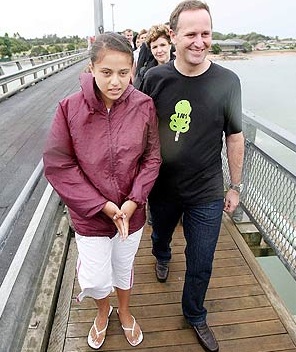
Nevertheless, the visit was a roaring success. Key, bearing smiles and gifts and wearing a tiki t-shirt, charmed the residents of McGehan Close and evidently persuaded them both of his party’s goodwill toward them and of its social and economic plan to lift them from their grim circumstances. The event culminated in Key taking 12 year-old Aroha to the Waitangi Day celebrations — a move full of potent symbolism, even if it was seen to be somewhat exploitative. Drawn out over a full week of coverage (at the time a rare commodity for Key, who had replaced Don Brash as leader just before the Christmas break) this was a highly successful stunt and should have been an early warning of Key’s great talent for making cheesy set-piece events ‘work’ and feel human. The sentiment he evoked in the people of McGehan Close was certainly real.

It’s just a pity the ‘ambitious’, ‘aspirational’ policy programme Key promised them wasn’t.

Joan Nathan, Aroha’s mother, remains on the DPB (having been let go from her hastily-arranged job working for National MP Jackie Blue) and struggles more than ever to cope, now with a sixth child. Aroha, now 16, is living in the care of Child, Youth and Family, which Joan says is the best thing for her, since she is unable to provide a decent life for her daughter. Nathan and others, although they believed in and voted for Key, are now disenchanted and universally express the sentiment that the government’s policies favour the rich, not the poor, and that they haven’t been helped one iota by the change of government; in fact, things have gotten worse. Not much of this is different than it was this time last year, when the Sunday Star Times visited the Close.

So far, so obvious, you might say — and it is; indeed this sort of outcome was very widely predicted at the time. But this is important because it is as strong a counter-narrative as exists for the opposition in this election year. It reframes Key as a faker, a charlatan, an opportunist who’ll exploit whatever circumstances will advantage him, without loyalty or the willingness or ability to follow through on his word; as someone whose focus is on boardroom issues rather than on peoples’ wellbeing. Discussing and reading around the topic on twitter this evening I’ve seen considerable criticism of this Campbell Live story as a cheap human-interest stunt, as opportunistic and exploitative (or moreso) than the original event. I couldn’t agree less. It is a clear, unambiguous example of an investigative journalist simply revisiting a story where much was promised, and measuring it against what has actually happened. This is crucial to its narrative value: these events reframe Key by measuring his own defining stunt — his signature trick — against the objective reality of lived experience. Theory and rhetoric versus real people, living in the real world governed by the policy built from that theory and rhetoric. It is a reality check in its purest form.

There are disadvantages to this narrative line, also, and the virulent responses to the Campbell Live report this evening — I believe I saw presenter Rachel Smalley shudder a little whilst reading some of them out — hint at them. One is the obvious suggestion that Joan Nathan and the other residents of McGehan Close could have done better for themselves, but have chosen not to; the victim-blaming routinely visited upon the poor by the less-poor. A more serious and related line of critique is that there’s a recession on, and everyone’s hurting. Or that it’s only been three years, and change takes time.

But hang on a minute — wasn’t the point of the whole point of electing a Key-led National government to take advantage of the resulting step-change which would boost economic growth, job growth, provide better opportunities, an end to welfare dependency, safer communities and a general increase in general socio-economic mobility and wellbeing? Key made all these promises quite explicitly, not just in person to the residents of McGehan Close, but to the whole nation throughout the campaign and at almost every opportunity since. There are no jobs. There are no higher wages, and without these things you can’t exactly buy shares in SOEs. There is no greater social mobility. The ‘underclass’, as exploitatively defined by Key, still exists.

Having failed McGehan Close, John Key has failed all of us. Quite apart from the fact that we were all promised these things, or things like them, and by and large have yet to receive them, a central theme of the ‘underclass’ policy argument was that by lifting people out of poverty and bringing then into the ‘overclass’ (? — this shows just how meaningless ‘underclass’ is except as a propaganda term), the government would make society better for everyone. This is a noble goal, and one I agree with in its idealistic entirety. I think you would go a long way to find someone in a position of any political credibility who’d publicly disagree with it. The first order of business for any opposition should be to hold John Key to those promises, and demand of Key the wealthier, more mobile, and socially healthier society we were promised.

But the most vicious response will be the one which the initial stunt in 2007 was meant to evoke — the notion that the ‘underclass’ are breeding in order to get more welfare from the Labour party. The core of this line of reasoning, if I may call it that, will be attacks on Nathan herself as a mother, having had a sixth baby and having had Aroha, the subject of the initial stunt, removed from her care. The attacks will be highly personalised, racist and gendered, and they will be lashed closely to Labour party policy and doctrine. But, assuming a competent and spirited opposition, that’s ok — the National party aren’t in opposition, 18 months out from an election; they’re in government in election year. Having been elected on a moderate, sympathetic platform with strong support from women and Māori, and looking to consolidate that platform into a strong and honestly-won mandate means that the government no longer has such freedom to dog-whistle. Particularly given that an opposition counter-narrative would cast doubt on all those sympathetic characteristics, the resort to the divisive tactics of 2008, such as trying to wedge ‘hard-working kiwis’ against the ‘underclass’, and so on, would be extremely risky for the government.

In light of my last post, perhaps it is a little glib to assume a competent and spirited opposition, and in perfect truth I don’t really think Labour has this fight in them (although Grant Robertson saw the Campbell Live piece and seems to have had a similar response to mine, which is heartening). But it is an argument waiting to be had, and one which must be had sooner or later. The boundaries are drawn up; media interest is already piqued, and this is a bread-and-butter social and economic justice issue for Labour. There’s a wealth of symbolic material and slogans to employ — ‘reality check’ and ‘by failing McGehan Close Key has failed us all’ are two they can have for free, and if a Labour party can’t base a campaign around ‘underclass‘ then they’re not worthy of the name.

Time to engage.

L

Hard rain’s a-gonna fall


The past week has illustrated in clear terms the New Zealand Labour party’s decline as an effective opposition party. In the opening moments of election year 2011, John Key has stepped up to demonstrate the full extent of the National government’s apparent impunity. He has done this in three ways.

First, by fronting Morning Report, Nine to Noon, Campbell Live and other tier-1 hard-news media to outline his intention to partially privatise SOEs. Privatisation, since the Fourth Labour Government, has been a ‘third rail’ issue; one the NZ left is unequivocally opposed to. By going into bat for privatisation personally, and in considerable policy detail, Key confounded criticism which has been (justly) levelled at him throughout the electoral term so far that he often refuses to show up on hard media, while continuing to keep regular spots in soft formats like Breakfast, and on less rigorous media such as Newstalk ZB. He also invested his own (considerable) political capital in the enterprise, making privatisation a matter of his own judgement and credibility.

Second, he sought out and is revelling in the controversy caused by his “Liz Hurley is hot” stunt, undertaken on Radio Sport with convicted back-breaker Tony Veitch. In political terms, the first bit was no meaningful risk; Key has played the ‘frankly, I’m a red-blooded Kiwi bloke’ card several times before, always to good effect, and most notably when he informed a press scrum he’d had a vasectomy. The decision to undertake an interview with the disgraced Veitch was a considerably more risky proposition because of the nature of Veitch’s offending against his partner, combined with the subject matter of their conversation, and the fact that Key’s political appeal to women has been considerably stronger than previous National leaders. This seems clearly calculated to demonstrate what he can get away with; and the gamble has in fact paid off so well that Phil Goff today felt compelled to follow suit, suggesting a slightly sad “me too, me too” narrative.

The third of Key’s big moves was today’s dual announcement that the election would be held on 26 November, 10 months away and following the Rugby World Cup; and that he would not consider a coalition arrangement which included Winston Peters. Coupled with ruling out working with Hone Harawira outside his present constraints in the māori party, this declaration will provide considerable reassurance to National’s traditional base, and will scotch any possibility of wavering conservatives casting a hopeful vote for Winston Peters as an each-way bet. It is a risky proposition, though — Peters remains a redoubtable political force, and it is not beyond possibility that he returns to parliament. However I think Key has read the electorate well; he knows that while a small number of people love Peters, and a small number loathe him, many of those in the middle are vaguely distrustful of him. As Danyl points out, he’s managed to link Peters to Goff in a way which emphasises both leaders’ worst attributes: Peters’ polarising tendency, and the general unease and disdain with which voters view Goff. The decision to call the election so early is also bold. It means relinquishing the incumbent advantage of being able to control the electoral agenda; being able to determine when ‘government as usual’ ceases and ‘campaign season’ begins. This is an intangible but valuable benefit, and it has been traded off against another piece of reassurance: the sense that Key and his government are “playing it straight” with the New Zealand public; that they intend to run an open and forthright campaign and to seek an honest mandate for their second term. The choice of election date isn’t entirely selfless, of course — the All Blacks are odds-on favourites to win the Rugby World Cup, and even if they don’t, the tournament, its pageantry and excitement and revenue boost will bifurcate the campaign. The traditional campaign period will mostly be drowned out by this event, save for the last few frantic weeks.

In most election years, swapping agenda-setting rights for a “playing it straight” feeling would be a poor tradeoff. In most election years, a sexist stunt with a known and publicly reviled wife-beater would be a poor start. In most election years, running a campaign based on privatisation would simply be a non-starter. While the paragraphs above read somewhat like breathless praise of Key’s status as a political playa, that’s not my intent. I think he’s good, but mostly John Key just knows what he can get away with. The reason he can get away with all of these things is because there is no credible opposition to prevent him from doing so. Anyone half-decent can look sharp when playing against amateurs.

It has been Labour’s job to prevent the government from reaching the state of near-impunity they now enjoy, and their failure to do so means there is now a real danger that Key will get the genuine and sweeping mandate he seeks. To a considerable extent they were doomed in the task of preventing this from the outset, because they didn’t think it was possible that he’d ever achieve it. Clark Labour throughout 2008 fundamentally misunderestimated Key, writing him off as a bumbling lightweight, and this was a crucial error. Since well before the election — this example is from July 2008 — I’ve been arguing to anyone who’ll listen that instead of taking easy pot shots at Key based on his weaknesses, any critique should focus on his strengths. Quoting myself, from the above:

Key’s strengths [per the Herald bio], which enabled him to succeed as a currency trader: Decisiveness. Determination. Patience. Ice-cold calm under fire. Willingness to risk it all. Ability to follow through. Remorselessness.
If you want to attack John Key, draw attention to what might happen under a Key government. Given his history, he’s not some motley fool who won’t make sweeping changes – he hasn’t gotten where he is today by being timid. I think he has the wherewithal to roll out a sweeping programme of political and social change the like of which we haven’t seen since Lange, but I think that, unlike Lange, he won’t get cold feet. If you don’t like Key’s politics, I suggest you begin thinking about what might happen if the guy is given the power he seeks.

The delusion that John Key is a hapless fool who’s somehow mysteriously gotten his hands on the reins of power remains very much alive within New Zealand lefties; this was the tired old line I got spun as recently as this afternoon, by one of the internet’s best-known Labourites (with a nice dollop of ‘if you don’t praise Labour, you’re a rightie’ for good measure).

But this tendency to misjudge and underestimate Key is only part of the problem. Denizens of The Standard aside, anyone within the loop who has a modicum of reason has figured out that Key is not the lightweight he was — quite willingly — framed as. But now the narrative is set: it’s That Nice Man John Key, who drinks beer out of the bottle while tending the barbecue with Prince Harry, and thinks Liz Hurley is hot. They don’t have a credible counter-narrative, but they have to say something against the health cuts, education cuts, tax cuts, ACC cuts, pending privatisation and so on — and so they fall back on their usual tired old cliches, which, while superficially looking like what an opposition is supposed to do, lack cohesion and run counter to the established wisdom about Key and his government — wisdom laid down, in the first place, by the Labour party in its 2008 campaign.

The lack of narrative cohesion is so dire that the party claims that privatisation of SOEs is repugnant to the voting public of New Zealand; and almost simultaneously puts out a press release saying that it’s a cynical ploy to “cling to power”. The manifest incompatibility of these two propositions — cynically promoting an unpopular policy to retain power — speaks for itself.

If the inability to construct a viable narrative is symptomatic of a wider lack of ideas and direction within Labour. Election-year spin aside, their policy offering is weak as well. Their big blockbuster kicking-off-election-year policy of a $5000 tax-free zone was big enough to draw plenty of criticism about cost and targeting (including from people like Brian Easton), but timid enough that nobody was made to sit up and take notice for any other reason (sidenote: when Brian Easton, John Shewan, Chris Trotter and I all oppose something, I think you can be pretty sure it’s not a winner).

This is just the most recent example of what we’ve seen throughout the past two years: Labour’s vision, and its execution, simply aren’t up to scratch. I have no internal knowledge of the Labour party, and I don’t know whose fault this is. I guess the leadership blames the strategists, the strategists blame the policy wonks, the policy wonks blame the spin-doctors and the spin-doctors blame the MSMâ„¢. All that’s just excuse-making for losers. There are no socially-just power-redistribution schemes in politics, and if there were they would be rorted. There is no fair. The job of being in opposition is to win despite the odds being stacked against you; to do and say things worthy of the news media’s time, worthy of the government’s concern, and worthy of the electorate’s endorsement. If you’re not doing that, you’re not up to the task.

As the title implies, the political weather this election year is not going to be a warm drizzle. John Key wants a mandate; he wants a strong and broad mandate which will permit him to wreak widespread social, economic and political changes upon New Zealand’s landscape, and he is prepared to put a lot on the line to gain it. He is playing for keeps, and my instinct is that an opposition who couldn’t keep pace with ‘smile and wave’ is going to be crushed by the rampant beast which is currently girding for war. What’s more, by all accounts Key is actually, genuinely coming to the New Zealand electorate with a transparent policy offering in good faith, keeping his promise that nothing would be privatised without his first having sought a mandate to do so, which robs Labour of their strongest symbolic weapon: the “by stealth” bit of their catchcry “privatisation by stealth”. Time will tell if this holds, but at present the Key government is doing exactly what it says on the box. Labour can’t claim they haven’t known about this all along. Privatisation has been the bogeyman about which they’ve been warning the New Zealand public for at least a decade, which makes the incoherence of their recent response all the more unforgivable. That National would consider running an election campaign on this cornerstone issue, loathed and feared by so many New Zealanders, is surprising. That they can expect to do so without trying to get their agenda through on the sly is shocking. That they reasonably expect to do all that and win is unthinkable. Let there be no doubt: if Key wins this election on these grounds, it is because Labour, by failing to adequately discharge their role as a competent opposition, have permitted him to do so.

Perhaps it is not too late. Perhaps Key has overplayed his hand; perhaps Goff has a secret weapon. Perhaps a young Turk is fixing to roll Goff and his cadres and make a break for it. I do not think any of these are likely. So it may be that the one good electoral thing to emerge from 2011 is a heavy and humbling loss which would see the Labour party reduced to a meagre husk. An exodus of the lively and creative thinkers of the party to another vehicle; or the enforced retirement of the deadwood responsible for the present state of affairs; or both would clear the way for a thoroughgoing rejuvenation of the movement’s principles and its praxis and its personnel. While it would be cold comfort to the generation of New Zealanders who will bear the brunt of the Key government’s second and third-term policies, it would be a crucial and long overdue lesson in political hubris, never to be forgotten, and infinitely preferable to another narrow loss and the moribund hope that next time it’ll be different.

L

Bloody liability

Sarah Palin, as has been clear for some years now, has an unmatched talent for drawing the spotlight. A week after the infamous ‘blood libel‘ video she’s still at it today, pouring more fuel on a fire which should never have been started. ‘Blood libel’ and the American Right’s shrieking, paranoid victim complex are now a bigger story than the (attempted) murder of Congresswoman Gabrielle Giffords and others at a political rally outside a suburban supermarket. That takes an awful lot of doing.

But she simply doesn’t know when to shut up. Let me be clear: I’m by no means saying that she must shut up, or even that I want her to shut up; nor am I attempting to curtail her First Amendment rights or impinge upon her cherished liberty — let there be no persecution fantasies regarding the humble analysis which is to follow. Palin’s conduct is a matter of political strategy for her PAC, the wider Tea Party movement and ultimately the Republican party. If they want to keep pursuing a strategy which, politically, is a hiding to nothing, then far be it from me to stand in their way. But I am arguing, as are plenty of Republican-oriented strategists, including former Bush advisor David Frum — that as a matter of strategy she should just shut the hell up and resume her place on the fringes of this topic, because there’s nothing to be gained and an awful lot to be lost by continuing to fan these flames. Frum is hardly a bleeding-heart liberal; he invented the ‘Axis of Evil’. He is also Jewish, as is Rep Giffords, so one assumes the misuse of ‘blood libel’ by a renegade WASP like Palin has special salience to him.

Let me also say that Palin and the Tea Party had some right to be angry at the invective levelled at them and their movement in the immediate aftermath of the Tucson shooting. I generally agree with Pablo’s previous points, that Palin and the Tea Party must bear some responsibility for the climate of discourse they have created; but I’d also say that they have not created such a climate on their own. While disproportionately on the elephant side, warlike imagery and symbols of political violence are a commonplace in both camps of US politics. Influential US liberal commentators, notably Keith Olbermann, jumped all too gleefully upon the chance to all but blame Palin (and Beck, etc) for pulling the trigger, although at best there is only a tenuous link between Jared Lee Loughner’s anti-government sentiments and the Tea Party. (Although it is often overlooked that Olbermann’s rant also called strongly upon the American left to repudiate (not refudiate) violence in word and deed). The extent of the speculation and the attempts to pin the murders on Palin and the Tea Party before the dust had settled were unmerited and, as I say, the objects of these accusations were justified in a certain amount of self-righteous indignation.

But one of the defining characteristics of the Tea Party, and of libertarian-oriented small-government revivalist movements in general, is their utter lack of perspective, and Palin simply went too far. These are people who genuinely believe taxation to be armed robbery, after all. So, like the white supremacist who blames all misfortune on immigrants; like the misogynist who bemoans the PC feminazi dykocracy; or the wealthy white elderly Sensible Sentencing Trust supporters who believe themselves to be the most vulnerable victims of crime, when, objectively, the reverse is true — the Tea Partiers and Palin simply can’t see past their own trivial victimisation to the actual and genuine victims of the Arizona tragedy, those who are dead, wounded or bereaved. IrishBill, writing at The Standard recently referred to these sorts as Right Whingers, and the persecution narrative is a feature of modern backlash movements: when elites come under such threat that they feel as if they no longer command the fields of cultural battle, they claim to have been victimised. And they go on and on about it. “Help, help, we’re being repressed!

Nobody likes a whinger or someone who talks a big game but can’t play, especially in US politics. One of the Republican party’s strongest symbolic assets through the latter 20th century has been the sense that it’s a party of rugged individuals with the thousand-yard gaze of their pioneer forebears, while the Democrats are a bunch of preppy sissies with excuses always at the ready. To an extent there’s been some truth to this narrative, but the “all hat and no cattle” label attached to Bush did his party’s political fortunes considerable harm, and Palin has already weakened her own pioneer and Mama Grizzly credentials immeasurably with the now-infamous ‘hunting’ episode of Sarah Palin’s Alaska. In it, despite her claim to being a life-long hunter, she appears unfamiliar with her rifle (“does it kick?”), is unable to chamber her own rounds (daddy does it for her); and takes five shots to hit a large animal standing on a skyline 120 yards away (and then there’s the estimate that a hunting trip in her home state cost $42,000 — not very pioneerish, that).

Likewise, the emergence of the Tea Party and its rather more extreme rhetoric has seen the erosion of the traditional, conservative pioneer narrative in favour of a more excitable tone — perhaps a shift from ‘pioneer’ to ‘revolutionary’ would be the metaphorical change. This shift in itself is not a weakness, except when its less favourable characteristics come to the fore, and it is these aspects of the Tea Party movement which the Democrats and other liberals have been emphasising: its crazed extremes and frightening rhetoric; the cultish, heightened emotionality of leaders like Glenn Beck, which verges on the religious; its lack of concern with details like grammar, factual accuracy and proportion; its brittleness and temporary, ad-hoc nature as opposed to the reliable stability of the Grand Old Party.

By resort to the strident ‘blood libel’ line, Palin has fallen into the trap of confirming — and defending — key aspects of the liberal narrative about her and by extension about her movement: she lacks any sense of perspective or proportion, public decorum or decency or compassion; she is an attention-seeker with a persecution complex who thinks it’s always all about her; she doesn’t know what the terms she uses actually mean; that they’re desperate cranks rather than serious statespeople; and most seriously, that she can dish it out but not take it. This last will be the master narrative going into the 2012 Presidential election, in the increasingly unlikely event that Palin is the nominee, and Democrats and liberals the world over relish the prospect of a proven big-game player like Obama against a scattergun show-pony like Palin.

The decision to release and then defend the ‘blood libel’ video is a double tragedy for the Republican party, who took a strong lead in the November mid-terms, and have now missed the best opportunity in a decade to consolidate that lead by looking like the calm, sober, conservative adults they claim to be and to represent. Palin’s decline may be better for them in the long term; many commentators are now confirmed in the belief they held before the mid-terms that she had outlasted her usefulness as an energising agent, and is now simply a liability, a distraction from the serious business of government to which the GOP must now turn its attention.

L

‘Efficient’ pricing and social cohesion in disaster recovery

In my view, one of the more shameful episodes in the Canterbury earthquake was the call by some for retailers to implement so-called ‘efficient’ pricing of crucial goods such as water. Among these was University of Canterbury economist Eric Crampton, whose article on the topic was even printed in the papers. Read his blog post In defense of price gouging. I often agree with Eric, but on this topic I just don’t.

I’m no big-city economist, and I seem to have misplaced the argument I wrote on the topic at the time, but essentially the problem is: if nothing is done, the resource just runs out and people who need it can’t get it. Absent some mechanism (rationing, gouging, &c) the criterion for access to the resource is speed and/or ruthlessness — the person who goes down to the supermarket & fills their ute with bottled water wins; everyone else has to rely on other means, such as asking their neighbours or others for help. I see efficient pricing as simply a means to shift the the criterion for access from ‘speed+ruthlessness’ to ‘accessible wealth+ruthlessness’. Those neither speedy nor wealthy (that is, almost everyone) will have to fall back on those same social structures of cooperation and goodwill to get their water in either case, and I don’t accept that privileging those with cash on hand is much of an improvement over privileging those who can get through the gate quickest.

However there is a non-economic factor to consider: in times of disaster, social cohesion is crucial. To large extent it operates on the notion that both the mighty and the humble are brought low; that we’re all in this together, and when the chips are down, Jack’s as good as his master. A resource allocation mechanism which punctures these illusions so as to damage social cohesion, such as by turning the poor against the rich, must deliver an enormous efficiency benefit in order to offset the harm it causes by sapping the goodwill upon which disaster recovery thrives. At a time when the foremost objective should be to promote social cohesion, ‘efficient’ pricing is an ugly imposition of individualism on the collective spirit.

Anyway, the point of this post wasn’t to relitigate that, or to criticise Eric, so much as to say that — by contrast — reports of price-gouging in post-flood Queensland have drawn a firm response from officials. Fair Trading Minister Peter Lawlor warned retailers of the possible strategic consequences of gouging:

“I think traders who attempt to profit from the misery of others during the floods should keep in mind that people have long memories. Even if there’s no official complaint, any quick returns they seek to make will be of little value to the business in the longer term.” [he said]. Mr Lawlor says if there is evidence they are breaking the law, they will be prosecuted.

More robust still was the statement from Ipswich Mayor Paul Pisasale, the same who warned looters that they would be used as flood markers if caught:

Ipswich Mayor Paul Pisasale says the city will remember businesses that try to take advantage of the disaster. “I know I’m not supposed to say [this] – but the health inspectors are on their way and the building inspectors are on their way after we finish this to see if we can help those businesses – [but] like hell,” he said.

This suggests a vigilante streak and willingness to bring the coercive force of the state to bear for social, rather than strictly regulatory reasons, and this is not usually a beneficial trait in a civic leader. However I think in cases like this there is some justification for such a stance. Pisasale’s position is a manifestation of the ‘Queensland culture’ called upon by Premier Anna Bligh in her speeches, and which may now be her political legacy. If it all came to pass, perhaps a disgruntled gouger might take legal action against Pisasale or his agencies for harrassment; but this would be an uphill battle, because Pisasale enjoys the protection of being right in the eyes of his society. After all; the only thing most Aussie battlers hate more than a government bureaucrat is a disaster profiteer. He is on firm ground as a representative of his people, because his representation rings true. His commitment is to the cohesion of his society. He is doing what crisis leaders do; efficiency be damned.

L

Stay classy, Atlases

VEXNEWS‘ headline, while verbose, really does nail it: GREEDY GERRY: Heartless Harvey fiddles at lavish Gold Coast party while Queensland drowns.

That’s Gerry Harvey, of Harvey Norman; and John Singleton, who (with Harvey) owns a thoroughbred brokerage aptly named ‘Magic Millions’. This photo and others were taken at its launch while much of the rest of the state of Queensland was underwater. From the article, with my emphasis:

When asked by a reasonably friendly Gold Coast Bulletin scribe about whether continuing the event in light of the hardship endured by the rest of Queensland, Harvey’s partner John Singleton’s response showed a remarkable lack of sensitivity even by the vulgar standards of the average Sydney spiv: “You feel a bit guilty having a good time when you see what is happening in other parts of Queensland and northern NSW, but on the other hand the Aussie way is life goes on.” Charming.

Context, however, is everything. There’s a good reference to the fall of Rome in there, but here’s the real bit of background which brings it home:

Gerry Harvey is closely associated with the brand of his many outlets where so many Australians buy the goods that furnish their homes. Many (fortunate enough to be insured) Queenslanders will come to file into these outlets in the days and months ahead when they want to replace all the things they lost. He stands to make (yet another) fortune. You’d think the man would show a little more decency during this sobering time for our country.

Well, you would — but in fact, it’s worse than that. Many of those worst affected by flooding actually aren’t insured for it — because insurers expressly exclude flood damage from their policies. Most cover storms (falling water in the local area) but not flooding (rising water, or that which originated elsewhere). The Queensland Department of Primary Industry has a summary:

A major obstacle that delays insurance claims is the different definitions for flood and inundation in insurance policies. The Australian Securities and Investments Commission (ASIC) defines ‘flood’ as:
“In general terms, flood damage refers to the inundation of a property by water which overflows from a natural watercourse, while storm and tempest damage refers to the inundation of a property by water as the result of a storm.”
Therefore, some inundation risks are covered by the term ‘flood’.
According to ASIC’s Consumer Understanding of Flood Insurance Report, both types of damage are usually linked to a storm, and a property may be inundated by both water from the storm and water overflowing from a natural watercourse. However, most insurance policies don’t cover damage to a property if caused by:
* inundation of water flowing from a natural watercourse
* inundation of water from both the storm and overflow of a natural watercourse (unless most of the damage is caused by stormwater)
* other phenomena, such as earth movement, even though this may itself have been caused by water from a storm.
The Insurance Council of Australia advises consumers to review the terms and conditions of their cover in their Policy Disclosure Statement.
If in doubt, contact your insurer.

It makes sense, as an insurer, to decline to offer cover for anything which might actually cost money; and there abides a regulatory environment which permits insurers to do just this. The topic, and related problems resulting from poor government policy, are covered in some detail in a column by La Trobe University disaster researcher Rachel Carter in today’s Australian. Consequently, despite the present floods being declared the most severe disaster in Queensland’s history and with some discussion today that it may be the worst in the history of the Commonwealth, insurers were, a few days ago, saying that the losses to their industry would be modest.

(Sidebar: if you’ve not connected the dots, this is the same insurance industry to which the Key government intends to deliver ACC early in their second term. Don’t say you weren’t warned.)

And so it is as it ever was: even in an affluent, modern first-world democracy with strong disaster-response agencies, which likes to regard itself as an egalitarian nation where the “little guy” gets a fair suck of the sav — when push comes to shove the big guys make out like bandits, and the little guy goes under.

In both cases, literally.

L

The Big Wet

Having neglected my bloggerly duties these past six weeks (in fact, I’ve been neglecting all my duties which aren’t strictly in service of looking after my family and keeping my job), I had resolved to write something about one of the many momentous events which have taken place recently. There are many to choose from. Some topics (Pike River; Wikileaks; Foreshore and Seabed for instance) are no longer immediate; others (the re-emergence of Winston Peters, commencement of the NZ general election campaign and its forerunner the Botany by-election) are not yet sufficiently well-formed for me to quite know what to say about them yet. Yet others (notably the shooting of Gabrielle Giffords, Wikileaks and the Urewera Terra trials) have been more ably dealt with by Pablo and/or so many others, such that anything I could say would be redundant. There’s already enough peoples’ two cents rattling around in the hollow urn of internet discussion. In the context of these events other things I was meaning to write about (such as the manvertising topic Pablo discussed before the break) seem a bit trivial.

Add to all of this, today there is really only one story; that an area twice the size of Texas — the canonical measure of a really big thing — is underwater in Queensland; including much of Brisbane. The coverage put out by the Australian media, and in particular the ABC, is first-rate, and the best I can do is commend it to your attention.

There is one point, however, that I don’t think has been made strongly enough: and that’s that events such as these are a consequence of climate change. While it is fashionable for climate change deniers to mock those pointing to the increasing frequency and severity of snowstorms, cold snaps, hurricanes and torrential rainfall events as evidence for ‘global warming’; implying that climate science proponents try to take everything as evidence of ‘global warming’, the fact is that the term ‘global warming’ was retired and replaced with ‘climate change’ because the thesis isn’t just that the planet will get warmer.

That’s part of it, but the events — snowfall and what not — being pointed to are not climate; they are weather. The relationship between climate and weather is a lot like the relationship between mathematics and arithmetic — indistinguishable if you don’t understand them, but fundamentally of a different order. Weather, like arithmetic, is by and large small, trivial, unarguable stuff — stuff which is more or less self-evident. It rained this much last week; 2+2=4 — whereas climate, and mathematics, are bigger, more open-ended and by definition less quantifiable. Mistaking ‘weather’ for ‘climate’ is an immensely useful rhetorical device, and one which I believe has not been sufficiently well guarded-against by those whose task it is to argue the climate change case. But even though it may not have been made clear to the degree necessary for broad public and political comprehension, this distinction is well understood by those working in the field and anyone who cares to acquaint themselves even scarcely with the material. And fundamentally the take-away is this: climate change caused by the increased quantity of greenhouse gases in the atmosphere, to the extent that it takes place, will have unpredictable flow-on effects such as increased frequency and severity of severe weather events, and not just heat waves and droughts such as ‘warming’ would suggest.

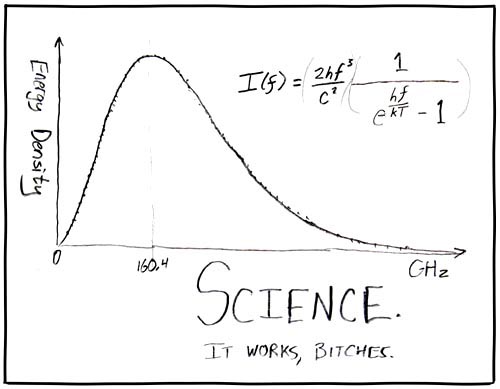
The XKCD comic above (of which some years ago, my wife bought me the t-shirt) shows the Cosmic Microwave Background radiation spectrum. This has nothing much to do with climate change, but it is a famous proof of the scientific method: a near-perfect agreement between theory and actuality which is pretty fundamental to our understanding of a bunch of stuff. Science’s only defence; the only thing which gives it any importance or makes it any use at all, is that it works. When properly applied, it predicts actual events. The Queensland floods, as well as other such events, are happening as predicted, and anyone who tells you otherwise is either ignorant, or having you on, or both. In Andrew Bolt‘s case, it’s both. Queenslanders — and others similarly impacted by such events — need neither.

L