Comparative value versus comparative worth.

Recent NACTFirst government assaults on female pay equity, public sector employment, labour regulations and other worker’s rights (to say nothing of trying to roll back Maori Treaty rights and enshrine the primacy of property right in NZ law), got me to thinking about how we measure value and worth in society. I tend to think of society being made of contributors and freeloaders. Contributors add value to their communities, be they large or small. They can be paid or unpaid, employed or volunteers, able-bodied or disabled. To me, these people are of high value and therefore of high worth. Freeloaders, on the other hand, are those who ride on the backs of others’ contributions. They can be criminals or hedge fund managers, financial advisors and consultants, rightwing bloggers and conspiracy theorists, gossip columnists or politicians. They do not create value in or for society. They appropriate worth when they can by appraising and selling themselves for more than their real value.

To be clear, this measure is not about surplus value in production and by whom it is appropriated. It is about the relationship between real value and actual worth, which may or may not be related.

Three illustrations of the spurious relationship of value and worth come to mind. There is an old saying in Latin America that a great bargain is to buy a person for their real value and then sell them for what they say they are worth. On another front, someone I know runs a financial advisory service where he caters to what he initially called “high value people.” When it was pointed out to him that he was conflating material worth with human value, he changed his firm’s logo but we have not had a good relationship since (he caters to clients with disposable investment assets of USD 10 million or more, including professional athletes). In a similar but opposite vein, my late mother, an organic intellectual if there ever was one, used to say that our wage scales are completely upside down. We should pay rubbish collectors and sewer cleaners the highest salaries and pay professional athletes and entertainers the minimum wage. Her reasoning was that athletes and entertainers provide some value to society but will receive many more benefits, material and otherwise, from the public adulation that they engender, and they will receive these benefits long after their active careers are done. Their material worth far exceeds their social value.

Conversely, those who do what in India is considered Untouchable work are essential to the good functioning of modern society and in fact critical to maintaining public health and well-being. Because of the nature of their work and the negative exposures involved in it, their careers are short and often brutish. And yet in modern society the reverse is true when it comes to their value and worth. They are paid far less (as a measure of worth) than their actual value to society. Why is that? Even if we factor in things like education, entrepreneurship and other intervening variables and admit for the existence of objectively fair measures of value and worth (and by this I do not mean the stupid comparisons of nurses and teachers versus cops and firefighter’s pay or any other gendered work comparisons), it seems that oftentimes the relationship between actual societal value and perceived worth is perversely skewed in inversely proportional ways.

That brings me back to the secondary teacher’s strike this past week. Although I left academia over a decade ago before the academic Taylorists turned universities into scholastic sweatshops whose focus is on revenue generation rather than intellectual advancement, and who believe that Science, Technology, Engineering and Mathematics (now sometimes replaced by “Economics and Management” as the back end of the “STEM” mantra) should be the sole focus of university research and teaching (eliminating the Arts and Social Sciences), I maintain contacts with a number of academics who have managed to keep their jobs and still pursue the life of the mind while teaching within the limits of current Taylorist curriculum paradigms and business models.

One of these contacts has just been made redundant by the NZ university to which they are affiliated (which is in the process of dismantling its social science programs while still recruiting students for admission in to them), so is considering turning to secondary school teaching as a new career path. They are also thinking about working in a policy analyst role, including in a parliamentary or political party setting. As part of the research and preparation process for that transition, and in light of the current stand-off between the government and secondary teacher’s union about cost-of-living (COLA) wage increases, they reached out to fellow colleagues who do research on related subjects in order to get a comparative idea of wages in those career fields. Although there are a number of interesting facts that came from the materials that my contact received that are worth discussing at another time, this one was shared with me. It involves the comparative base remuneration of backbench MPs and the upper end of teacher’s pay scales.
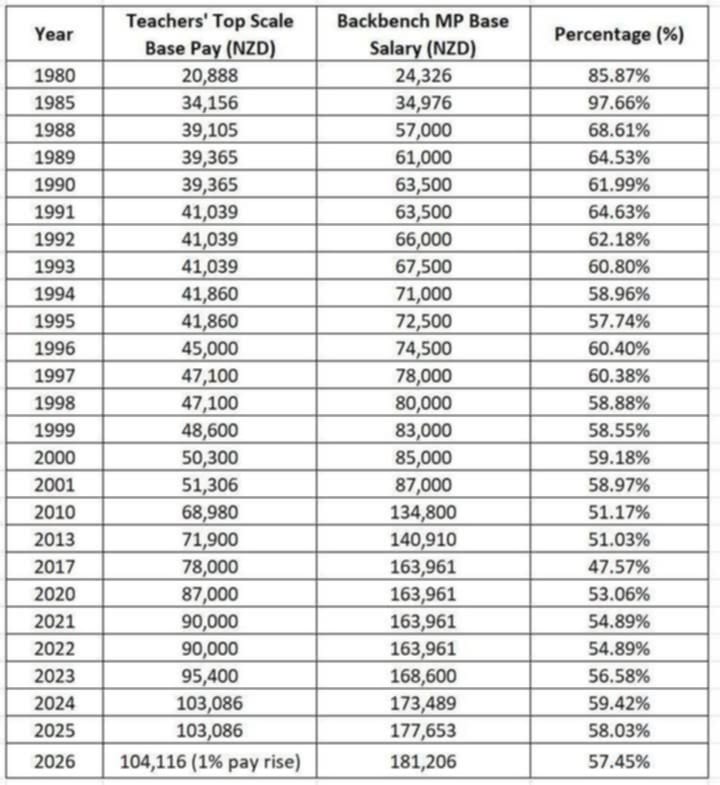
The data begs some questions. Who brings more value to NZ society, MPs or teachers? How is their value measured? What is worth more to NZ society, politicians or teachers? How is their (comparative) worth measured? Comparatively speaking, in terms of their contributions to NZ society, who is valued more and who is worth more? More broadly, is there a relationship between value and worth in NZ?

As for the specifics of the chart. Why is is the worth of backbench MPs (as measured in wages) significantly higher than that of the most experienced and well paid teachers? Since MPs also receive non-wage benefits such as accomodation and travel allowances and are often “comped” by lobbyists and other interlocutors in the form of meals and other incidentals, why is the wage gap between them and the most experienced teachers so significant? As for work equivalence, it can be argued that both MPs and teachers work long hours beyond their assigned time in class or in the parliament debating chamber, and both sacrifice family life and other leisure pursuits in order to do so. Both have formal work hours and yet engage in much informal work (say, coaching sports teams or participating in civic groups). Both MPs and teachers have invested much time and resources into their own educations and qualifications as well as through practical experience. So why the difference in worth if their value to society is similar if not equal? Or is their value not equal and hence their worth simply reflects the difference?

That last question is key. Does NZ society value MPs more than teachers and thus pay them more as a measure of their worth? Admitting for a degree of autonomy in setting institutional wage standards, are the average parliamentarians worth that much more than the most experienced teachers? Is their comparative worth–and that of teachers–based on any measure of value?

Perhaps there is a market-based answer to the question such as “politicians are rare gems that are hard to find while teachers are a dime a dozen because they are like pebbles on a beach, etc.” But even if this were true, perhaps scarcity of a resource is not a true measure of value. Memecoins such as $TRUMP may be worth much (+USD8.36/coin with a market cap of over USD 1.6 billion) but do they have any intrinsic or tangible value?

I will leave it for readers to ponder these questions and the more general question about the relationship of social value and material worth. However, one thing should be clear. Only when that relationship is defined and put into practice can we begin to speak of working towards a fair and equitable democratic capitalist society.

Some comments on NZ politics.

I had some time on my hands the past few days so spent more attention than usual consuming news about NZ domestic politics. My interests tend to lie further afield, but recent government assaults on Maori rights, women’s pay equity, constitutional neutrality, environmental, health and safety regulations, equitable taxation policy, state sector employment, Labour’s pandemic response and assorted other lesser insults have drawn me, perhaps like a moth to flame, to seek some illumination on the local political scene. These are a few tidbits that I took away this week., translated into social media posts.

  1. Chloe Swarbrick’s remarks about the government’s cowardice on the issue of Palestinian statehood in the wake of Israeli actions in Gaza.:

First all, Swarbrick is correct. If only six coalition MPs had some moral-ethical courage, then NZ could join the majority of the international community, including three of the 5 Eyes partners, in condemning Israel’s collective punishment of all Palestinians for the sins of Hamas on October 7, 2023, including the IDF’s use of ethnic cleansing and mass starvation as a means to that end. For that she was told to apologise by the Speaker (and National MP) for using the phrase “if six…members had a spine” and when she did not, ordered to leave the debating chamber. and later “named.” This is my comment on social media: “Peters, Jones and Seymour voice ugly boorish insults against their opponents (including racist taunts) and are allowed to remain in the House. Swarbrick correctly points out the spineless behaviour of government MPs regarding Gaza and gets thrown out. So much for Speaker impartiality” (referencing routine remarks made by the NZ First and Act leaders).

Also, as an aside to the particulars of this case, I should note that in light of prior history by Brownlee and other conservative MPs when it comes to progressive female members, there is a whiff of misogyny in the ruling. As a relative said to me (paraphrased here), male MPs can be loud, rude, condescending and bombastic when speaking to the House, but women cannot get angry or raise their voices even in defense of universal values. Now, I realise that Brownlee fashions himself as “old school” when it comes to parliamentary ethics and protocols, but if these boy’s club unwritten rules are part of the “old school” way of doing parliamentary politics, I say that he and others of his ilk need to be woken from their Rip Van Winkle stupor and shown the door.

By way of a broader backdrop, we should be clear that for all of its talk about foreign policy independence and having stood up to the US and its Anglophone allies with the 1985 non-nuclear declaration, NZ is a diplomatic follower, not a leader. It waits until other States make a move or show initiative on sticky international issues or events, then coattails on whatever seems most beneficial over the short-term. It pays lip service to international rules and norms but sniffs the wind when foreign policy smoke is in the air.

This syndrome has been accentuated in recent decades, particularly by National-led governments, and is now at rock bottom when it comes to NZ supination to other’s interests. The governing coalition’s current lack of resolve when it comes to denouncing the Palestinian catastrophe and upholding the right to Palestinian self-determination can be attributed to slavish obsequiousness to the US (Trump) position on the matter, perhaps abetted by the influence of the NZ Israeli lobby. Whatever ulterior ends the coalition of chaos may think that this approach may serve vis a vis the bilateral relationship with the US, they are sorely mistaken. NZ is just another squirrel looking for that elusive US nut.

2) On the decision to remove Maori words from schoolbooks :

I wrote “a main tool of cultural erasure is to remove all public references in a language other than that of the dominant social group. The CCP does it to the Uyghurs in the PRC. The excuse for doing so is usually to promote assimilation and social cohesion. The real motive is darker.”

I could go on about the attempts to erase indigenous languages and dialects in the public sphere is a host of places, particularly in Latin America, the region I am most familiar with, but also in Canada, the US, Africa and parts of the Pacific. The practice was so common in the colonial past that some linguists have written about the cultural genocide that follows erasing of a native language. When ti comes to identity and cultural preservation, language (and words) matter.

What is also remarkable is that it is well accepted that, rather than “confusing” in the Education Minister’s words, learning other languages at an early age promotes brain development and complex thought. Defending the removal of Maori words from children’s books is therefore doubly retrograde: it is the first step of an attempt at cultural erasure (at least in the public space), bookending similar attempts to remove te reo from public buildings and signage; and it is counter-productive (and counter-factual) as a pedagogical approach. Shame on Erica Stanford and her acolytes! And if a few Maori words are confusing, why not remove all non-English words from school books? Sacre bleu!

3) On the refusal of former Labour Ministers to front up to a public hearing of the Royal Common of Inquiry into the Pandemic Response:

“Why front up to a kangaroo court when the kangaroo judges are the political opposition? Especially after providing written answers to documented questions supplied by the kangaroos about events long in the public domain? Smacks of an ex-post political beat-up best avoided.” The fact that the Inquiry was instigated by ACT and NZ First as a partisan bludgeon after listening to conspiracy theorists and anti-vaxxers appears lost on the corporate media (partisan media like Plunket, Bridges and Hoskings just megaphone the anti-Labour lines). In fact, Labour should be pushing back harder at the political instigators, for example by questioning how they came to get involved in the witch hunt after actively supporting Labour’s pandemic response at the time, and who feeds them their talking points.

4) On a serving NZDF member is standing trial for espionage.

“The espionage charge against a serving NZ soldier is remarkable. The defendant is accused of working for, at the behest, or on behalf of a foreign State. Many questions arise from soldier’s court martial/trial. 1st: Which State? 2nd: what motive(s)? 3rd: what was compromised?”

Charging an active duty NZDF member with spying is remarkable because that charge–espionage– is only brought if the accused is suspected of working as a covert foreign agent. It does not refer to any domestic interlocutor., patron or client. I seem to recall at the time of the arrest that the soldier was detained for having objectionable material, presumably extremist literature (the military does not court martial people for having porn unless it is of the illegal variety). The soldier was also said to have links to right wing white supremacist groups. So it would be premature and very possibly wrong to finger the PRC as the puppet master (as the usual suspect). Given its other dark activities in NZ, Russia is a possibility. Or some other State. What should be clear is that it would not be an ally of the NZDF like the US, UK, Australia, Canada, France or other countries that routinely share higher-level intelligence with the NZDF (say, on operations, deployments, capabilities and tactics) that the soldier could not easily access unless s/he was in a military intelligence billet.

There could be a mix of motives involved, including money, sex and ideology. The counter-intelligence aspects of uncovering the suspected spy are also worth considering. In that light the trial should be interesting and revelatory, assuming that coverage is not effectively shut down for reasons of national security (yeah, right).

Should it be your inclination, feel free to weigh in within the KP rules of discourse.


Another Hollow Bluff.

I know from reviewing readership stats that KP readers are not as much interested in international relations as they are in NZ domestic and foreign policy and various social issues. There is some interest in what Donald Trump is doing to the world from his throne in the Oval Office, so I figured I would scratch that itch and write a brief about yet another moronic move that he has recently made.

After being trolled on Telegraph by former Russian president and current Russian National Security Council Deputy Chair Dimitry Medvedev, Trump posted on his Truth Social media account that he had ordered two nuclear submarines “closer to Russia” in “the (appropriate) regions.” He repeated this on the conservative Newsmax television channel a few hours later, claiming that what Medvedev said was a threat that needed a strong response. However, given the realities, I doubt that Medvedev or Putin are quaking in their boots. Let me break down why they are not.

To begin with, Trump is presumably talking about nuclear armed submarines like the Ohio-class “boomers” that carry sea launched ballistic missiles (SLBMs). The US has plenty of nuclear powered attack submarines (SSNs) like the Virginia class boats that are the basis of the AUKUS development project with Australia and Great Britain, but these do not carry SLBMs and would not provide any deterrent effect on Russia or another hostile nuclear-armed State. If the message is not meant as a strategic deterrent and SSN;s are being sent, then their strike value is limited and tactical.. Given that Trump’s complaints about Russia are about a strategic ceasefire in Ukraine, a tactical response is unlikely to move the Russians into compliance and will just escalate the situation beyond Ukrainian borders.

So Trump is likely referring to the Ohio class boats, which carry Trident II D5 SLBMs that have ranges of 4100-7600/11,500-14,000+ nautical miles/kilometers and travel at supersonic speeds ranging upwards from MACH 19 (20,000 feet per second or 18,000 mph/29,000 kph). The carry 8-14 multiple independently targeted re-entry vehicles (MIRVs) with warheads that have “throw-weights” of 100 to 435 kilotons (the latter deigned to hit “hardened” targets like missile silos, command bunkers and deep tunnel complexes. In comparison, the “Little Boy” bomb that destroyed Hiroshima was 15 kilotons). They tend to lurk in off shore deep waters, often in undersea canyons, waiting for the order to strike. Given their ranges and speeds, there is no need for SLBM platforms like the Ohio class boats to “get closer” to targets. In fact, to do so is folly.

Why? When the order comes, these submarines must rise from deep water (they are said to be able to dive as deep as 1,500 feet or more) to relatively shallow depths of 150-200 feet. That is because the underwater propulsion stage of the SLBM, which uses a sophisticated variant of steam-based propulsion, does not have the energy or pushing power to reach the surface from greater depths. Once the surface is reached, a solid gas propellant is ignited, accelerating the missile to supersonic speed before MIRV re-entry.

This is where Trump’s bluff is called. Ordering US SBMs “closer to Russia” negates the advantages of deep water concealment because it brings the submarines over shallower coastal shelves or seas (say, the Baltic or Black Seas). That makes it easier for Russian anti-submarine warfare (ASW) platforms (including attack submarines of their own) to hunt, locate and track them. In addition to sonar and radar as well as satellite imagery, modern hydrophone detection systems and seafloor thermal and acoustic mapping arrays are used to seek out and record the acoustic signatures of submarines (which can be as distinctive as finger prints), something that is easier in more shallow and warmer waters given sea layer temperature variations produced by water density, depth pressure, refraction, salinity, thermoclines, etc., including the waters of narrows, straits and other maritime chokepoints. Even deep water can conduct and bend sound over long distances, such as in the low frequency SOFAR channel that extends from 600-1200 meters down in low to middle latitudes to near the surface at higher latitudes (which is one way of listening to whale calls with hydrophones). All of which is to say that the frequency, wavelength, bend and amplitude of underwater sounds are related to water temperature and depth, so have become important markers for underwater scientists and engineers, including those in the submarine/ASW businesses.

Phrased another way that Trump might understand: cold and deep water good for submarines; warm and shallow, bad. Trump clearly has not gotten this brief. Or perhaps his version came from the same advisors who told him that a tariff is a non-transferable tax paid by foreign exporters to the US.

In that light ordering US SLBM submarines into shallower and possibly warmer waters near Russian coasts as a show of force and then giving the precise number of those being told to so is a breach of basic submarine operational security. It allows the opportunity the Russians the opportunity to refine their ASW skills and perhaps even get a better idea of how the two particular submarines in question look and sound like underwater. In other words, besides the childish nature of the tit-for-tat spat with Medvedev, Trump has been suckered into blurting out, yet again, potentially sensitive information about US naval capabilities and operations.

The US Navy has choices to make. It can do nothing and try to pretend that it followed his orders, hoping that his minions in the Navy and Pentagon are kept out of the submariner information loop. It could order the ships to drive around in circles and claim that it followed orders. It can object to the commander-in-chief’s order and try to convince him to rescind it at the risk of having careers ended (if he in fact issued one). Or they can salute and follow commands as they are instructed to do even if it puts crews and contingency plans at risk. None of this was necessary given current US submarine operational protocols and capabilities, so this was not a believable warning much less a credible threat. It was theatrical bluster without merit.

But then again Trump is a mixture of ignorance, impulse, thin-skinned ego, bully and pomposity, so his meaningless showman’s gesture will remind Medvedev, Putin and many otherwise US-allied leaders yet again that there is a petulant knucklehead sitting in the Oval Office as POTUS.

MAGA!

Kash Patel comes to town.

This week FBI Director Kash Patel arrived in Wellington to open a full time Legal Attache office (previously Legal Attaches rotated from offices at the US embassy in Canberra depending on need). Like excited children government ministers lined up for photo ops and the corporate media breathlessly reported on what Patel had to say. What he had to say, and how it was reported, was a mixture of circus side-show and fawning toadying, all uncritically covered by click-bait obsessed media scribes.

In view of that, please allow me to correct the record.

To begin with, the FBI is a law enforcement agency with powers of arrest, not an intelligence agency that does not have arrest powers. It is not a secret spy agency. Its NZ partner agency is the NZ Police, not the SIS or GCSB. In that role the FBI is a consumer of intelligence streams coming from 5 Eyes agencies (in NZ, the GCSB) as well as the NZ Police and SIS, but is not part of the 5 Eyes network. 5 Eyes is a signals and technical intelligence gathering and sharing network to which the FBI does not belong. INTERPOL is an international law enforcement partnership that the FBI is a member of. Although INTERPOL may share intelligence that originates in 5 Eyes, it has a distinct organisation, function and role. As 5 Eyes partners, the GCSB counterpart in the US is the NSA, and the US partner of the SIS ( a human intelligence agency) is the CIA.

In short, the FBI is an altogether different type of security agency and should not be confused with intelligence agencies properly defined.

Patel’s talk of direct FBI/5 Eyes links is therefore PR spin pushed by the US and Trump’s entourage that has no actual basis in fact. Using the LEGAT office ribbon-cutting ceremony in Wellington as an excuse, Patel’s visit was an overdue “show the flag” exercise by a US senior official more than 6 months after Trump entered office, and rather than Secretary of State Marco Rubio the US sent a conspiracy theorist-turned-second tier executive branch official instead, who then ran the anti-PRC/5 Eyes line even if Legal Attaches (FBI agents) deal with transnational crime, not strategic balancing or geopolitical competition and do not participate directly in 5 Eyes activities. (Note to readers: the FBI director is not a US cabinet position and is subordinate to the Attorney General in the US Department of Justice, so trotting out NZ cabinet ministers for a meet-and-greet, including those involved in intelligence matters, was obsequious in the extreme).

Be that as it may, Patel engaged in a bit of diplomatic performance art using the NZ government and media as props with which to push Trump’s anti-PRC agenda rather than focus on the relatively mundane business of opening a stand-alone LEGAT office, which are common in most US embassies and which, again, other than intelligence sharing on transnational crime via INTERPOL and partner agencies in foreign countries like the NZ Police,, do not directly engage in espionage or other forms of intelligence gathering (the fact that the office is outside the main US embassy complex and has undergone a slight name change does not mean anything particularly significant other than the need for more dedicated space and Trump’s obsession with putting his branding on everything. But a “law enforcement attache” is just a LEGAT by another name, and having separate office space may simply be a matter of re-allocating physical resources).

Patel’s remarks about the LEGAT office opening being a counter to the PRC that bolstered the 5 Eyes was a purposeful distraction from what should have been a low-key affair and should have been treated as such because for NZ bringing in an adversarial take on the PRC in an otherwise unremarkable and unrelated matter makes for disproportionate diplomatic discomfort. Neither the US embassy or MFAT press releases mentioned the PRC or 5 Eyes., so the cringe factor must have been high amongst the diplomatic corps. Then again, Patel likely knew that, but since hype and showmanship is what Trump is all about and Patel’s main audience was the one in the Oval Office, the NZ government and corporate media dutifully obliged by indulging the dog-and-pony show about the PRC and 5 Eyes. It was a pitiful display of diplomatic supination that may well have adverse consequences down the road.

To be clear. The significance of Patel’s visit to open a dedicated full time LEGAT office in NZ lies in the fact that it is official recognition that transnational crime is now a major problem in the Southwest Pacific and hence a priority for the US and other Western security agencies. In the measure that the PRC is involved in things like drug smuggling and cyber crimes in the region, it will be on the radar of these agencies, but in that regard it is just one of many state and non-State actors operating in what are known as “grey area” zones where criminal organisations and some State actors cooperate out of mutual interest. North Korean and Russian use of South-Pacific flagged ships to circumvent sanctions and smuggle oil is one example of this, as is the cyber-hacking activities of criminal entities tied to the Kremlin, Iran and PRC (among others). Likewise, transnational crime networks presence in island States like the methamphetamine trade in the Samoas (where drugs sourced in the US and Mexico are smuggled from American Samoa to Samoa across their common land border) require better resourced and coordinated regional law enforcement responses. The new US LEGAT office in Wellington is part of that effort.

As for terrorism and people smuggling (other designated priority areas announced by the US embassy during Patel’s visit), the role of the PRC is marginal at the very worst. And yet Patel placed it front and centre in his remarks at the opening ceremony

Regardless of the US spin so slavishly reported in NZ, opening a dedicated LEGAT office in Wellington is not about countering the PRC or bolstering 5 Eyes. It is about strengthening bilateral crime-fighting capabilities between the US and NZ in the Southwest Pacific. And if there is anyone other than criminals tracked and caught by the enhanced inter-agency law enforcement cooperation and regional presence of the FBI in the SW Pacific who have most to fear by the upgrade, it is those who may have extradition warrants issued by the US for their arrest. That is because Legal Attaches are the main vehicle for executing US warrants in any given country.

Kim Dotcom, are you paying attention?