A discourse on David Shearer and the identity politics thing

For my sins, over the past week or so I have been engaging at The Standard again. It’s been a rather tiresome business (for them as well, I’m sure) but has yielded some lucid moments. One exchange between “Puddleglum”, Anthony and I in the bowels of an open mike thread has been particularly useful, and since it contains my views on a question I am often asked, I’d rather it not end up down the memory hole. I reproduce it here in full (without the benefit of editing; so it’s a bit rough).

[I originally said Anthony was the author FKA “r0b” at The Standard — this isn’t the case; it’s some other Anthony. My mistake, and thanks to the r0b, Anthony Robins, for pointing it out.] Puddleglum has a blog himself — thepoliticalscientist.org — that is well worth reading.

Puddleglum
Hi Lew,

If Armstrong is correct in the following quotation (and this leadership race has all been about the ‘blokes’ battling the ‘minorities’ and the ‘politically correct’), then won’t the election of Shearer shift Labour more towards the right wing, social conservatism that you appear not to like about NZF?

“Shearer will bring change by making the party less hostage to the political correctness that still plagues its image. He is interested in things that work, rather than whether they fit the party’s doctrine. “

I may misunderstand where your ‘loyalties’ or preferences lie, but it does seem odd if you are supporting a shift in Labour’s focus towards something that would be much more compatible with NZF (including Prosser and Peters, neither of whom strike me as staunch upholders of ‘political correctness’), given how little regard you appear to have for NZF.

(As an aside, I’m not sure why Armstrong is so sure he knows Shearer’s mind – he’s obviously heard Shearer say more than he’s been reported as saying – but I guess he is a political journalist … It would have been good to hear Shearer say these things to the public if, indeed, Armstrong has it from the horse’s mouth, as his tone strongly implies – “Shearer will …”, etc..).

Lew
Hey PG,

I’m not convinced by this argument that Shearer represents the forthcoming defenestration of Māori, women, gays, the disabled, and so forth as a matter of doctrine, although folk who hope it does have been eager to say so — Armstrong, Audrey Young, Trotter amongst them. Shearer’s MSc was on the tension between Māori cultural values and environmental resource management, and he has worked on behalf of Māori in that field, preparing Tainui’s land claim to the Waitangi Tribunal and looking at sultural issues around wastewater treatment in Auckland. I have as yet seen no evidence that Shearer represents the social “right” of the party either. His pairing with Robertson as deputy certainly seems to counterindicate that argument. He says he’s “right in the middle” of Labour, though I suppose he would say that. I am open to persuasion on both these points, however, and if such defenestration does occur I may yet come to regret my support for Team Shearer.

But I think there’s also a misreading of my “loyalties”. The much-loved canard around here and at Trotter’s place is that I want Labour to be an “identity politics” party, whereas, in actuality, I want an end to the infighting that pits “the workers” against other marginalised groups or seeks to subsume everyone’s needs to those of straight white blue-collar blokes. All must have a presence within any progressive movement. I think there’s a false dichotomy that to appeal to “middle New Zealand” a party must be just a wee bit racist, homophobic and sexist, because that’s what “middle New Zealand” is. I don’t agree; although I can see how that is one route to popularity, I don’t think it’s one that’s very suitable for Labour.

Notwithstanding all of that I do think that being able to break the factionalisation and patronage — crudely expressed by Damien O’Connor — that has resulted in a weak list and a dysfunctional party apparatus is the most crucial task facing Shearer, and I can see how this could be spun against him. But on balance, getting the overall institutional and overall health of the party back on track is the priority. As long as it’s not simply replacing one lot of factions with another.

L

Anthony
It really depends if he plays zero-sum loss/gain, instead of fixing problems that when addressed help everyone. But even though I preferred Cunliffe I don’t think Shearer is a evil bastard who will throw women, gays and Maori under the bus.

It’s just convincing insecure pricks like Armstrong that they’re not missing out (and normal people who are perfectly fine), while they lift everyone up.

Been one of the problems with the left for a while – not taking middle NZ with them in their thinking and just expecting them to “get it” after it’s done and dusted.

You can see how the Nats do it better with their policy formation and with the task forces they set up, they admit there is a problem that needs to be solved in some way, get a team of “experts” in place, get feedback from all quarters then create policy based on it (even if they were planning that policy all along). It’s a great way to create a narrative that the electorate can follow to understand policy or at least get some understanding that a problem that needs to be solved exists in the first place.

If it looks in the slightest way controversial or a potential wedge issue they will use this method.

Puddleglum
As I said, “If Armstrong is correct …”

I think previously you’ve noted the importance of symbolism (e.g., in the early days of the MP coalescing with National).

There is a danger that the symbolic projection being attempted (‘we are ordinary New Zealanders too’ – whatever that means) can box Labour in when it comes to ‘judgment calls’ on those social issues.

Trying to benefit electorally from symbols you don’t really believe in (in its crudest form, ‘dogwhistling’) can bite you back.

I think, for example, that Shearer may well be keen not to “get in front” of middle New Zealand on any of these issues (wasn’t that one of the concerns about Clark’s government, for ‘middle New Zealand’?).

That’s fine and pragmatic, and doesn’t mean necessarily being a little bit racist, homophobic, or whatever. But it might mean muting your commentary and positioning on those issues a tad.

And that could make some, at least, leap from the windows rather than waiting to be ‘defenestrated’.

I think that’s the challenge with the more ‘centrist’ positioning.

Lew
Anthony, I agree with all of that.

PG, I think that is the challenge with a more “centrist” positioning, but ultimately the long game is what matters. It’s mostly futile to try to campaign outright on unpopular topics — or those that are “in front” of popular thought, as you aptly put it — when you don’t control the agenda. Clark found out in 2004/5 when Brash hijacked the agenda at Orewa after a very progressive first term, and again in 2008 when the s59 repeal became a de facto government bill about the childless lesbians Helen Clark and Sue Bradford* wanting to personally bring up Waitakere Man’s kids.

I daresay there will be a lot of ideological austerity shared about over the coming term, not limited to the usual whipping children of progressive movements, but likely encompassing the unions and hard-left factions as well (and much of this may be pinned on Shearer to frame him as a “right” leader, when his hand may have been forced by political circumstance.) The project is to rebuild Labour as a political force, because if Labour continues to decline nobody — not Māori, not women, not the unions — is going to benefit.

Sometimes discretion is the better part of valour. My major stipulation is that whatever gets nudged out onto the ledge, as it were, is done with due engagement and consideration of those it impacts, not simply decreed by the leadership as being “not a priority” (and if you disagree you’re a hater and a wrecker).

L

* Notwithstanding the fact that neither are lesbians, and Sue Bradford isn’t childless.
Opening moves

This morning David Shearer won the Labour leadership, as many expected and as I had hoped he would. More substantive analysis will follow, but I want to remark on two things. First, via Mike Smith at The Standard:

He’s a listener and an unifier – the best sort of leader. When both David’s were asked the question in Wesley Church, “What is charisma”, David Shearer’s answer was to quote Drew Westen’s “The Political Brain” about the importance of connecting emotionally, and to say that the first thing he would do was to get out and listen to people all around New Zealand. I was reminded of Lao Tsu’s famous saying:

Go to the People. Live among them, Love them, Learn from them. Start from where they are, Work with them, Build on what they have. But with the best leaders, When the task is accomplished, The work completed, The people all remark: We have done it ourselves.

As a non-member I was not in attendance at that meeting, and I was not aware of this detail, but it should be clear to anyone who has read me over the last few years that this gives me great hope. One of my chief complaints about the Labour leadership and its activist community has been its boneheaded obsession with hard facts and rational policy detail. To the extent that Shearer can moderate that he has potential to breathe new life into the movement.

The second is Shearer’s first public action as leader: declaring that the ministerial forum on poverty announced as part of the māori party’s confidence and supply agreement should include leaders of other political parties. Video from interest.co.nz:

This is a good move for three reasons: first because it gives Labour an opportunity to be at the centre of a major policy initiative, rather than on the outside; second because it gives Shearer an opportunity to use his much-hyped skills in this field; and third because it should add some heft to a committee which otherwise would likely have been dominated by Bill English channelling advice from Treasury. It doesn’t take a terrible cynic to see that the committee was intended as a sop to Tariana — another symbolic bauble with nothing behind it. Shearer’s presence, and possibly that of other leaders, would make it a much more meaningful concern, which is probably why it won’t happen. But nevertheless, it sends a crucial signal: poverty is bigger than partisan politics. National would be foolish to ignore it.

The job’s not even started yet; there’s much to do and much ground to gain, the bones of which have been sketched out in two epochal posts by Jordan Carter, here and here. Other important questions, like whether David Cunliffe’s abilities will be adequately used, remain — but I am very encouraged by what I have seen.

L

Bainimarama channels Pinochet.

The Fijian military-bureaucratic regime fronted by Commodore “Frank” Bainimarama has promised elections for September 2014, these having been preceded by a constitutional consultation process that is to produce a new Charter in September 2013. The timetabling of the elections will follow ratification of the new Constitution.

The Commodore has already said that he intends to stand for Prime Minister in the 2014 elections. This presumably means that he will retire from active service and lead a military-backed party in them while allowing for open party competition. To date there is no sign of either milestone happening. Nor, for that matter, have the terms of the constitutional consultation process been detailed, which is of import because the presumed stakeholders in the re-making of the foundational document would have to include groups that are currently banned, dismantled, in exile or subject to legal and physical restraints on their activities.

On the other hand, the Bainimarama regime has, under the de facto state of emergency it has ruled by since 2006, used executive decrees to reshape the legal context in which these actors will need to operate. That includes the Essential Services Bill, which outlaws strikes and imposes serious restrictions on union activities in violation of International Labour Organisation standards. This exclusionary state corporatist approach to labor relations has been paralleled by similar efforts to control the media (to include provisions that media outlets have to be majority owned by Fijian citizens, which forced out foreign-controlled news agencies). In fact, there has been a militarization of the Fijian state apparatus as a whole under the Commodore’s rule, as active duty, retired, reservists and relatives of military personnel are given privileged access to civil service jobs. This form of patronage is designed to maintain loyalty as well as promote a military perspective on policy-implementation within the public bureaucracy.  Given that the regime’s “Peoples Charter for Change, Peace and Progress” proposes a profound transformation of cultural mores, social structures, political institutions and economic practices as part of a project of national rebirth overseen by the Republic of Fijian Military Forces, it seems that military colonization of the state apparatus is being used as a pre-requisite for the pursuit of those goals.

Such ambitious objectives cannot be achieved within the timeframe currently outlined for the constitutional re-draft and elections. That means that either Bainimarama and his colleagues have no intention of relinquishing control in 2014, or at best plan to use the elections as a procedural fig leaf with which to legitimize a military backed “civilian” government led by the Commodore that will continue to pursue the transformational objectives of the Peoples Charter. Since those objectives will be resisted, the elections will have to be rigged and dissent suppressed after they are over. What is envisioned, in other words, is what in Latin America have been called “guarded” or “protected” democracies, or for those who know Spanish, “democraduras” (“hard” democracies).

The Latin connection may in fact be stronger. The Pinochet regime in Chile held a constitutional referendum five years after it came to power in which it re-drew the foundational principles of the nation so that challenges to private control of the means of production and elite domination of the political system were made near impossible. Pinochet also colonized the state apparatus with  military personnel (although in his case the appointments were designed to promote ideological uniformity within the public bureaucracy rather than as a form of personal patronage). His timetable for the foundational elections of 1989 was established by the 1978 constitution and included Pinochet as the leader of a civilian party after his retirement. It had provisions for conservative control of the Senate (including the appointment of “Senators for life” by the Pinochet regime before its departure) and for military veto of legislation deemed inimical to national security or the national interest. Popular resistance eventually forced Pinochet to abandon his plans to rule in civilian guise after 1989 (in exchange for other conservative guarantees like those listed above), but the model for an orderly transition to a “guarded” democracy after a major constitutional reform was established by his regime. It will therefore be interesting to see what materializes in the constitutional reform process set to get underway in Fiji next year.

Given Chile’s market-driven economic “success” and the elimination of serious threats to the socio-economic and political status quo resultant from the authoritarian episode and its constitutional revisions, it seems possible that the Bainimarama regime has taken more than passing interest in it. In fact, it appears that mutatis mutandis, the Commodore and his clique have emulated the Pinochet experiment, Fijian style. The objective, as far as can be determined at this point, seems to be to establish the bases by which a “protected” or “guarded” elected civilian regime can be installed that will continue the transformational objectives outlined in the People’s Charter. Or, it could just be the best way for the regime and its supporters to continue to feed at the public trough. Either way, it is likely that the 2014 elections will not be an honestly contested affair, if they are held at all.

The second alternative (military colonization of the state as a source of patronage and rent-seeking) is not a frivolous aside. Corruption is rife in the Fijian public service, and military appointments to it on non-meritorious grounds exacerbates the problem while diminishing the organizational efficiency (such as it is) of public services. Moreover, it has been demonstrated in Latin America and elsewhere that military colonization of the civil service leads to a deterioration of operational readiness and command authority the longer soldiers are seated at desks in civilian Ministries. This is a problem for the Fijian military, which prides itself on its professionalism (mostly related to its long history of UN peace-keeping service), and which sees itself as the guardian of the nation (it should be noted that the Fijian military swears allegiance to the nation, not the constitution–as the suspension of the 1997 constitution clearly shows).

The more the Bainimarama regime colonizes the Fijian state with soldiers (however smart it may be as a tactical move given his objectives), the more likely that divisions will emerge in the ranks over the proper military role and adherence to corporate standards of conduct. It is one thing to be an arbitrator or mediator military in a praetorian civil-military relations context that intervenes in politics when civilian governments prove too inept or corrupt to govern (as has been the case in Fiji since independence in 1970). It is another thing for the military to try to rule as an institution over the long-term, especially when kleptocratic tendencies are encouraged by the use of military sinecures as sources of patronage. The downside of the latter is great on several levels.

Needless to say there is much more to the Fijian transitional picture, if that is in fact what we are observing. The praetorian nature of Fijian society, evident in zero-sum approaches to politics and economics that results in an impossible game of mutual vetos between contending interest groups divided by ethnicity and class, has continually “pulled” the military into intervening (in 1987, 2000 and 2006). The incompetence of civilian elected governments, the nepotistic and opaque ways in which business is conducted, and the general malaise of civilian institutions accentuate the military urge to put things right. Having failed in its arbitrator role, it now seems that Bainimarama and his colleagues want to perpetuate military rule, even if under civilian guise after 2014, so as to continue the process of national transformation in order to eventually “put things right.”

All of this is set against the backdrop of Fiji re-orienting its “Looking North” foreign policy from West to East in response to the sanctions imposed by its traditional allies and partners (Fiji has been suspended from the Pacific Island Forum, seen the suspension of financial aid from the EU and Asian Development Bank and downgraded its diplomatic ties with Australia and New Zealand as a result of their criticism of the coup and its aftermath). The Commodore has emphasized the need for a “re-balancing” of Fiji’s foreign relations, and to that end has encouraged closer trade, investment and/or military ties with Asian nations (particularly China) and the Middle East. Although these new ties have not brought Fiji out of its economic doldrums as of yet (net growth has been negligible for the last five years even though tourism is at all-time highs in terms of visitors and contribution to GDP), they do allow the Bainimarama regime some room for maneuver as it works to reconcile the constitutional reform and election timetables with its long-term objectives.

All of which is to say, if I were a bettor or a futures forecaster, I would hedge against uncertainty and assume that the 2014 elections will be delayed, manipulated or even canceled. As for the longer-term future–that ultimately will be for the Fijian military to decide.

Supporting independent investigative journalism.

There is a fund raiser for Jon Stephenson, the journalist, on Tuesday December 13 in Auckland. Jon is preparing to head back to Afghanistan to continue his work on the conflict and New Zealand’s role in it. He also has some other irons in the fire. In order to do this work he needs funding because the mainstream media outlets are too cheap or too scared of what he may bring back by way of reports. After all, look at how the government responded to his previous stories about NZDF involvement in the Afghan occupation–defamatory personal attacks coupled with a blacklisting from official sources of information even though, as it turns out, pretty much everything he has written has turned out to be true. The hard truth is that governments do not like being exposed and corporate media players do not like being off-side of governments, certainly not when the government is popular and recently re-elected. That means that the NZ MSM shy away from funding Jon’s projects (I could write an entire post on how the SST has handled Jon’s reports in the face of government threats and pressure, but the point about MSM timidity has been made).

Given the sad truth about NZ journalism and the logics that underpin it, a group of interested parties has decided to step in and organize a pub fund raiser for Jon that will allow him to return to Afghanistan. It will include entertainment and a silent auction (I am not involved in the organization of the event so am not completely up on the details). Because journalists of integrity and persistence such as Jon do not come along that often, I am going to break from my Waitakere cover and head into town to attend the event. Should Auckland-based readers be interested in attending, the details are as follows:

Gone by Christmas
6.30pm, Tuesday December 13
The Horse and Trap, 3 Enfield Street, Mt. Eden, Auckland
Tickets: $20 on the door or from Eventfinder.

Another KP milestone.

Around 9PM last night KP reached 500,000 unique page visits. That comes a little under two years after we started up (Jan 2009).  It is not much in the grand scheme of things but as a niche soft-lefty intellectual type of forum based in a small country, it represents decent growth. We average over 500 visits per day and between 7-8000 visits per month, with the largest number of page views directed at posts on domestic topics.  We get a fair bit of traffic from other NZ political blogs, but search engines, Facebook and twitter are starting to dominate our feeds. Most of our readers are from NZ but we are getting a steady flow of foreign readers as well. Not surprisingly, if the comments thread gets acerbic the number of page reads increases. Even so, and barring some notable transgressions (to which I unhappily have contributed), the overall tone of the discussions on the threads has conformed to the civility guidelines outlined in the comments policy. Of particular interest to me is the tendency of threads to go off-subject even when people are not trolling, and how some of these tangents then take on a life of their own that many times are informative and/or expands my comprehension of tangental subjects. In any case, I believe that KP has been largely been able to show that a political blog can be civil as well as provocative, with just three people banned for malicious trolling (and no, one of them is NOT Russell the anti-communist).

The blog saw readership drop while Anita and Lew were not posting regularly (our lowest total was in October 2011 when both were absent), but has been on the upswing in recent weeks now that both are back on-line, if only sporadically in Anita’s case (the more we see of her posts the better we are). Lew’s posts never fail to generate serious interest and seem to get the most referrals. Weekdays see the most reads (Mondays in particular), with a fair drop off during the weekends. This suggests to me that, although there is a fair bit of evening reading people tend to read KP at work and have better things to do on the weekends.

There is more to the KP demographics but this is just a brief recognition of our progress rather than a dissection of it. I am grateful to have Lew and Anita as partners in this venture and hope that we can continue to contribute to public debate in the months and years to come. In the meantime we shall think about revamping the site and perhaps look for another writing partner whose interests are a bit different than and complementary of ours.

Shipping water

The fact that Brian Edwards now considers Shearer unsuitable for the public communication aspects of the leadership should ring alarm bells. He needs media training — desperately needs it — and Edwards is probably the only person able and qualified to do the job in the relatively short timeframe available.

Danyl reckons Edwards approached Shearer, who declined his services. I have no idea what this is based on, if anything, but if true it would suggest a lack of judgement on Shearer’s part that should raise very serious concerns.

It also seems like Cunliffe, to borrow some sporting terminology, wants it more. He’s hustled better. Cunliffe and his presumptive deputy Nanaia Mahuta have responded with alacrity to questions (some of which are quite unkind) on Red Alert — Cunliffe was answering questions until 1o’clock this morning, and then back into it early; Shearer hasn’t responded yet.

Anyway, I don’t know if this will sink the bid, but my view is it probably should, or at least cause it to ride lower in the water. More to come, I’m sure.

Perverse incentives

The National-ACT spending cap:

The spending cap legislation will “within the next two years provide that core Crown operating spending … will be subject to a spending limit”, which will allow spending growth “no faster than the annual increase in the rate of population growth multiplied by the rate of inflation.”

The new regime will exclude spending on unemployment benefits, asset impairments and natural disasters.

Doesn’t that create an incentive to the public sector to increase inflation? (Only in things that individuals and families need, of course)

Not to mention incentives to:

  • not remove overstayers
  • write off assets to avoid the on-going depreciation
  • import loads of cheap foreign labour
  • increase the birthrate (that’s a longer term strategy :)
  • categorise more things as national disasters (see – I didn’t suggest they should create national disasters :)
  • and so on.

(I expect the incentives to suppress public sector wage growth and casualise the workforce are deliberate)

There may be many criticisms of the Public Sector, but no-one has ever said they can’t read the hidden signals and navigate government policy.

Friends like these

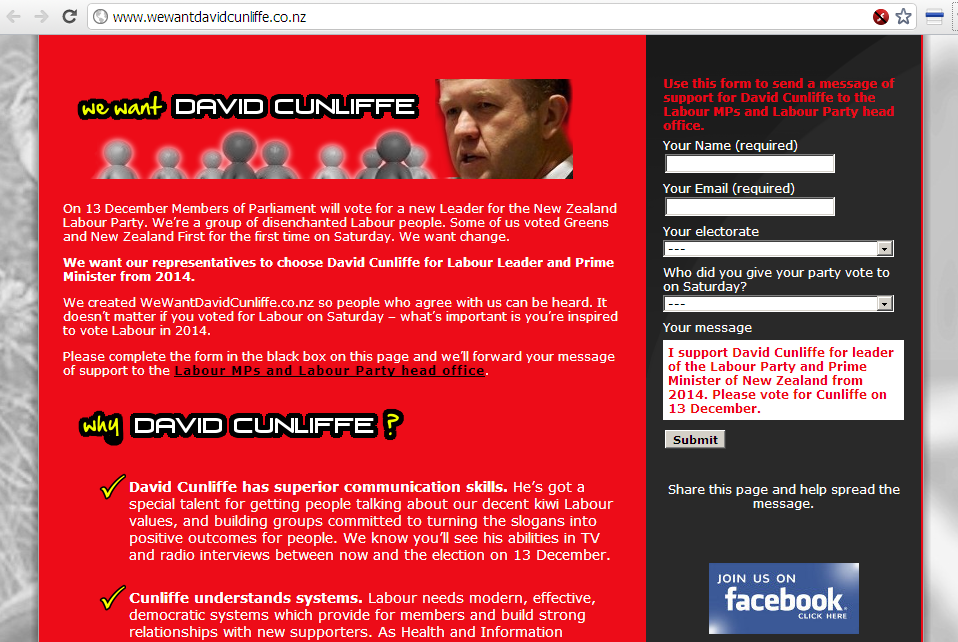
I don’t know who’s set up wewantdavidcunliffe.co.nz to lobby for his leadership of the Labour party, but I’m pretty sure David Cunliffe won’t be thanking them, despite their obvious enthusiasm. Click the image below for a full size version.

wewantdavidcunliffe.co.nz

All the information is broadly accurate (except for the idiotic scaremongering of “Don’t let the right-wing bloggers hijack your party’s Leadership election. Submit the form now!”). Cunliffe is a strong candidate with many good qualities. But I doubt many people will read that far because the site is offensive to the eye. The layout is horrible, and I know colour-blocking is meant to be in right now, but seriously — the dominant red is too much. Contrast with the text is poor, and the faux-script headings and such give the whole thing a 1990s Geocities-Angelfire feel that has no place in the 21st Century interwebs.

Worst of all is the banner — it tells us that grey, faceless bobble-headed people want David Cunliffe as leader. As a friend of mine, a graphic designer by training, said (after “MY EYEEEES”) — aren’t grey bobble-heads the New Zealand First brand?

The use of such symbolism is a slander on David Cunliffe that even a member of Team Shearer like me can’t support.

L

Know your enemy

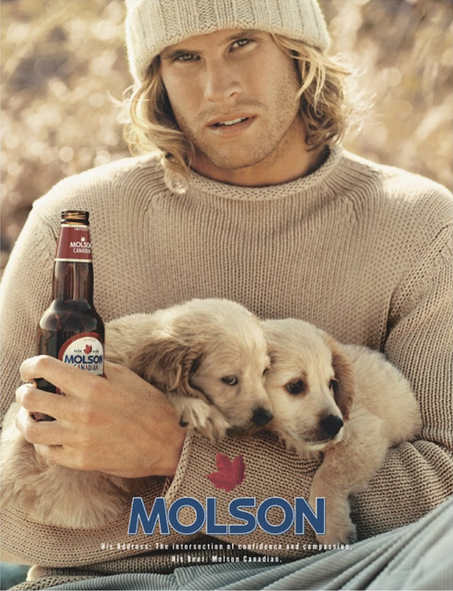
The image above is “scientifically formulated to enhance [women’s] perception of men who drink Molson […] a perfectly tuned combination of words and images designed by trained professionals. Women who are exposed to it experience a very positive feeling. A feeling which they will later project directly onto [men who drink Molson].”

That’s not my analysis; it’s what the creatives who developed the ad said about it, in another ad. The first ad, the one you see above, ran in Cosmopolitan and was pitched at women. The ad from which the explanatory text was drawn ran in Playboy under the heading “Hundreds of thousands of women. Pre-programmed for your convenience.” The full analysis is here, on the Sociological Images blog.

The lesson is essentially that propaganda relies on market segmentation; messages crafted and pitched with accuracy and intent. If you read what you’re told to read, you’ll think what you’re told to think. Avoiding such a fate means embracing diversity of input, understanding your opponents’ arguments and their reasoning even if you disagree with it. To a large extent that means consuming their media. For a rounded perspective you’ll need, at least occasionally, to read sites like DailyKos and Free Republic, infuriating and interminable comment threads on The Standard and Kiwiblog, and SOLOpassion and Gates of Vienna and WSWS and the Wall Street Journal; listen to talkback, watch Fox News and pick up both Cosmo and Playboy from time to time, for the articles or whatever. This is obviously not an exhaustive list, but the point is: read, listen, watch and discuss promiscuously. Argue with those folks you disagree with; drink beer with them from time to time. Take them seriously. Insist that they take you seriously, and give them reasons to do so.

It might hurt; in fact, it often will. But it beats being a dittohead.

L

Edit to add: Anita points out that the Sociological Images post created a bit of a stir. They write:

Apparently the company has been getting calls from consumers and reporters regarding the Molson Cosmo/Playboy ads we posted about yesterday. It turns out the ad campaign is quite old (2002/2003) and they would like to distance themselves from it now.

As you would. Not clear whether they now regret the decision to run such ads, or whether it’s a pro-forma blowback response.

Further thoughts on Team Shearer

These things occurred to me while making my daughter’s birthday cake:*

Endorsement games continue, with a range of people from across the political spectrum still out for Shearer; including Goff’s erstwhile strategist John Pagani and that notorious Mooreite Phil Quin alongside the rest of us Tory plants. Meanwhile, David Cunliffe has the endorsement of the Young Nats, here and here. Cheap shots, but it is the Young Nats after all. When they’re not photoshopping your head onto a dictator they obviously have the hots for you.

This sudden and spontaneous outbreak of public-sphere democracy is sending Labourite dittoheads into a panic; they’re convinced it’s a trap — one so cunning they can’t see what the right has to gain from it, but it must be something. It’s like they’ve forgotten what they believe; they just read Farrar, Slater, Hooton and Odgers and believe the opposite. Tragic. Those guys are good and all, but they only have so much power because so much of the NZ left is stricken with paranoiac idiotosis.

Meanwhile Trevor Mallard has it all figured out: the Vast Right-Wing Conspiracy decision to endorse Shearer is not a trick to ship Labour with an easybeat leader (or worse, a wolf in sheep’s clothing) — in fact it’s a double-bluff designed to give Labour second thoughts about choosing the obviously-best candidate. (Incidentally James Meager, formerly of the now-defunct Mydeology blog, called this on Thursday.) Someone should redo the poison scene from The Princess Bride with such rationalisations. It’s positively Kremlinesque; parallels to the well-documented phenomenon of impending-collapse paranoia within authoritarian regimes seem almost too obvious.

Nevertheless, amongst all the bogus objections, I think there are two legitimate concerns about Shearer’s potential leadership. The first I noted in the Close Up interview: his presentation is not strong. He ums, stutters and hesitates, speaks too softly and lacks cut-through. When he’s been put on the spot he has struggled. He is much better at the set-piece but that on its own is not enough. What he does have to say is often very good; he is a very perceptive listener and he has a pretty remarkable grasp on a wide range of issues. (There’s a comprehensive archive of his weekly in-depth interviews with interesting and important people on the radio here.) That having been said, our present PM is akshully not the world’s greatest public speaker, and the public may view a less-polished performance as a common touch. Whatever the case, this weakness can be overcome by training; presentation is one of the few things in politics that can really be taught. Key and Clark are both great examples.

(Incidentally, it amuses me greatly to see folk who’ve always been focused on wonkish detail and hard policy, to the stern exclusion of doing anything that might win elections, now complaining about a candidate on the grounds that he talks a bit funny.)

The second objection is a bit more substantive, and was raised separately by Anita and by Chris Trotter, and also by Audrey Young: Shearer is reputedly aligned with Damien “gaggle of gays” O’Connor, and perhaps other members of what I have previously termed the blue collars, red necks faction of Labour. Because of this, Young suggests, a Shearer-led Labour will be “a more pragmatic party, with less emphasis on gays and feminists”, or as others might say, he might mean the end of identity politics. Leaving aside the offensive dichotomy between pragmatism and support for equal rights, I don’t think this necessarily follows. O’Connor’s views as expressed in his infamous “gaggle of gays” comment were somewhat archaic, but it’s not clear they will greatly shape the party’s culture. In addition, O’Connor has a point: homophobia aside, his critique of the faction politics of the Labour party has some merit (he also criticised “self-serving unionists”, Trotter’s latest target). Absent any indication that Shearer himself shares O’Connor’s unreconstructed views I think it’s a long bow to draw. Even so, I think the priority for Labour now is sorting its institutions out, and that will mean deemphasising some other projects. I can see this being a touchstone issue for some people; vive la difference.

Lastly, what we have before us is a Labour leadership candidate that can be supported by the right-wingers and former strategists noted above, Sanctuary, AK, myself and presumably because of his potential appeal to Waitakere Man and supposed opposition to identity politics, Comrade Trotter. A person like that doesn’t come along very often.

L

* Huhu grub cake made of rolled lemon sponge filled with fresh cream and bush honey, lemon cream cheese icing. Yeah, colonial-bourgeois Kiwiana is how we postmodern Gen-X long-spoon suppers roll.