Posts Tagged ‘David Cunliffe’

A discourse on David Shearer and the identity politics thing

datePosted on 20:51, December 14th, 2011 by Lew

For my sins, over the past week or so I have been engaging at The Standard again. It’s been a rather tiresome business (for them as well, I’m sure) but has yielded some lucid moments. One exchange between “Puddleglum”, Anthony and I in the bowels of an open mike thread has been particularly useful, and since it contains my views on a question I am often asked, I’d rather it not end up down the memory hole. I reproduce it here in full (without the benefit of editing; so it’s a bit rough).

[I originally said Anthony was the author FKA "r0b" at The Standard -- this isn't the case; it's some other Anthony. My mistake, and thanks to the r0b, Anthony Robins, for pointing it out.] Puddleglum has a blog himself — thepoliticalscientist.org — that is well worth reading.

Puddleglum
Hi Lew,

If Armstrong is correct in the following quotation (and this leadership race has all been about the ‘blokes’ battling the ‘minorities’ and the ‘politically correct’), then won’t the election of Shearer shift Labour more towards the right wing, social conservatism that you appear not to like about NZF?

“Shearer will bring change by making the party less hostage to the political correctness that still plagues its image. He is interested in things that work, rather than whether they fit the party’s doctrine. “

I may misunderstand where your ‘loyalties’ or preferences lie, but it does seem odd if you are supporting a shift in Labour’s focus towards something that would be much more compatible with NZF (including Prosser and Peters, neither of whom strike me as staunch upholders of ‘political correctness’), given how little regard you appear to have for NZF.

(As an aside, I’m not sure why Armstrong is so sure he knows Shearer’s mind – he’s obviously heard Shearer say more than he’s been reported as saying – but I guess he is a political journalist … It would have been good to hear Shearer say these things to the public if, indeed, Armstrong has it from the horse’s mouth, as his tone strongly implies – “Shearer will …”, etc..).

Lew
Hey PG,

I’m not convinced by this argument that Shearer represents the forthcoming defenestration of Māori, women, gays, the disabled, and so forth as a matter of doctrine, although folk who hope it does have been eager to say so — Armstrong, Audrey Young, Trotter amongst them. Shearer’s MSc was on the tension between Māori cultural values and environmental resource management, and he has worked on behalf of Māori in that field, preparing Tainui’s land claim to the Waitangi Tribunal and looking at sultural issues around wastewater treatment in Auckland. I have as yet seen no evidence that Shearer represents the social “right” of the party either. His pairing with Robertson as deputy certainly seems to counterindicate that argument. He says he’s “right in the middle” of Labour, though I suppose he would say that. I am open to persuasion on both these points, however, and if such defenestration does occur I may yet come to regret my support for Team Shearer.

But I think there’s also a misreading of my “loyalties”. The much-loved canard around here and at Trotter’s place is that I want Labour to be an “identity politics” party, whereas, in actuality, I want an end to the infighting that pits “the workers” against other marginalised groups or seeks to subsume everyone’s needs to those of straight white blue-collar blokes. All must have a presence within any progressive movement. I think there’s a false dichotomy that to appeal to “middle New Zealand” a party must be just a wee bit racist, homophobic and sexist, because that’s what “middle New Zealand” is. I don’t agree; although I can see how that is one route to popularity, I don’t think it’s one that’s very suitable for Labour.

Notwithstanding all of that I do think that being able to break the factionalisation and patronage — crudely expressed by Damien O’Connor — that has resulted in a weak list and a dysfunctional party apparatus is the most crucial task facing Shearer, and I can see how this could be spun against him. But on balance, getting the overall institutional and overall health of the party back on track is the priority. As long as it’s not simply replacing one lot of factions with another.

L

Anthony
It really depends if he plays zero-sum loss/gain, instead of fixing problems that when addressed help everyone. But even though I preferred Cunliffe I don’t think Shearer is a evil bastard who will throw women, gays and Maori under the bus.

It’s just convincing insecure pricks like Armstrong that they’re not missing out (and normal people who are perfectly fine), while they lift everyone up.

Been one of the problems with the left for a while – not taking middle NZ with them in their thinking and just expecting them to “get it” after it’s done and dusted.

You can see how the Nats do it better with their policy formation and with the task forces they set up, they admit there is a problem that needs to be solved in some way, get a team of “experts” in place, get feedback from all quarters then create policy based on it (even if they were planning that policy all along). It’s a great way to create a narrative that the electorate can follow to understand policy or at least get some understanding that a problem that needs to be solved exists in the first place.

If it looks in the slightest way controversial or a potential wedge issue they will use this method.

Puddleglum
As I said, “If Armstrong is correct …”

I think previously you’ve noted the importance of symbolism (e.g., in the early days of the MP coalescing with National).

There is a danger that the symbolic projection being attempted (‘we are ordinary New Zealanders too’ – whatever that means) can box Labour in when it comes to ‘judgment calls’ on those social issues.

Trying to benefit electorally from symbols you don’t really believe in (in its crudest form, ‘dogwhistling’) can bite you back.

I think, for example, that Shearer may well be keen not to “get in front” of middle New Zealand on any of these issues (wasn’t that one of the concerns about Clark’s government, for ‘middle New Zealand’?).

That’s fine and pragmatic, and doesn’t mean necessarily being a little bit racist, homophobic, or whatever. But it might mean muting your commentary and positioning on those issues a tad.

And that could make some, at least, leap from the windows rather than waiting to be ‘defenestrated’.

I think that’s the challenge with the more ‘centrist’ positioning.

Lew
Anthony, I agree with all of that.

PG, I think that is the challenge with a more “centrist” positioning, but ultimately the long game is what matters. It’s mostly futile to try to campaign outright on unpopular topics — or those that are “in front” of popular thought, as you aptly put it — when you don’t control the agenda. Clark found out in 2004/5 when Brash hijacked the agenda at Orewa after a very progressive first term, and again in 2008 when the s59 repeal became a de facto government bill about the childless lesbians Helen Clark and Sue Bradford* wanting to personally bring up Waitakere Man’s kids.

I daresay there will be a lot of ideological austerity shared about over the coming term, not limited to the usual whipping children of progressive movements, but likely encompassing the unions and hard-left factions as well (and much of this may be pinned on Shearer to frame him as a “right” leader, when his hand may have been forced by political circumstance.) The project is to rebuild Labour as a political force, because if Labour continues to decline nobody — not Māori, not women, not the unions — is going to benefit.

Sometimes discretion is the better part of valour. My major stipulation is that whatever gets nudged out onto the ledge, as it were, is done with due engagement and consideration of those it impacts, not simply decreed by the leadership as being “not a priority” (and if you disagree you’re a hater and a wrecker).

L

* Notwithstanding the fact that neither are lesbians, and Sue Bradford isn’t childless.

Opening moves

datePosted on 18:46, December 13th, 2011 by Lew

This morning David Shearer won the Labour leadership, as many expected and as I had hoped he would. More substantive analysis will follow, but I want to remark on two things. First, via Mike Smith at The Standard:

He’s a listener and an unifier – the best sort of leader. When both David’s were asked the question in Wesley Church, “What is charisma”, David Shearer’s answer was to quote Drew Westen’s “The Political Brain” about the importance of connecting emotionally, and to say that the first thing he would do was to get out and listen to people all around New Zealand. I was reminded of Lao Tsu’s famous saying:

Go to the People. Live among them, Love them, Learn from them. Start from where they are, Work with them, Build on what they have. But with the best leaders, When the task is accomplished, The work completed, The people all remark: We have done it ourselves.

As a non-member I was not in attendance at that meeting, and I was not aware of this detail, but it should be clear to anyone who has read me over the last few years that this gives me great hope. One of my chief complaints about the Labour leadership and its activist community has been its boneheaded obsession with hard facts and rational policy detail. To the extent that Shearer can moderate that he has potential to breathe new life into the movement.

The second is Shearer’s first public action as leader: declaring that the ministerial forum on poverty announced as part of the māori party’s confidence and supply agreement should include leaders of other political parties. Video from interest.co.nz:

This is a good move for three reasons: first because it gives Labour an opportunity to be at the centre of a major policy initiative, rather than on the outside; second because it gives Shearer an opportunity to use his much-hyped skills in this field; and third because it should add some heft to a committee which otherwise would likely have been dominated by Bill English channelling advice from Treasury. It doesn’t take a terrible cynic to see that the committee was intended as a sop to Tariana — another symbolic bauble with nothing behind it. Shearer’s presence, and possibly that of other leaders, would make it a much more meaningful concern, which is probably why it won’t happen. But nevertheless, it sends a crucial signal: poverty is bigger than partisan politics. National would be foolish to ignore it.

The job’s not even started yet; there’s much to do and much ground to gain, the bones of which have been sketched out in two epochal posts by Jordan Carter, here and here. Other important questions, like whether David Cunliffe’s abilities will be adequately used, remain — but I am very encouraged by what I have seen.

L

Shipping water

datePosted on 13:09, December 7th, 2011 by Lew

The fact that Brian Edwards now considers Shearer unsuitable for the public communication aspects of the leadership should ring alarm bells. He needs media training — desperately needs it — and Edwards is probably the only person able and qualified to do the job in the relatively short timeframe available.

Danyl reckons Edwards approached Shearer, who declined his services. I have no idea what this is based on, if anything, but if true it would suggest a lack of judgement on Shearer’s part that should raise very serious concerns.

It also seems like Cunliffe, to borrow some sporting terminology, wants it more. He’s hustled better. Cunliffe and his presumptive deputy Nanaia Mahuta have responded with alacrity to questions (some of which are quite unkind) on Red Alert — Cunliffe was answering questions until 1o’clock this morning, and then back into it early; Shearer hasn’t responded yet.

Anyway, I don’t know if this will sink the bid, but my view is it probably should, or at least cause it to ride lower in the water. More to come, I’m sure.

Friends like these

datePosted on 12:13, December 6th, 2011 by Lew

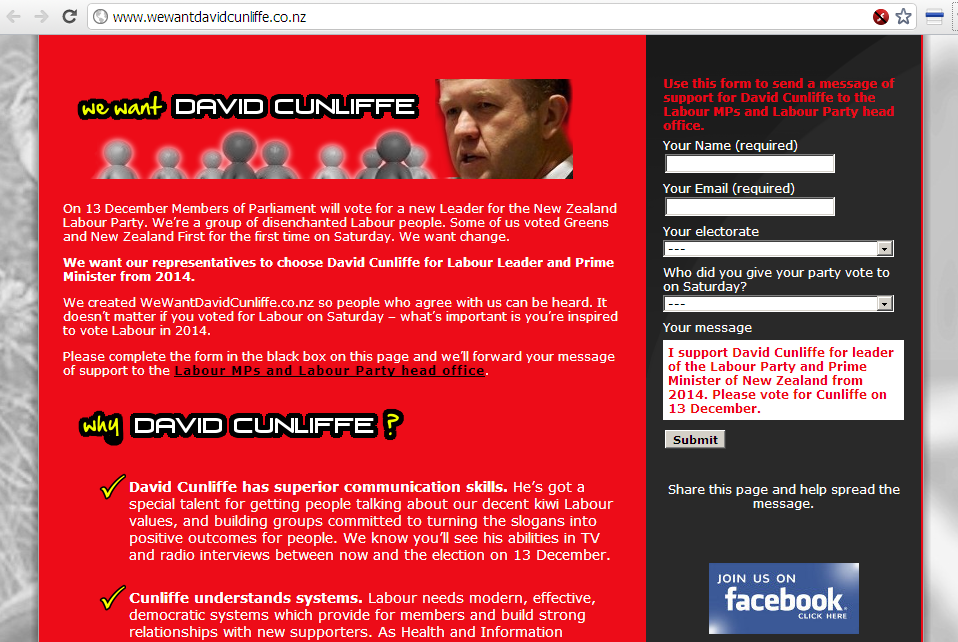
I don’t know who’s set up wewantdavidcunliffe.co.nz to lobby for his leadership of the Labour party, but I’m pretty sure David Cunliffe won’t be thanking them, despite their obvious enthusiasm. Click the image below for a full size version.

wewantdavidcunliffe.co.nz

All the information is broadly accurate (except for the idiotic scaremongering of “Don’t let the right-wing bloggers hijack your party’s Leadership election. Submit the form now!”). Cunliffe is a strong candidate with many good qualities. But I doubt many people will read that far because the site is offensive to the eye. The layout is horrible, and I know colour-blocking is meant to be in right now, but seriously — the dominant red is too much. Contrast with the text is poor, and the faux-script headings and such give the whole thing a 1990s Geocities-Angelfire feel that has no place in the 21st Century interwebs.

Worst of all is the banner — it tells us that grey, faceless bobble-headed people want David Cunliffe as leader. As a friend of mine, a graphic designer by training, said (after “MY EYEEEES”) — aren’t grey bobble-heads the New Zealand First brand?

The use of such symbolism is a slander on David Cunliffe that even a member of Team Shearer like me can’t support.

L

Further thoughts on Team Shearer

datePosted on 01:08, December 3rd, 2011 by Lew

These things occurred to me while making my daughter’s birthday cake:*

Endorsement games continue, with a range of people from across the political spectrum still out for Shearer; including Goff’s erstwhile strategist John Pagani and that notorious Mooreite Phil Quin alongside the rest of us Tory plants. Meanwhile, David Cunliffe has the endorsement of the Young Nats, here and here. Cheap shots, but it is the Young Nats after all. When they’re not photoshopping your head onto a dictator they obviously have the hots for you.

This sudden and spontaneous outbreak of public-sphere democracy is sending Labourite dittoheads into a panic; they’re convinced it’s a trap — one so cunning they can’t see what the right has to gain from it, but it must be something. It’s like they’ve forgotten what they believe; they just read Farrar, Slater, Hooton and Odgers and believe the opposite. Tragic. Those guys are good and all, but they only have so much power because so much of the NZ left is stricken with paranoiac idiotosis.

Meanwhile Trevor Mallard has it all figured out: the Vast Right-Wing Conspiracy decision to endorse Shearer is not a trick to ship Labour with an easybeat leader (or worse, a wolf in sheep’s clothing) — in fact it’s a double-bluff designed to give Labour second thoughts about choosing the obviously-best candidate. (Incidentally James Meager, formerly of the now-defunct Mydeology blog, called this on Thursday.) Someone should redo the poison scene from The Princess Bride with such rationalisations. It’s positively Kremlinesque; parallels to the well-documented phenomenon of impending-collapse paranoia within authoritarian regimes seem almost too obvious.

Nevertheless, amongst all the bogus objections, I think there are two legitimate concerns about Shearer’s potential leadership. The first I noted in the Close Up interview: his presentation is not strong. He ums, stutters and hesitates, speaks too softly and lacks cut-through. When he’s been put on the spot he has struggled. He is much better at the set-piece but that on its own is not enough. What he does have to say is often very good; he is a very perceptive listener and he has a pretty remarkable grasp on a wide range of issues. (There’s a comprehensive archive of his weekly in-depth interviews with interesting and important people on the radio here.) That having been said, our present PM is akshully not the world’s greatest public speaker, and the public may view a less-polished performance as a common touch. Whatever the case, this weakness can be overcome by training; presentation is one of the few things in politics that can really be taught. Key and Clark are both great examples.

(Incidentally, it amuses me greatly to see folk who’ve always been focused on wonkish detail and hard policy, to the stern exclusion of doing anything that might win elections, now complaining about a candidate on the grounds that he talks a bit funny.)

The second objection is a bit more substantive, and was raised separately by Anita and by Chris Trotter, and also by Audrey Young: Shearer is reputedly aligned with Damien “gaggle of gays” O’Connor, and perhaps other members of what I have previously termed the blue collars, red necks faction of Labour. Because of this, Young suggests, a Shearer-led Labour will be “a more pragmatic party, with less emphasis on gays and feminists”, or as others might say, he might mean the end of identity politics. Leaving aside the offensive dichotomy between pragmatism and support for equal rights, I don’t think this necessarily follows. O’Connor’s views as expressed in his infamous “gaggle of gays” comment were somewhat archaic, but it’s not clear they will greatly shape the party’s culture. In addition, O’Connor has a point: homophobia aside, his critique of the faction politics of the Labour party has some merit (he also criticised “self-serving unionists”, Trotter’s latest target). Absent any indication that Shearer himself shares O’Connor’s unreconstructed views I think it’s a long bow to draw. Even so, I think the priority for Labour now is sorting its institutions out, and that will mean deemphasising some other projects. I can see this being a touchstone issue for some people; vive la difference.

Lastly, what we have before us is a Labour leadership candidate that can be supported by the right-wingers and former strategists noted above, Sanctuary, AK, myself and presumably because of his potential appeal to Waitakere Man and supposed opposition to identity politics, Comrade Trotter. A person like that doesn’t come along very often.

L

* Huhu grub cake made of rolled lemon sponge filled with fresh cream and bush honey, lemon cream cheese icing. Yeah, colonial-bourgeois Kiwiana is how we postmodern Gen-X long-spoon suppers roll.

Team Shearer

datePosted on 22:19, November 30th, 2011 by Lew

I have little useful to add to the voluminous discussion about who the Labour party will choose to succeed Phil Goff. I’m on the outside. This is Labour’s decision to make, and I don’t have a dog in the fight, except inasmuch as a good opposition and a strong Labour party is going to be crucial to Aotearoa. So I don’t know which way the caucus votes are headed, but like any other punter I have views, and I thought I’d sketch them out anyhow.

First of all it is positive that Goff and King have not stepped down immediately, forcing a bloodletting session 72 hours from the election. Two weeks is, I think, long enough to come to terms with the “new normal” and for a period of sober reflection (and not a little lobbying), but not long enough for reflection to turn to wallowing, or lobbying to degenerate into trench warfare. Leaving it to brew over summer, as some have suggested by arguing Goff should remain until next year, would be the worst of all possible options and I am most pleased they have not chosen this path.

As for the options: after some preliminary research the other day I declared for Team Shearer. I am still somewhat open to persuasion, and he lacked polish on Close Up this evening. But he seems to have unusual intellectual substance and personal gravitas. His relative newness to parliamentary politics is offset by extensive experience in other fields, particularly with the UN where tales of his exploits are fast becoming the stuff of urban legend. Most crucially, I understand he is the least institutionalised or factionalised of the potential leaders, the one with the greatest capacity to wrangle the “political wildebeest” that is the Labour Party, to use Patrick Gower’s excellent phrase. This last is, I believe, the most crucial ability. I said before the election that the next long-term Labour leader will be a Great Uniter, as Clark was (although possibly not in the same way Clark was; awe and fear aren’t the only ways to unite a party), and while there are not broad ideological schisms within the Labour party*, it is deeply dysfunctional in other ways and needs to be deeply reformed. This is a hard task, and it may be that no one leader can manage it, and it may take many years in any case, but it looks to me like Shearer’s external experience and outsider status make him the stronger candidate on this metric.

One other thing about Shearer: he seems to have strong support among non-Labourites, including Labour’s ideological opponents. In the Close Up spot he was reluctant to declare Labour a “left-wing party” which will make him unpopular (though I consider this just a statement of fact). I’ve seen some tinfoil-hattery around this — “if people like Farrar and Boag like him, it must be a trap” and so forth. This notion that “the right” has nothing better to do than wreck the Labour party, that every endorsement or kind word is an attempt to undermine, or the suspicion that the muckrakers must surely have some dirt on a favoured candidate borders on a pathology. Such reasoning leads to perverse outcomes, and adherents to this kind of fortress mentality make excuses for poor performance, and congratulate themselves for narrow wins and near losses, rather than challenge themselves to build a strong, disciplined unit capable of winning more robust contests in the future. An example of this in the recent election, where a small but crucial group of Labour supporters abandoned their party, campaigning and voting for New Zealand First in a last-ditch effort to produce an electoral result in their favour, without concern for the strategic effects this might have on the party’s brand and future fortunes. In spite of the lesson of 2008, they swapped sitting MPs Kelvin Davis, Carmel Sepuloni, Carol Beaumont, Rick Barker and Stuart Nash for Winston Peters and his merry band of lightweight cronies. Plenty of dirt there; it would have been a miserable term in government for Phil Goff if the numbers had broken slightly to the left, and (depending on the intransigence of Peters and the other minor parties) one from which the Labour Party may never have properly recovered.

Ironically, Labour has those defectors — about 3% of the electorate if the polls are to be believed — to thank for the opportunity now presented to it by the resounding defeat. If the result had held at around 30% (and NZ First been kept out by the threshold), temptation would have been to revert to the mindset post-2008 election that it had been close enough, that the left had been robbed by the electoral system and the evil media cabal, and that little change was really needed. With support at its worst since the Great Depression, no such delusions can persist, and there is, it would seem, a strong will for reform within the party.

I don’t think the other two likely Davids would make bad leaders either (concerns about Cunliffe that I expressed during the campaign notwithstanding). Cunliffe’s platform with Mahuta is strong, in particular because it will enable the party to reach out to Māori, which they desperately need to do to remain relevant. Parker reputedly has greater caucus support than Cunliffe, and he is also apparently standing with Robertson, who is also said to be standing for the leadership himself. All three Davids are talking about reform, and it will be harder for any of them to paper over the cracks or pretend that nothing is wrong, as Goff and King did. But whatever their will, it is not clear that Davids Cunliffe or Parker have the same conflict-resolution, negotiation and strategic development experience that Shearer does. And they are themselves a part of the problem, having been ministers (however excellent) under Clark, and supporting and sharing responsibility for the abysmal strategy and see-no-evil mentality evident within Labour since 2008.

But the party must do what is right for the party. It is important that the final decision remains with the caucus because as the past year has shown, no matter what the public and commentariat thinks no leader can be effective who is at odds with his team. Ideological congruence also matters; Shearer may be have the best skillset for the reform job, but he may legitimately be considered too centrist by the caucus.

I’ve always been clear that I want the NZ left to win, but I want them to have to work hard for it. I don’t want easy outs, excuses or complacency; I want Labour to be able to beat the toughest, because that’s what produces the smartest strategy and the strongest leaders, and the best contest of ideas. I am sure principled right-wingers hold similar views; they are just as sick as I am of a dysfunctional opposition obsessed with its own faction-wars and delusions of past glory, stuck in the intellectual ruts and lacking in strategic and institutional competence, even though it might make their electoral challenge easier. Good political parties don’t fear the contest of ideas; they embrace it. So my hope is that Labour does not concern itself overmuch with second-guessing the views of their ideological foes, or those on the periphery, but puts the candidates through a thorough triage process and then lets him get on with the job of putting their party back together. It’s not a trap, it’s a challenge.

L

* The lack of ideological diversity is a problem; a healthy political movement should always be in ferment. But it is not the most pressing problem facing the party at present.

Mr Self Destruct

datePosted on 09:15, November 5th, 2011 by Lew

Labour seems to believe that it’s easier to seek forgiveness than permission. With the missing figures in the Press Debate, they’ve sought forgiveness for failing to perform on the night, with predictable effect, and yesterday on the wireless with Paul Henry, Labour’s finance spokesperson David Cunliffe remarked about Police minister Judith Collins that if she were the last woman on earth “the species would probably become extinct”. That’s a couple of pretty big steps beyond the usual (and also unjustified) fat jokes about Gerry Brownlee and others, and it’s the sort of behaviour we’d expect in Berlusconi’s Italy, from some of the viler denizens of the lunatic fringe, or perhaps from Paul Henry himself — but it is not conduct becoming a former minister and possible Prime Minister-in-waiting.

I anticipate we’ll see a cringing apology today or tomorrow once the media cycle gets hold of it, but it’s too late — the damage is already done. Some lefties will inevitably claim that having a bit of “mongrel” is crucial to win back “Waitakere Man” (more on this later), or will point to examples of comparable outrage on the other side, but again, it doesn’t matter: Labour is dead in the water if it holds itself to the standards of the rabid right, and this reeks of desperation more than it does of strategy. As Pablo wrote recently, negative campaigning isn’t always a losing strategy, but it has to be done right — and this isn’t. [Edit to add: this sort of behaviour also negates a tactical advantage of being able to criticise Key for his media engagements, such as with Tony Veitch.]

As Labour partisans take great delight in reminding me, I have no knowledge of the inside of Labour’s organisation, and all my Kremlinology about its dysfunction is based on near-obsessive observation of what public evidence is on display. With that caveat, let me advance a thesis: Goff is actually coping pretty well with the campaign so far, but Cunliffe is not. After all, Goff’s only major failure has been an inability to produce costings for the fiscal policy — Cunliffe’s portfolio. Goff, as leader, bears ultimate responsibility for not demanding a better performance from his finance spokesperson, but since Goff has enough on his plate as it is, producing those numbers was surely a responsibility delegated to Cunliffe and his people, and they did not do so. Whether we interpret Cunliffe’s outburst about Collins as (charitably) cracking under pressure or (less charitably) the mask of civility slipping, it looks like he’s feeling the heat more than Goff who is performing better than most people expected (and knows it).

Just a final word about Waitakere Man. Yesterday Stuff.co.nz ran a wee video package they called the bloke test in which journalists asked Key and Goff the same set of questions in order to measure their purported blokiness. This has been widely derided (mostly by the same people who think Labour is running good strategy) as an exercise in vapid idiocy, but that’s not so. Just as much as we have a right to demand political and institutional competence from our leaders, we have a right to judge them on their instinctive, bedrock responses; and this was a case where two leaders were asked a series of unpredictable personal questions and expected to answer them off-the-cuff.

While its utility in measuring “blokiness” is highly dubious, this exchange contained a lot of other information about how the leaders respond to pressure, to humour, their attitudes towards social transgression and their place in society and a sense of who they “really” are. In a representative democracy where voters can be expected to have neither the time nor the expertise to become proficient in every policy field that impacts them, they rely on other indicators to determine who is more likely to make appropriate decisions in their stead. I’ll leave the interpretation of who “won” the Waitakere Man test as political rorschach, but suffice it to say that anyone who thinks this sort of thing is irrelevant trivia needs remedial classes in voter behaviour.

L

Fire in the House

datePosted on 21:17, May 5th, 2010 by Lew

The opposition was strong in Parliament today. I’m stuck for time, so what follows is somewhat stream-of-consciousness.

Front and centre was the government’s failure to perform on unemployment and wage growth, the subject of criticism from both flanks. Bill English had led off with “the budget will be about the many, not the few”, and then “but seriously …”, to a stinging rebuke from David Cunliffe, who listed the government’s failings as he saw them. This adoption by the government of Labour’s own tagline looks like an attempt to muddy the counter-campaign and poach their emphasis, trying to set up National as the party representing “the many”, rather than the policy merits of the government’s program, but if so it’s a fairly ham-fisted one. While “the many” looks on its way to becoming this election cycle’s “hard-working Kiwis”, the government’s attempt here to muscle in indicates that National has accepted Labour’s rhetorical framing, although they disagree with it. If you adopt your opponent’s narrative, you need to be able to make it your own — either that, or you need to dismantle and discredit it. English did neither.

Cunliffe was strong, also raising the variance between English’s aspirational and controversial “Plain English” ad and the policy track he has delivered. Sir Roger Douglas also took aim, and was forced by the Speaker to rephrase the question (to Paula Bennett): “Which is more important? Young people getting jobs, or pandering to the Left?”.

Bennett also took a bit of a pasting on the matter of the identity of one Peter Saunders. The Standard has picked this up so I’ll not elaborate more. Wayne Mapp, standing in for the Minister of Agriculture also stumbled on a line of questioning from Sue Kedgley regarding AgResearch’s GM cattle trials. Not exactly a shock since, not being the minister himself, that information wasn’t top of his mind, but it contributed to the general atmosphere.

Then it was all on in General Debate, with Goff, King and Cunliffe leading off on the same topic matter (jobs/wages) with a couple of fiery speeches, and re-emphasising the “smile and wave/photo-op/government by poll” meme and the retrenchment of the government’s mining plans. Judith Collins concentrated on David Cunliffe’s lack of orthodox economic credibility, and purported concern for Goff having to shoulder the dual burden of leading a party in which Cunliffe was both the finance spokesperson and a leadership contender. Nice concern troll, but what’s more interesting is how much she was looking forward to seeing Cunliffe’s expenses records — and the threats hurled across the House while she thought she was not miked — “You wait, just you wait! …” Some irony in this given that it was just yesterday Collins raised the most threadbare defence of her (or someone else’s) extensive use of the ministerial self-drive car: “All the travel is within the rules – that’s all I’m prepared to say on it.”

So, while superficially an ordinary sort of Wednesday (albeit one where the Member’s Day was not clobbered by urgency), I think this has provided a few glimpses of the 18 months to come: a robust focus on core materialist issues from the Labour party, ahead of the budget, and a clear desire to debate the policy merits; combined with continued attacks on the credibility and perceived competence of English and Bennett in particular; the government attempting to subvert the opposition’s framing rather than exclusively arguing the merits; Collins v Cunliffe shaping up as a key battle. Nothing flash, but it’s starting to look like something resembling a threat. Most importantly, something to require the government to rethink its own gameplan. Until now they’ve had the ability to act almost with impunity, their errors going unpunished. If today’s performance is any indication, no longer.

L