Ka ora! (I live!) – the triumphant second part of the famous challenge in Te Rauparaha’s haka Ka Mate, composed after his narrow escape from seemingly-certain death. Ka mate is itself a symbol of life and vigour and indomitable spirit, a rowdy celebration of vitality, and one of the most vivid and tangible symbols of New Zealand culture, both for MÄori and for Tau Iwi, and much-loved and admired by people the world over, so ubiquitous that many simply know it as the haka, as if there were none other.
Now the rights to this famous tÄonga are to be vested in Te Rauparaha’s descendants, NgÄti Toa Rangatira. This is a sore spot for many people, who for the reasons above feel as if they have a stake in Ka Mate as well. Much of this hearkens back to the old `iwi/kiwi’ rhetoric of the 2005 election campaign, and in particular I’d like to point to one small exchange which I think illustrates that that rhetorical line no longer has quite the currency it did; then I’d like to engage with the actual matter of the issue: the meeting of intellectual property, identity and mÄtauranga MÄori.
Backdown
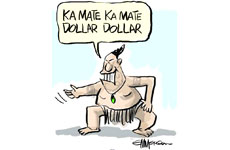 The Rod Emmerson cartoon at right appeared on the front page of the New Zealand Herald on 11 February 2009, the day the Letter of Agreement between NgÄti Toa Rangatira and the Crown was signed, and is the most direct reference to the old iwi/kiwi debate. The image was also attached to the online story. However, that day during Question Time, Minister for Treaty Negotiations Chris Finlayson harshly criticised the cartoon, saying it was “puerile and inaccurate […] highly offensive to NgÄti Toa. We are not talking about that kind of redress”. This position was reiterated by John Key, and was the subject of another article the following day. They’re absolutely right: as I will demonstrate below there is no merit whatsoever to the argument.
After Finlayson’s statement in Parliament, the cartoon was detached from the article – but it remains on the NZ Herald’s server, and that it was attached to the article is proven by google images. Tangentially, the cartoon appears to be one of a batch by Emmerson, including this one, very similarly composed. At least two other cartoons emphasised the financial issue – Mike Moreu’s and Tom Scott’s.
The importance of this very minor editorial backdown by the NZ Herald is huge. I’m not arguing that Finlayson’s statement in the House caused the Herald to take it down, but it was undoubtedly an influence: perhaps the Herald saw that the tide has turned. The very fact that a National Minister would so firmly repudiate such an allegation of graft among MÄori business interests, against the editorial line of both our major press outlets, shows how far they have come since the bad old days of Don Brash’s populist point-scoring. It also shows that they’re in government and mean to stay there.
Rights
People talk about `intellectual property’ as if it’s unified by a central legal idea, or created from whole cloth. In fact the whole realm is a minefield of social, legal, technical, customary and common-law complexity from several intellectual traditions, dating back to the enlightenment, and very poorly updated to encompass things which have happened since. The S92 protests currently underway are an example of its deep and thorough dysfunction. It’s vastly more ugly and complicated than you might think: for an excellent critique of the whole system, I can recommend none better than Drahos and Braithwaite, Information Feudalism. Incidentally, like Richard Stallman, I abhor the term `intellectual property’ for this reason; though unlike him I don’t eschew its use when talking about the whole awful mess together.
When people talk about `intellectual property’, usually they mean `copyright’ but want to sound knowledgeable. Even when people talk about `copyright’ they are usually, in fact, mixing up two quite distinct parallel traditions: economic rights of copyright, and moral rights of the author. Simply; economic rights allow the copyright holder to extract a rent from a work, while moral rights afford other sorts of protection, such as the requirement of attribution. The two sets of rights can exist independently or apart; they need not necessarily go together, but can coexist happily if need be. The discourse inherent in the cartoons above, and in much of the news copy, is rooted in the supposition that economic rights are the only rights, and that NgÄti Toa Rangatira must therefore be looking to extract a rent from Ka Mate (even if only a piffling, `dollar dollar’ for the single most famous piece of MÄori art in existence). This is also the foundation of Whale Oil’s rather smug argument that, since NZ copyright allows for a term of 50 years after the death of the author, copyright on Ka Mate lapsed in 1899 and it’s now in the public domain.
As is so often the case, the reality is quite different. The Letter of Agreement mentions nothing of the sort – no discussion of economic or moral rights, or of copyright, or even of that broadest of terms, `intellectual property’. No, the complete text in the LoA relating to Ka Mate is as follows:
– Ka Mate haka
The settlement legislation will also record the authorship and significance of the haka Ka Mate to NgÄti Toa and the Crown will work with NgÄti Toa to address their concerns with the haka in a way that balances their rights with those of the wider public.
The Crown does not expect that redress will result in royalties for the use of Ka Mate or provide NgÄti Toa with a veto on the performance of Ka Mate. NgÄti Toa’s primary objective is to prevent the misappropriation and culturally inappropriate use of the Ka Mate haka.
This stops well short of even the weakest copyright protection. It implies a subset of moral rights, and explicitly enjoins exercise of economic rights. The entire line of argument is therefore completely discredited, and if anything, NgÄti Toa Rangatira are faced with a hard task of staking a claim in any way other than the symbolic. If they choose – and there’s the big question nobody is asking.
Colonising MÄtauranga MÄori
Suppose NgÄti Toa Rangatira had been offered exclusive, authorial economic and moral rights to Ka Mate. Should they accept? Ultimately, of course, this is a matter of utility for that iwi, and them alone – but let me sketch a few of the issues in play. First, and most obviously, the adoption of Tau Iwi systems of knowledge ownership for mÄtauranga MÄori (MÄori knowledge) is a dangerous business. Those who have legitimate entitlement to the mÄtauranga might be prevented from exercising it by colonial IP laws; more importantly, the nature of the mÄtauranga itself is impacted upon by its presence within a framework, and the degree of codification and specification that requires. As M A Hemi said regarding the use of MÄori terms in the Resource Management Act,
MÄori concepts when treated in isolation are incapable of proper function and development. In fact, any concept when divorced from its cultural base is subject to dysfunction and cultural reinterpretation or hi-jack. (Quoted in Mason Durie, Te Mana, Te KÄwanatanga, p33.)
Nevertheless, there can be great utility in protecting these things by colonial means, in order to prevent their exploitation by colonial systems. This is the foundation for the WAI 262 claim, to my knowledge the longest-running and most complex claim ever brought to the Waitangi Tribunal, with enormous precedent value. And why shouldn’t they see any tangible economic benefits from their mÄtauranga now, given that for generations it has been exploited and co-opted and adapted without their consent or input, and to great commercial gain?
The question is a live one – ka ora.
L